[Letter from Anu Singh (Mother)]
August 10, 2024
Dear Judge Kaplan,
I want to begin by sincerely thanking you for taking the time to read this letter. Though writing this letter has been challenging, it’s also been an exercise in gratitude as I’m reminded of Nishu’s remarkable compassion and the tremendous joy he’s brought to the lives of everyone who knows him.
First, let me provide you with some background about our family. I was raised in India in a modest household, where my father worked for the government, and my mother was a homemaker. We lived in a single room-home and shared an outdoor bathroom with three other families. My mother taught us the true meaning of abundance saying, ‘together we have so much.' Whether it was sharing our meals, helping care for each other's children, or tending to the needs of our elderly neighbors, we all contributed to a spirit of collective kindness that defined our local community.
I never dared to dream of a life in America back then, but my brother showed us that a different future was possible. He came to the U.S. on an academic scholarship and later helped me follow. I supported myself through college by busing tables in the cafeteria and borrowing the textbooks that I couldn’t afford from my professors. Supported by the kindness of others, I was able to earn a doctorate in Clinical Psychology a year after Nishu was born.
Nishu was raised in an environment that mirrored the communal spirit of my own upbringing. We lived next to my brother and sister-in-law, and knocked down the fence between our yards so the children could run freely between the houses. Our home bustled with visitors, mostly other Indian immigrants who were also finding their way in America. Two of them also lived with us, and though they aren’t related by blood, Nishu has always called them his aunts. They fed Nishu from a bottle, lovingly spoke Kannada with him, and when they had children of their own, they were all siblings in the only ways that matter.
Nishu’s father Raj and I are deeply grateful for the opportunities we’ve had and found it most important to impart the values of gratitude and generosity to our sons. As a child, Nishu absorbed and emanated those values naturally. With the other children, he’d find his favorite toy, thrust it into their arms, and say, “See! For you.” Even with his dogs, I’d find him eating his ice cream cone, taking a lick then giving one to the dog then one to the other. He’d go around in a circle like that. I had to scold him since it was bad for the dogs! It was such a strange but heartwarming thing to observe in a five-year old – such little attachment to things he loved but such great joy in sharing them.
Fast forward to when Nishu was seven, our family went back to India for a distant family member’s wedding. A reception was held in an outdoor courtyard. At the edge of the party, mothers and their children were begging for food, arms reaching through the gates. I’m ashamed to admit that I barely registered them at the gate along with the rest of the party. I had become blind to poverty, especially back in India where it was ever present. Nishu tugged at my sari and asked if they were okay. Through his young eyes, I saw clearly again. We discreetly took some food over and handed it through the gate.
Nishad peppered me with questions throughout the evening. He couldn’t grasp why such inequality existed. “Can’t we just give them all this food?” “Why do we need to do it quietly?” “Why is everyone else ignoring them?” My heart broke as I tried to explain. Over the rest of the trip, he gave away every [ECF p. 42] toy he brought along to children we passed on the street. I felt quietly proud of him. After this trip, I saw him not only give to others from a place of joy, but also one from a broken heart, now knowing that the world wasn’t always fair.
As Nishu entered high school, his desire to help others took a new shape. It was during this time that he first learned about effective altruism. It resonated strongly with Nishad.
In college, he met Claire, who’s now his fiancée. My heart melted as I saw them interact as the best of friends. It brought me great comfort as his mother to see Nishu had found someone so wonderful who understood him.
After graduation, Nishu accepted an offer to join Facebook as an engineer. One role he was considering was to work on its Donations product: the Facebook feature that helps people do things like raise money for a charity on their birthday, which seemed like a good fit for him.
As Nishu learned more about the underlying vision for the feature, he started thinking about ways it could be improved with things like prioritizing effective charities at the top of the product. He reached out to his childhood friend, Gabe Bankman-Fried, to get his thoughts as they both shared an interest in charitable giving. Gabe, in turn, connected Nishu to his older brother Sam Bankman Fried to get other advice on refining the idea.
Nishu barely knew Sam but he looked up to him as he had a reputation for being a genius. They brainstormed some ideas together about ways to make the Nishad’s feature proposal robust. But when Nishad pitched it to the Facebook Donations team, not only was it rejected, but he came away feeling discouraged about the likelihood of them being receptive to any effectiveness-oriented product changes. So, Nishu decided to join Facebook’s Machine Learning team instead. Once he started, he found that he really liked his team but, in his heart, he knew he wanted to work for an organization with a more charitable mission.
Just a few months later, Sam called Nishad and pitched him joining Alameda Research. Raj and I were initially hesitant. However, we had known Barbara Fried and Joe Bankman as Gabe’s parents. We knew they were successful, respected Stanford professors and had a relationship with them. Their informal connection to Alameda as Sam’s parents reassured us.
Nishu's role at Alameda and later FTX required significant personal sacrifices. After relocating to Hong Kong, the intensity of his workload made it impossible for him to take a break or get away for vacation. For example, Nishu asked permission to take a vacation to attend my second wedding in 2021, but was denied. I was so sad he would miss being part of such an important occasion, as family has always been a priority for him. However, Nishu was with us in spirit and made his presence felt at our wedding as he suggested we ask for charitable donations from our guests instead of gifts. On each table, we placed cards with a QR code Nishu set up that allowed people to make contributions to a nonprofit to help improve conditions for factory farmed animals.
In December 2021, I visited Nishu a few weeks after he moved to the Bahamas. Nishu tried to get us to meet outside the apartment, but we visited early by surprise. Entering the luxury apartment, my reaction was amazement and pride at the accomplishments it reflected, but Nishu was having none of it, and was actively ashamed of its splendor.
After unloading groceries, we sat down and he said that he didn’t know how long he’d stay at FTX. When I asked why, he explained that the company culture was changing. Back in Hong Kong, people spent long hours in the office, but were collectively energized by what they were building. Now, Nishu felt people were taking it easy, caught in a “luxury and status trap.” Nishu was worried about the company’s values drifting away from the charitable goals they declared.
The following February, I felt a pull to visit him again; something like a mother’s sixth sense. I returned to the Bahamas. The moment I saw him, I knew he was doing much worse. He had gained a lot of weight and was exhausted in a way that was not just explained by the long hours. My 26-year-old boy walked like a middle-aged man.
We went on a walk just the two of us, and he confided in me that he felt like the company was losing what made it special. People were focused on compensation instead of work, and Sam kept agreeing to more that stretched the team thinner. Expensive acquisitions Nishu disagreed with were doubly painful as they generated more demands on the engineering team. He said he felt he was constantly fighting battles he wished he didn’t have to.
He thought about leaving, but felt he’d be letting his engineering team down. However, as a psychologist, I was concerned that Nishad was once again putting the needs of others above his own. I told him to just focus on what he could control: his own work and his team. I advised him to lead by example. But, truthfully, I worried anyway.
Back home, I checked in on him more frequently. Below are screenshots of one of our conversations I took to send a friend for advice – I also didn’t truly know what Nishu should do.
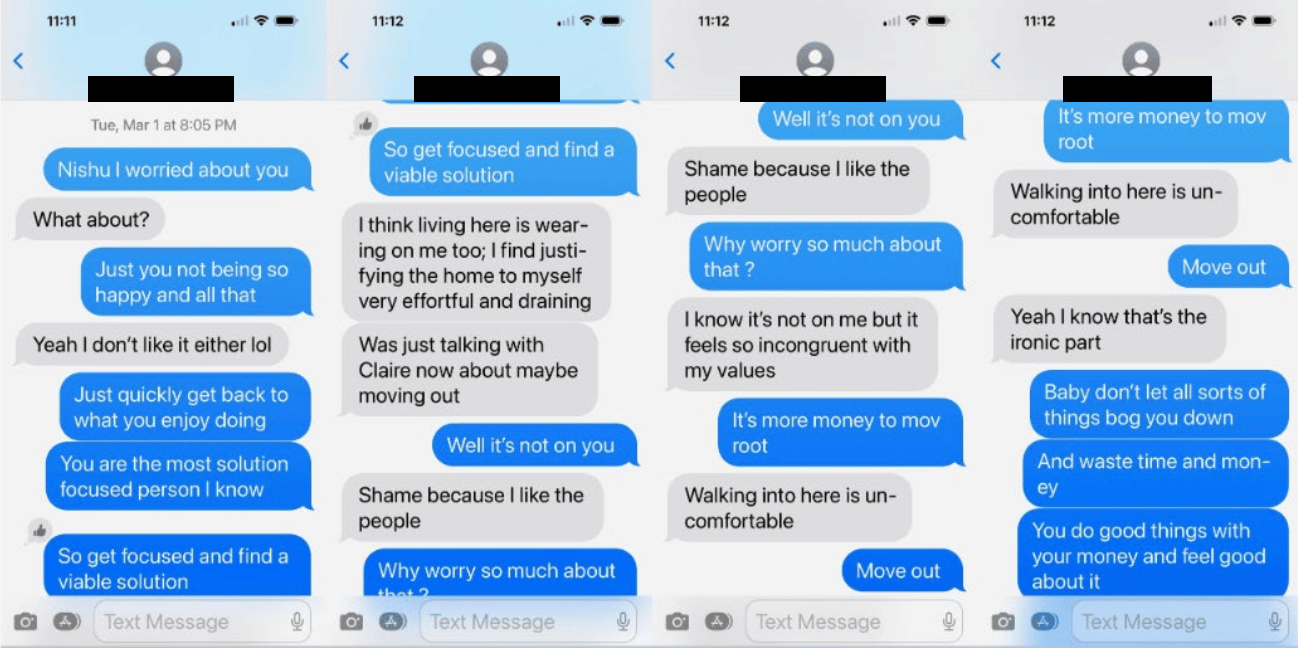
[The phone number in each header has been blacked out by this site. The messages are transcribed below. “Right” is a message on the right-hand side of the screen (the side of the person whose phone it is) and “Left” is a message on the left-hand side. Each screenshot repeats the last messages of the one before it. A thumbs-up mark sits beside the message “So get focused and find a viable solution”. The small symbols at the top of each screenshot and the grey words in the empty entry field at its foot are not typed.]
Screenshot 1 (clock: 11:11). At the top: [WITHHELD BY THIS SITE: telephone number]
Tue, Mar 1 at 8:05 PM
Right: Nishu I worried about you
Left: What about?
Right: Just you not being so happy and all that
Left: Yeah I don’t like it either lol
Right: Just quickly get back to what you enjoy doing
Right: You are the most solution focused person I know
Right: So get focused and find a viable solution
Screenshot 2 (clock: 11:12). At the top: [WITHHELD BY THIS SITE: telephone number]
Right: So get focused and find a viable solution
Left: I think living here is wearing on me too; I find justifying the home to myself very effortful and draining
Left: Was just talking with Claire now about maybe moving out
Right: Well it’s not on you
Left: Shame because I like the people
Right: Why worry so much about that ?
Screenshot 3 (clock: 11:12). At the top: [WITHHELD BY THIS SITE: telephone number]
Right: Well it’s not on you
Left: Shame because I like the people
Right: Why worry so much about that ?
Left: I know it’s not on me but it feels so incongruent with my values
Right: It’s more money to mov root
Left: Walking into here is uncomfortable
Right: Move out
Screenshot 4 (clock: 11:12). At the top: [WITHHELD BY THIS SITE: telephone number]
Right: It’s more money to mov root
Left: Walking into here is uncomfortable
Right: Move out
Left: Yeah I know that’s the ironic part
Right: Baby don’t let all sorts of things bog you down
Right: And waste time and money
Right: You do good things with your money and feel good about it
[End of the image.]
Then came the collapse of FTX – and Nishu with it. When he landed back in the US, I couldn’t get him in my arms quickly enough. I held him as tightly as I could, rocking him back and forth as he wept. I saw his pain pouring out of his eyes as the aftermath of what happened was unbearable for him. He quickly acknowledged his mistakes and accepted full responsibility for his role in what happened. He was [ECF p. 44] riddled with guilt and consumed by shame.
“I’m so sorry, Amma.” I heard him say, over and over, like a broken record. Our family kept a 24/7 suicide watch over him and he remained in a very dark place for months. His brother and I finally convinced him to meet with a psychiatrist who [REDACTED]. Even when he was prescribed medication, he refused to take it at first. He saw his pain as the karmically appropriate response. He couldn’t stop thinking about the people he’d harmed. He only began to take his medication once we convinced him it’d help give him the mental space necessary to fully cooperate with the government and work on making amends for his actions.
Over the past two years, I’ve seen Nishu work tirelessly to help the government agencies with their investigations. He spent so many nights scouring his notes, messages and documents to find any evidence that could be helpful. It was incredibly difficult for him, mentally and emotionally, to look back on what happened, now seeing so much of the history so differently than what it felt like in the moment, but he knew it was important and necessary.
In the early months after the collapse, when he wasn’t working, he was despondent. To help lift his spirits, his wonderful fiance Claire held his hand and took him to volunteer. They found a group that helps the homeless, and going there every week has helped bring him back to life. He started building a new life, volunteering his skills on a project relating to climate change and homelessness, working as a software engineer at a company that adores him, and tutoring a friend’s kids in computer science. After years apart, he is the most attentive and doting son a mother could ask for. He no longer aspires to achieve grand, abstract goals, but he now finds fulfillment through simple actions that improve people’s lives. I see so clearly how this refined focus has helped him rebuild his life with authenticity, and it gives me hope it will help him heal.
I know his life is now altered in a way none of us could ever have imagined, and I know that he has caused real harm, but I still believe that he has the potential to do a great deal of good in the world.
I count my blessings that my son is safe and back with our family. I pray we needn’t let him go. I hope these memories I’ve shared paint a picture of the Nishu I so deeply cherish. Your Honor, I thank you in advance for your consideration.
Respectfully Yours,
Anu Singh
[Letter from Raj Singh (Father)]
August 26, 2024
Dear Judge Kaplan,
My name is Gururaj Singh and I am Nishad Singh’s father. I hope this letter can help provide a view into the thoughtful, sensitive, and hardworking person Nishad is and the values our family holds dear.
I grew up in India in a lower-income home where my grandparents did not have the resources to go to high school and my father could not afford to go to an engineering college. My parents valued hard work and did their best to give me educational opportunities beyond what they were given. After completing my undergraduate degree in India, I was fortunate to get a Regents scholarship for graduate studies at UC Santa Barbara. I came to the US with only a suitcase and $600 in my pocket. After graduating, I began what became a long career in technology that has spanned over 40 years. Anu (Nishad’s mother) and I have worked hard to pass on the values of hard work and gratitude to our own two boys.
Nishad went to college on the same Regents scholarship that I did. When he graduated, he joined Facebook and worked for their Applied Machine Learning group, a coveted team. He planned on donating much of his salary to charity, but told me he thought he could do more.
Several months after he started at Facebook, he was introduced to Sam Bankman-Fried and the company he started, Alameda Research. Nishad was told about Alameda’s goal of donating a significant portion of the profits to EA charitable causes. Nishad was intrigued and began using his weekends and evenings to volunteer on a trial basis at Alameda. Over the next two months as he learned more about the company, Nishad told me he was considering leaving Facebook and joining Alameda.
Nishad talked with me about the pros and cons of making such a big move. At that time, I was not comfortable with him leaving his position at Facebook where he was working on cutting-edge technologies and was being well compensated. However, Nishad took me to visit Alameda’s office to see for myself.
It was clear this group of highly-motivated individuals felt they were on the cusp of an exciting business opportunity. And what made Alameda a great fit for Nishad was their mission to make an impact in the world of charitable giving. If I was Nishad’s age, I could see being drawn to work there, too. I spoke to Sam for a few minutes and found him to be very bright and someone who had the potential to make Alameda successful.
Nishad left Facebook to join Alameda as a junior engineer. At 22 years old, he was the youngest and least experienced member of the Alameda team, and was excited to learn from the brilliant people around him. I knew from my personal experience with startups that this move was risky. On the other hand, I was proud that Nishad was willing to take the chance to work somewhere where he felt more passionate.
Nishad would call me to talk on his drive to or from work at odd hours - sometimes two or three o’clock in the morning - because he put in 14-hour days six or seven days per week. He would speak with amazement about his colleagues, telling me how some came directly from nonprofits, and others were “savants” who previously worked at Jane Street, went to universities [ECF p. 46] like MIT, and were top competitors in math competitions throughout their lives. Nishad is very smart, but he would often tell me their thinking was on another level entirely. Working shoulder-to-shoulder with them made him feel invigorated.
Shortly after Nishad joined, there was a rift between the Alameda founders and half the employees departed. Nishad hadn’t even realized there was tension brewing and was caught by surprise. There were only four engineers left at the company. After a few months, Nishad called me with a dilemma. Sam asked Nishad if he would supervise and grow the engineering team as he needed someone who could provide hands-on management. Sam would set the engineering priorities, Gary would figure out how they should be done, and Sam needed Nishad to handle people-management and training.
Nishad was worried that without prior management experience, and being a junior engineer, he was not equipped for the role. He was inspired by Gary’s engineering talent and preferred to invest in growing his own ability to be more like Gary. I advised him this was wise - I had myself been a hands-on engineer for many years before I managed people, and if nothing else it made me a more capable manager later on. Nishad also has a personality that would make management difficult at such a young age - he had always had a hard time being assertive or confrontational with people older than him.
Nishad said as much to Sam, but Sam persisted. Sam told Nishad that he had the emotional sensitivity and interpersonal skills that were needed for the role. Sam said the company was at a critical juncture and needed Nishad’s help. Nishad listened to my thoughts and concerns with an open mind, but, at the end of the day, he was willing to accept the job and try his best. Nishad knew he had much to learn.
Shortly after becoming a manager, Nishad hired and onboarded three other engineers. He came to me for advice often in this period. Two of the three new engineers flourished. However, one underperformed, and Nishad struggled with the more confrontational aspects of the job including terminating the employee. Only after several months over which I reassured Nishad the employee would be okay in the long run did he eventually ask the engineer to move on from the company. I myself understand how difficult it can be to terminate employees, but Nishad's struggle with making the decision and taking action was particularly tough. At the time, I introduced him to a wise coworker of mine to help him navigate the challenges he faced with the termination process since it was so difficult for him.
Even as he grew as a people-manager, it seemed from our conversations that the hardest parts of his job were not improving. He felt he was isolated and missing the guidance he needed to grow. He wasn’t in regular meetings with the leadership, but felt even more out of the loop because they had moved to Hong Kong. He looked up to Gary and saw him as a genius, but he was often unavailable for days to answer questions. Nishad found it difficult to get the technical guidance he needed. Being responsible for guiding the other engineers only compounded the issue.
I was supportive of Nishad’s decision to move to Hong Kong because of his commitment to his team, but I didn’t know when I would see him next, especially given the pandemic travel restrictions that were in place at the time. So we talked on the phone often. He would do laps around Hong Kong Park and Facetime me, talking about his life abroad and showing me the birds in the park. There was much he loved about working at FTX, and it was a relief to be working beside his team after over a year apart. But over 2020 many of his previous difficulties with the company’s management structure resurfaced.
Nishad talked about how he wanted to provide stability to his engineers, but he needed to stretch himself thin to serve as a buffer from the chaos. Sam would go straight to Gary to handle critical engineering projects, so Nishad needed to figure out what tasks Gary wasn’t going to do to determine what the rest of the team should work on. All the while, Gary was less available to provide guidance to Nishad or the rest of the team. This felt unsustainable to me and did not seem to be an effective way to run an engineering organization. I advised Nishad to speak with Sam. Nishad, defeatedly, relayed to me that Sam reaffirmed that he should focus on taking work off Gary’s plate so he could concentrate on the crucial engineering priorities.
In the summer of 2020, Nishad was able to visit the US. Nishad had adopted a style of management that was focused on supporting his teammates by removing obstacles rather than directing their work. To spare his team the brunt of the unpredictable interruptions, he was the primary on-call engineer. I saw this in real life when I got to hear him take these calls, maybe five times per day or night, and triage technical issues and implement fixes. He showed me the biggest project he had coded himself: a ticketing system for the customer support team, that enabled a way for customers to submit questions, feedback or complaints. The project was impressive and I was proud of his engineering growth. But as he took perhaps his tenth Tums that day (Nishad struggles with acid reflux that gets worse with stress), I could also see the intense workload taking its toll.
On that same visit back, Nishad was offered equity options in the FTX if he forewent any future cash bonuses. We were actually in my apartment when he got the call from Sam telling him about the grant. Over dinner, Nishad relayed the advantages of donating equity over cash that Sam had explained. I had personally been through many difficult financial situations in my life, so I connected him to speak with a certified public accountant to help guide his thinking and provide direction on how to manage his newfound wealth. Nishad had multiple conversations with the accountant and ultimately ended up donating an eight figure gift to a non-profit organization whose mission was near and dear to Nishad’s heart. I admired his generous instincts, but this wasn’t my intention when I connected him to the accountant. I’d hoped he could be persuaded to take a more balanced approach to his giving and save some money for himself and his future.
In November 2021, Nishad was so busy that he couldn’t get away from work so I decided instead to visit him in the Bahamas. Over the course of a few days, I realized he was worn down in a way I had never seen before. On one hand, I appreciated the positive effect he seemed to have on everyone he worked with. However, his work was expanding to impossible levels, and he complained about how there were internal political battles around every engineering project. I was afraid this was an unsustainable work environment and worried about his personal well-being.
Close to a year later, the week before FTX filed for bankruptcy, Nishad called me sounding terrified. He said "Can you come here? I’m scared, I need you." Nishad frequently called me to ask for advice, but I had never heard him like that before. I immediately booked a ticket to the Bahamas, but the situation was very quickly spiraling out of control. I tried to keep in contact with Nishad, but he was mostly unreachable and when he was available he was totally distraught. I was very worried about his safety and the wellbeing of customers, the company’s future, and everyone at FTX. I coordinated with Claire, Nishad’s fiancee, to get them on a flight back home.
I picked up Nishad from the airport when he returned home after the company’s collapse. He was in total shock. It was gut-wrenching to see my child suffering and completely broken, but I held myself together so he knew he had family that he could rely on.
Nishad was a shell of himself, completely destroyed by his guilt. For four months, he was suicidal and our family took turns having someone with him at all times to make sure he didn’t harm himself. Every minute I was not next to him I worried that I would be told by someone that he had just ended his life. I knew I had to put all of my energy towards being there for Nishad, helping him get better and make amends, so I put my job on hold for the next five months to care for him.
Nishad deeply regrets not going directly to the authorities when he learned of the missing customer funds in September. Despite the magnitude of his transgressions, I admire the way he’s owned his past mistakes and I’m proud of how he’s worked tirelessly to do what he can to make things right. Within a few weeks of arriving home, Nishad and I began traveling to New York on a regular basis so he could meet with the Department of Justice and give them every piece of information he had on FTX and its systems.
I know Nishad is deeply remorseful for his role in the FTX collapse. The conversations we have about his hopes for the future tell me that his previous die-hard attitude about doing good have been replaced by something more measured. To him, this means a renewed focus on family, on getting married, becoming a father one day, and being the best friend he can be. He has nurtured his relationships at his new job, and has enjoyed returning to the creativity of engineering. Nishad and Claire visit me each week. We have a routine: we go on walks together, do crossword puzzles, chat about the books he’s reading or the newest health kick I’ve found.
I love my son and I'm happy he’s now pouring his heart into building a simpler life he can still be proud of. I hope the context I provide will help you to appreciate the potential he still has to make the communities around him brighter.
I humbly ask you to consider Nishad’s true character when you decide his fate and ask for your mercy and grace.
With Kind Regards,
Gururaj Singh