Exhibit A
Sentencing Letters Submitted On Behalf of Nishad Singh
Case No. 22-cr-673 (LAK)
[Pages 2 and 3 of the PDF are images of a table. The table was typed out from the images. Its last rows, on page 4, are text in the PDF. In the lines below, “|” stands between the three columns, and the lines in italics are the headings of the table’s sections, which stand on a coloured band in the original. Under “Friends”, the lines “Childhood Friends”, “College Friends”, “Other Friends” and “Family Friends” are sub-headings, on white rows in the original.]
Index of Letters
Author | Title/Relationship | Page Number
Former Alameda and FTX Employees
Adam Yedidia | Former FTX Engineer | 6
Ceri Howells | Former FTX Operations | 8
Andrea Lincoln | Former FTX Engineer | 9
Rey Jose Ramirez Suero | Former FTX Customer Support | 11
Willie Kaufman | Former FTX Engineer | 12
Linchuan Zhang | Former Alameda Engineer | 14
Jack Zhang | Former FTX Office Chef | 16
Adam Kalinich | Former FTX Engineer | 17
Ashish Suvarna | Former FTX Customer Support | 19
Philippe Maes | Former FTX Engineer | 21
Adam Jin | Former FTX Business Development | 23
Christian Drappi | Former Alameda Engineer | 25
Can Sun | Former FTX General Counsel | 26
Shuang (Claire) Zhang | Former FTX Colleague | 27
Anonymous | Former FTX Colleague | 28
Anonymous | Former FTX Colleague | 30
Anonymous | Former FTX Engineer | 32
Anonymous | Former FTX Colleague | 33
Immediate Family
Claire Watanabe | Fiancé | 35
Anu Singh | Mother | 41
Raj Singh | Father | 45
Rajeev Patel | Stepfather | 49
Malhar Singh | Brother | 52
Teachers & Professionals
Alan Waters | Accountant | 57
Norm Epstein | Wealth Management Advisor | 58
FTX MDL Plaintiffs | Counsel for FTX MDL Plaintiffs | 59
Katie DeVaul | Psychiatrist | 61
Jeff Nichols | Teacher | 65
Simon Olavarria | Teacher | 67
Gerlicelda Rudas Benag | Former Cleaner and Dogsitter | 68
Charles Dunford | Physical Trainer | 69
Volunteering Community
Andy McCabe | Manager, Gubbio Project | 71
Brendan Taliaferro | Founder, Homeward Initiative | 74
Marie O’Connor | Volunteer, Gubbio Project | 76
Extended Family
Pam Watanabe | Future Mother-in-law | 79
Keith Watanabe | Future Father-in-law | 82
Bridgette & Evan Schroader | Fiancé’s Cousin | 84
Ellie Schroader | Fiancé’s Cousin | 86
Jacob Whitsitt | Fiancé’s Cousin | 88
Debi Binford | Fiancé’s Aunt | 90
Erick Watanabe | Future Brother-In-Law | 92
Erica Djen | Fiancé’s Sister-In-Law | 94
Brian Moyer | Fiancé’s Extended Family | 95
Dennis Whitsitt | Fiancé’s Uncle | 97
Gina Djen | Fiancé’s Extended Family | 98
Lynette Neu (Whitsitt) | Fiancé’s Cousin | 99
Chad Songer | Fiancé’s Extended Family | 101
Julie Songer | Fiancé’s Extended Family | 102
Janice Guevara | Fiancé’s Family Friend | 103
Vivian Djen | Fiancé’s Extended Family | 104
Suchitra Vaidya | “Aunt” | 105
Seth Redmore | “Uncle” | 107
Vasudha Redmore | “Aunt” | 110
Antara Rao | Cousin | 113
Meghana Rao | Cousin | 115
Murli Thirumale | Uncle | 117
Vandana Thirumale | Aunt | 120
Samir Vaidya | “Cousin” | 121
Ahir Redmore | “Cousin” | 124
Shaunak Vaidya | “Cousin” | 126
Alamelu Iyengar | Great Aunt | 129
Anil Vaidya | “Uncle” | 130
Amrit Singh | Cousin | 131
Friends
Childhood Friends
Connor Hegarty | Elementary School Friend | 134
Phillip Korolog | Elementary School Friend | 136
Colin Smith | Elementary School Friend | 139
Gabe Bankman-Fried | High School Friend | 143
Peter Buckley | High School Friend | 145
Baylor Odabashian | Middle School Friend | 147
Greg Etzbach | Elementary School Friend | 150
College Friends
Corey Zumar | College Friend | 152
Isabel Yang | College Friend | 154
Rohit Mukherjee | College Friend | 156
Sahil Chinoy | College Friend | 159
Roshan Varadarajan | College Friend | 160
Varun Tolani | College Friend | 162
Darren Zhao | College Friend | 164
Stevie Kobori | College Friend | 167
Rahul Joshi | College Friend | 169
Caley Zheng | College Friend | 171
Other Friends
Briana Reynolds | Partner of “Cousin” | 173
Myles Baumann | Post-College Friend | 175
Liza Babin | Partner of Brother | 177
Kermit Cuff | Ultramarathon Friend | 178
Ruhi Christie | Partner of “Cousin” | 179
Anonymous | Post-FTX Friend | 181
Anonymous | Post-FTX Friend | 183
Family Friends
Rattan Gujadhur | Family Friend | 187
Wynn Anderson | Family Friend | 188
Rajeev Char | Family Friend | 190
Arun Simha | Family Friend | 191
Indira Almedia | Family Friend | 193
Shishir Ramam | Family Friend | 195
Renuka Char | Family Friend | 197
Lily Patel | Family Friend | 198
Jayshree Ullal | Family Friend | 199
Meenakshi Kaul | Family Friend | 200
Esateys Stuchiner | Family Friend | 201
Sowmya Simha | Family Friend | 202
Sriram Viswanathan | Family Friend | 203
Anu Mahal | Family Friend | 204
Deepa Shenoy | Family Friend | 205
Ganesh Pattabiraman | Family Friend | 206
Subbalakshmi Subramaniam | Family Friend | 208
Aditya Guleri | Family Friend | 209
Letters from Former FTX/Alameda Employees
[Letter from Adam Yedidia (Former FTX Engineer)]
Adam Yedidia
July 8, 2024
Lewis A. Kaplan
Judge
Daniel Patrick Moynihan
United States Courthouse
New York, NY 10007-1312
Dear Judge Kaplan,
My name is Adam Yedidia; I was a software engineer at FTX. You may remember me as one of the first witnesses for the prosecution in the criminal trial of Sam Bankman-Fried.
I became friends with Nishad Singh when I started working for FTX in January 2021. Prior to that date, he was a few-time acquaintance of mine; I knew him as a friend of a friend. When I started at FTX, though, he was my boss. When I began working, he and I both spent three weeks in Hong Kong's quarantine, staying in different hotel rooms. We spent many hours on video calls together, as he patiently taught me the basics of writing code at FTX. Through that experience, we very quickly became close friends.
Through those weeks and almost the two years that followed, Nishad was my manager. He was, and remains, the best boss I've ever had. He was warm and patient, extremely kind and hardworking. When I made a mistake while writing code, he made sure I knew, but simultaneously never made me feel bad about it—a difficult task for any manager. He never asked me to do a task that he couldn't have done himself. While I was at FTX, Nishad spent between 70 and 80 hours a week in the office, and was the primary engineer on call. He was on average woken up in the middle of the night 3-4 times per week to deal with issues. There was a company Slack channel, #urgent-dev, which was a graveyard of people reporting urgent bugs at all hours and Nishad fixing them and thanking the people reporting them.
Despite the intense demands of his job, he was unfailingly cheerful and nice. His style was more like that of a friend than a superior, not just with me but with others as well. He was the best kind of technical manager: the kind who writes more and better code than you do, while simultaneously managing over a dozen other engineers. I learned an enormous amount of software engineering from Nishad; I left FTX a far better engineer than when I joined, and most of that is due to him. As his report, I admired him deeply, and I still do.
In addition to being an amazing mentor and manager, Nishad was also my close friend. In Hong Kong, I slipped down a flight of stairs, dislocating my left shoulder. Nishad followed me in the ambulance to the hospital, and stayed by my bedside for hours, reassuring me, while they put me on painkillers and popped my shoulder back in.
About a year later, he and his girlfriend were driving down the street in the Bahamas at night, when they saw the car in front of theirs hit a dog and drive off. They pulled over and rushed out of the car to help, but when Nishad approached the dog, it bit him hard, breaking the skin and drawing blood. He called a mobile veterinarian to help with the situation. The bite turned out not to be serious, and the dog died anyway, but Nishad's actions that night have stayed with me. As much as we can all agree that it is good to pull over to help a dying stray animal on a dark street, I believe that most of us would simply keep driving. Nishad's reflexive decision to get out and help, I think, reveals a lot about his character.
At one point in early 2022, Nishad fell sick with COVID, and FTX simultaneously had a serious problem with an increasing number of cases of scams against certain users, particularly the elderly: the victim would be coached by the scammer to open an account on FTX and give their credentials to the scammer, who would later withdraw their money to their own account. Nishad, from his sickbed, worked through his illness to develop a system for preventing this species of scam—and also successfully agitated for FTX to reimburse the users who had been scammed, at the company's expense. His instinctual response was to help the victims of the scam; as part of the work he did to figure out what was happening, he called and gently talked to them to figure out what was wrong and reassure them.
This episode is noteworthy not because it is remarkable, but because it was par for the course for Nishad. My experience of him at the company was that of him trying his best to do the right thing in so many difficult circumstances, even when there wasn't a clear playbook for doing so.
In late 2022, before the company collapsed, I know that Nishad worked hard to reduce FTX's expenses—agitating to have an expensive expansion of FTX's office canceled, for instance, and arguing against further acquisitions. In the final week, as FTX was collapsing, he came to my room and apologized repeatedly, sobbing on the floor, completely inconsolable. His reaction took me off-guard. Part of that is I hadn’t yet learned all the details of the situation. But also, I didn't blame him then, and still don't today, for what happened. He worked very hard and sacrificed for the company; I understand him to have been a strong advocate of moderation and thrift. But regardless of how I personally see him, there is no doubt whatsoever that Nishad was deeply contrite and felt enormously guilty for what happened.
I am extremely grateful to have known Nishad. He is a kind, warm and compassionate person, and he was one of my closest friends. I have sorely missed spending time with him since FTX declared bankruptcy. I feel terribly for him. He is incredibly kind and generous; the herculean effort of building FTX, of which he took on a huge portion, would have been a credit to him in a better world but is instead a stain.
I loved working with him. Many if not most of my fondest memories of FTX are of being his coworker. I truly hope to one day have the opportunity to work with him again. I hope that you will give Nishad a lenient sentence.
Thank you,
Adam Yedidia
[Letter from Ceri Howells (Former FTX Operations)]
To Whom It May Concern,
I had the pleasure of working with Nishad Singh at FTX Digital Markets for over a year, and I can confidently say that he is one of the most genuine, kind-hearted individuals I have ever met. Nishad's humility and compassion were evident from the moment I met him, and his positive impact on both my team and the entire company cannot be overstated.
Nishad was always friendly and approachable, not just to me but to everyone on our team. He made it a point to learn our names, check in on how we were doing, and genuinely cared about our well-being. His kindness extended beyond simple pleasantries—he would go out of his way to be helpful, whether it was assisting with a task or just offering a listening ear. This level of attentiveness and empathy is rare, and it left a lasting impression on all of us.
One of the most admirable qualities Nishad demonstrated was his deep concern for people. He was particularly passionate about ensuring that everyone was treated fairly and with respect. I recall how he advocated for higher salaries for the Bahamian staff when he realized the discrepancies that existed. He didn’t just talk about making changes; he took action to ensure that everyone, regardless of their background, was compensated fairly. Furthermore, he took the time to help some of our local logistics staff learn coding, offering them skills that would open up new opportunities. These actions clearly showed that Nishad wasn’t in it for wealth, power, or fame—he was motivated by a genuine desire to make a difference in the lives of those around him.
In fact, Nishad seemed to actively avoid the trappings of power and prestige. Despite his significant role, he always shied away from the spotlight. He had no interest in mingling with the famous personalities who often visited the company or being interviewed. Nishad was content with focusing on his work and the well-being of his team, rather than seeking recognition or accolades.
As a member of the operations team, I often interacted with Nishad while handling logistical requests for employees. Unlike some others, Nishad never made extraordinary or unreasonable demands. He was always incredibly grateful for our efforts and made sure we knew it. He didn’t expect special treatment and would even feel embarrassed if we tried to offer it. To him, we weren’t just colleagues—we were friends and peers, and he treated us with a sibling-like respect and warmth.
In conclusion, Nishad Singh is a person of exceptional character. His humility, kindness, and commitment to fairness make him stand out as one of the most remarkable individuals I’ve had the privilege to work with. I wholeheartedly vouch for his integrity and the positive influence he has on those around him.
___________________________
Ceri Howells
[Letter from Andrea Lincoln (Former FTX Engineer)]
Andrea Lincoln
July 8, 2024
Lewis A. Kaplan
Judge
Daniel Patrick Moynihan
United States Courthouse
New York, NY 10007-1312
Dear Judge Kaplan,
I am a professor of computer science. I worked at FTX between my postdoc and my current professorship. Nishad was my boss while I was employed at FTX. Over the course of my time there I became friends with him and his girlfriend Claire. Nishad was gentle and kind to me. He treated me well as a boss and a friend.
Late one night, Nishad was bitten by a wild dog. I later learned what happened from another employee who was in the car with Nishad and Claire. The employee told me that she needed a ride home and Nishad and Claire offered to drive her. As they drove home the car in front of them hit a dog and kept driving. Nishad insisted that they pull over and check on the dog. Nishad wanted to make sure the dog was okay and came up close. The injured dog panicked and bit him and limped off into the woods. Nishad waited for animal control to come take care of the dog, despite just being bitten. Then they drove the employee home before he got treated for the bite, literally putting the dog and employee before himself.
When I was working at FTX, I got rear-ended by a car whose brakes gave out. I was fine but had some frightening back pain the next day. I was going to get checked out by a doctor when Nishad and Claire found me. When they asked if I was okay I tried to tell them I was fine but burst into tears. Nishad rearranged his day so he could drive me to get seen by the doctor. He stayed waiting for me for the whole appointment, working the whole time of course, so he could also drive me home. Nishad and Claire checked up on me and made sure I was getting treatment until I got better.
Nishad worked very hard. He worked long hours in the office, continued working while at home, and even worked through illness. When something needed to get done he would do it. He took on boring and unglamorous tasks like preforming code-reviews, fixing bugs, and doing maintenance work. Continuing to engage with the unglamorous but necessary tasks made him a much better boss. When someone needed to be on call and no one else would do it, he would be on call. When someone pushed a bug and it needed to be fixed he would wake up in the middle of the night to fix it, and he wouldn’t complain or make the bug’s author feel bad. I remember showing up to the office at 3am with Nishad already there (I think he had never left the office that day), he was working to fix a bug created by another employee. The other employee was upset at themselves and Nishad comforted them while simultaneously working to manage the fix. That isn’t the kind of work that is [ECF p. 10] splashy or fun. But being in a nearly empty office at 3am debugging an issue while comforting the person who caused is necessary to keep projects running and to keep employees happy. It was one of his strengths as a manager: he actually did the work. He is smart, quick, and cares about his employees.
Judge Kaplan, I know your job is hard and you must weigh many aspects of a case. But I ask you to consider the Nishad I saw: a gentle, kind, and hardworking man. I cannot imagine that he would re-offend. I hope that Nishad receives no jail time. I hope he can play with his dog, spend time with Claire, build new software products, and manage teams of developers. A world with Nishad in it is a warmer and safer world.
Sincerely,
Andrea Lincoln
[Letter from Rey Jose Ramirez Suero (Former FTX Customer Support)]
Dear Judge Kaplan,
Address: [REDACTED], Bella Vista, Santo Domingo, Dominican Republic
Date: 27 June 2024
Reynaldo Jose Ramirez Suero
Nishad and I met in 2019 over telegram. FTX staff at the time was mostly in Hong Kong so they offered me a job while I was simply helping on telegram. In 2020 January I traveled to Hong Kong to meet the team but I did not have the honor, yet, of meeting Nishad.
Meeting Nishad initially happened online. Nishad was constantly on top of the bugs I reported about the platform and always happy to take the feedback. The reality is Nishad always was ready to help and work at FTX. Due to me workring in America’s time I had to constantly call Nishad if the FTX platform went down or if we had any particular issue that required developer intervention. It didn’t matter if other developers caused the issue, were more knowledgeable, or were supposed to be “on call”, Nishad was the one who actually responded to us and our customers. Over time, Nishad became the person that the customer support team knew they could count on.
To me it was obvious the dedication of Nishad to the company, someone who was always online and barely slept, I constantly recommended him to take care of his health. I met Nishad in Bahamas and had time to talk to him. Nishad felt as a young humble man and never saw me as someone below him but rather as an equal which made me feel very appreciated. I had some personal issues and commented them to Nishad and he took these issues as if they were his own and tried to help me.
Nishad had an incredible ability to empathize, he truly made me feel like I was part of the FTX team and that what I had to share and say was important, he went beyond what was considered politeness to connect with me and to understand the things I explained.
Nishad always had the ability to make you feel like his family and not his co-worker. To this day I still consider Nishad one of the person with the purest heart out there and would always consider working with him. Nishad never let the money get to his head, always kept a cool head, a smile while working on the things he loved and never said anything that would hurt anybody.
People in the company looked up to Nishad as a leader despite his young age and only Director title, and because of how hard he worked and how well he treated others.
I heartily believe that Nishad deserves a chance at redemption as to me he’s not only an incredible programmer but one the best humans and coworkers that I have ever interacted with.
[Letter from Willie Kaufman (Former FTX Engineer)]
William Kaufman
September 15, 2024
Honorable Lewis A. Kaplan
United States District Court Judge
Southern District of New York
Daniel Patrick Moynihan Courthouse
500 Pearl Street
New York, New York, 10007-1312
Dear Judge Kaplan,
I am writing to share with you whatever insight into the character of Nishad Singh that I can. He and I have been friends for close to ten years at this point. We met when we were both in college through mutual friends, and though we did not attend the same school, we quickly became friends and remain so to this day. Nishad’s wit, kindness, and intelligence were immediately clear to me - I will always have fond memories of hanging out, playing video games together and talking about anything and everything.
Nishad is one of the most unabashedly supportive people I know. He has an infectious excitement for the achievements of others - I will share with him what feels like a mundane accomplishment and he will somehow convince me that I have overcome a great challenge. As far as I can tell, the only person’s achievements he has ever undersold are his own. He would tell stories emphasizing some extremely embarrassing mistake he made, but when I asked others who were there, their memory of the event is much more flattering to him. He often matter-of-factly spoke of how he didn’t belong in charge of anything and had just lucked into his position at FTX. I have to wonder if his feeling that his contributions were minimal and he was among people smarter than him were part of what stopped him from speaking up against what he knew was wrong.
I briefly worked with Nishad at FTX. During that month or so, he was a mentor to me. It was clear that, despite his nominal managerial role at the company, he took much more pride in his individual contributions as a programmer. The one part of his role as a manager he clearly did enjoy, however, was finding ways to make others happy. Figuring out which kinds of projects I enjoyed, who I liked working with, and finding time to answer my questions were clearly the parts of his job that he enjoyed. I know he’ll find other ways to put his intelligence and compassion to work.
One thing I can strongly attest to is how obvious it was that Nishad was never interested in personal enrichment. Well after FTX had reached valuations in the billions of dollars, he told me about his plan to someday buy a house with his partner near where he grew up and I was struck by how modest of a plan it was. He didn’t spend money on luxurious travel accommodations, fancy meals or expensive clothes, and it was obvious that they weren’t even of interest to him.
I saw Nishad very briefly during the collapse of FTX. He was distraught to such a level that I was worried about his safety. He was barely able to put a sentence together, but what he [ECF p. 13] expressed was deep remorse and concern over the harm his actions had caused without a thought for himself. I have to imagine those feelings have left an impression on him, carrying a viscerally felt lesson about right and wrong that will lead him well as he moves forward.
It hardly makes sense to talk about Nishad without also mentioning his partner, Claire. They make a wonderful couple, and I have seen them be good for each other through ups and downs of all kinds. Nishad has a lot of work ahead of him to get his life back on the track that it should always have been, but knowing they’ll be doing it together, along with their dogs and their supportive families, gives me the utmost confidence.
Thank you for reading what I have to say about the character of Nishad. I only hope that my testimony can help you see Nishad as I see him. I know he has much left to offer the world.
Sincerely,
[The signature that follows in the original is a picture of the name “William Kaufman” in a script typeface. No typed name follows it.]
[Letter from Linchuan Zhang (Former Alameda Engineer)]
The Honorable Judge Lewis A. Kaplan
United States District Judge
Southern District of New York
Dear Judge Kaplan,
I worked at Alameda Research in Berkeley between September and December of 2019 as a software engineer. Nishad was my direct manager. During that time, I found Nishad to be kind, helpful, and extremely hardworking, if a little naive.
I applied to work at Alameda Research because I was excited by their mission and thought it’d be good for my career capital and donation plans. I was taken in by the messaging about the company a) having prosocial goals and b) was unusually competent relative to the rest of the crypto industry, allowing them to get outsized returns. I ended up giving up a significant chunk of unvested Google stock and annual bonus to join.
When I joined, most of the team (including senior people like Bankman-Fried and Gary Wang) had already left to work on launching FTX in Hong Kong. Nishad and I were among about 8 people still in Berkeley (not all of whom were full-time).
I mostly didn’t like working at Alameda. However, Nishad was very helpful throughout the process. I was nervous about wasting people’s time, but Nishad repeatedly encouraged me to speak up more and ask more questions. He patiently explained details of the codebase that I didn’t understand to me, as well as more high-level questions like the company’s stated philanthropic values, philosophy and culture. Even when I disagreed with him, I found Nishad to be careful and nuanced. It was clear he consistently looked for the good in other people. For example, he never said a bad word about the people who left Alameda in the 2018 exodus, and even strongly complimented one of them (“one of the best traders I know”), despite my understanding that the split was anything but amicable.
I respected Nishad significantly as my manager. He was clearly technically competent, much more hardworking than I am, and also performed admirably when he was thrust into a management position at a young age (he was the first manager I’ve had who was younger than me, and I was 26). That said, occasionally I found him a little naive, though not unusually so for his age or vocation. For example, I remember discussing charity with him, and he remarked how there’s approximately no diminishing returns to charitable giving, a claim that might make sense theoretically but to me seemed implausible considering the relative magnitudes of Alameda and the charities in question.
While Nishad was competent and hardworking, he sometimes seemed to struggle with asserting his own views, particularly when they might conflict with those of more dominant personalities in the company. I don’t recall him ever openly disagreeing with Bankman-Fried about software choices, despite Nishad being more of a domain expert. At one point, he told me that he initially had severe doubts about launching FTX and thought Alameda should focus on trading rather [ECF p. 15] than consumer-facing software, a decision that he in retrospect endorsed as FTX looked like it was going to do well. He shared that the experience of him seemingly being proven wrong about decisions made him less willing to question others’ product judgment.
I ended up leaving Alameda because it was not a good cultural fit. Everybody was overworked, I personally found the work environment rather stressful and I didn’t agree with, and had trouble adapting to, the coding practices the company followed that were very different from Google’s, such as the lack of unit tests. However, Nishad was extremely supportive throughout the process. Even though our professional interests were clearly at odds, he was very helpful and genuine as I navigated leaving the company, and I still remember his kind words and offers to help on my last day.
While I found Nishad to be intelligent, fundamentally kind and well-intentioned, I can see in retrospect how his inexperience, trusting nature, and difficulty in standing firm against stronger personalities could have led him into compromising situations.
Sincerely,
Linchuan Zhang
[Letter from Jack Zhang (Former FTX Office Chef)]
Honorable Judge Kaplan,
My name is Jack Zhang, and I was a former chef at FTX, working for the company from July to November 2022. I was responsible for preparing lunch and dinner for all employees.
Nishad Singh was a manager, and when I joined the company, he gave me a lot of help. I have always been grateful to him. During my four months of work at FTX, I found that Nishad Singh was not only friendly but also very frugal. He is a vegetarian, and since most of the food I prepared was meat-based, it might not have been fully suitable for him. However, his only request was to ensure that the dietary needs of the majority of employees were met, and he did not ask for any special treatment.
When my family moved to the Bahamas, Nishad also helped find school for my daughter in the Bahamas. I have always been very grateful for this. Later, I found out that he had been treating all employees this nice, which made me respect him even more.
Therefore, I humbly ask you, Honorable Judge, to not be too harsh on Nishad Singh. He is a very kind person and an excellent supervisor. His respect and generosity towards every employee will be remembered deeply by all of us.
Jack Zhang
10/10/2024
If any further testimony is required, please feel free to contact me: [WITHHELD BY THIS SITE: telephone number]
[WITHHELD BY THIS SITE: email address]
[Letter from Adam Kalinich (Former FTX Engineer)]
[Pages 17 and 18 of the PDF are images. Their text was typed out from the images.]
October 1, 2024
Hon. Lewis A. Kaplan
United States District Court
Southern District of New York
Daniel Patrick Moynihan Courthouse
500 Pearl Street
New York, New York 10007-1312
Re: United States of America v. Nishad Singh (22 Cr. 673 (LAK))
Dear Judge Kaplan,
I write in support of my former colleague, Nishad Singh. I can say, without qualification, that Nishad was the most hardworking and kindest manager I have ever worked for.
I first met Nishad in the fall of 2021, after I had joined FTX US, and was assigned to work as a developer in the FTX US Chicago office. I was initially sent to the Bahamas office for training, where Nishad was the Head of Engineering. Over the course of the next fourteen months, I was assigned to work in various locations, including Chicago and, for most of 2022, in Nassau, Bahamas with the majority of the FTX developers.
For a newly-created exchange growing at the rate FTX did in 2020-22, with the rapidly-increasing number of customers and transactions, we had a relatively small group of developers. Comparable operations employ hundreds of developers, so the round-the-clock workload demanded from our small developer team was often overwhelming, with Nishad shouldering the bulk of the day to day workload. Without question, Nishad worked longer hours than any other developer in the company and carried an astounding burden.
Nishad is truly one of the most selfless individuals I have ever known. While he held a position that would have entitled him to delegate almost any task to a subordinate, Nishad would always take on the most unpleasant tasks himself, and if a complicated or extremely urgent situation arose, Nishad was always the guy who would jump on it, and would stick around to be as helpful as possible even when he needed to call in more experienced developers. On the rare occasions when he could find time to attend a company social gathering, Nishad would invariably bring his work laptop along to respond immediately to issues that required urgent attention. I recall one morning in which Nishad told us he had been awakened six different times the prior night for various emergencies. Nishad worked this hard, frequently on little sleep, day in and day out, to the apparent detriment of his own [ECF p. 18] health. Our employees learned they could rely on Nishad and he did not want to let anyone down.
Of all the FTX leadership, Nishad stood out as the one who consistently showed the most empathy and compassion toward his employees. He provided honest, constructive feedback with genuine respect and always encouraged us to excel in our work while supporting us through personal and family challenges. When I was relocated far from home, Nishad went above and beyond to ensure that we received help in finding housing, making friends, accessing medical care, and meeting other personal needs. No matter how many hours into the workday, he was always patient enough to listen when employees sought his advice and to provide them with the guidance to solve their problems. It was clear that he sincerely wanted us to be happy and feel supported, in addition to sharing in the company's success.
I will never forget how Nishad responded when I opened up to him about the suicide of my best friend, which happened while I was working long hours for FTX. I was struggling with grief, and Nishad didn't hesitate to offer his time and a listening ear. He was there as both a manager and a friend, checking in on me regularly. His empathy during that difficult period meant more to me than words can express. Through his example, I learned invaluable lessons about treating colleagues with kindness and respect, and I remain deeply grateful for the compassion he showed me and others.
I respectfully ask Your Honor to extend as much mercy as possible when determining Nishad's sentence. I acknowledge the extent of financial losses experienced by many, including me, but I believe that a lengthy sentence for someone of Nishad's exceptional character would only compound the tragedy. I respectfully urge you to consider the shortest sentence permissible under the circumstances, and I would be profoundly grateful for your compassion towards him.
Sincerely,
Adam O. Kalinich
[Letter from Ashish Suvarna (Former FTX Customer Support)]
2nd September 2024
Dear Judge Kaplan,
I started working for FTX as a part of the Customer Support team in March 2020, right when the covid lockdown began. The Customer Support and engineering teams worked closely to identify bugs or resolve technical issues customers brought to our attention. In my role, I was fortunate to get to know Nishad, and ended up working with him almost on a daily basis for two years.
Right from the start, one thing that stood out about him was he was very welcoming, responsive and open to thoughts / suggestions. Hierarchically he was the head of engineering at FTX but it always felt like I was talking to a peer or a friend that was willing to listen carefully what we had to say and respond with courteous and actionable insights. I would say this was true for all of Nishad’s interactions with most if not all people in the team.
Due to the nature of crypto being 24x7, we were often working in a way such that at least >1 employee was always on shift to keep an eye out for issues on the exchange. As I was in the asia time zone and was also working weird hours, I often called Nishad, waking him up at 3am his time for critical issues. Sometimes, we were unaware if an issue was critical or not, and Nishad always encouraged us to err on the side of caution and call him anyway. If we were ever very off about that judgment, he would point out that waking him up was probably not needed in that scenario but was always very calm and composed about it and would never be annoyed at us.
I recall a time when a new joinee was asking a hilariously simple question in one of the FTX slack channels and Nishad was very calmly and patiently holding his hand through the entire process of solving the new joinee’s issue. Nishad did not have to do that and someone else that was not as busy could have solved it easily but Nishad handled it very humbly. I recall this particular instance because the new joinee only later realised that Nishad was the head of engineering at FTX. This was not the exception but the norm. He was always around for any questions and it made all of us feel more welcome to the team.
I moved to the Bahamas in April of 2022. All of my interactions until this point with Nishad were only behind a computer screen. He was genuinely very happy to see me, and me him. Nishad was easily the nicest guy in the FTX Office. Nobody could even get close to being nicer than Nishad. I am 100% sure if you ask anybody who used to work at FTX, they would say the same thing. He is very down to earth.
Nishad is a very caring teammate who takes a genuine interest in the people he works with. As I got to know Nishad better, I told him I’d like to build my skills so one day I could move from Customer Support into an engineering role on his team as I had a background in engineering . Nishad was very encouraging and personally helped ramp me up, and helped [ECF p. 20] navigate splitting my time with my manager in a way that made everyone happy. I am grateful for what I learned from him, and he also took this kind of interest in other employees within the company.
Throughout my career, I have interacted with and reported to a lot of superiors. Often when a superior does a mistake, I have observed that they try to sweep it under the rug or do not publicly apologise for it or just ignore the issue at hand. Nishad on the other hand, has been one of the select few so far I have interacted with who has publicly and often, accepted his goof ups, apologised for it humbly, and owned up to it.
Seeing Nishad work relentlessly all the time and look after others drove us further and all of us worked harder. Although Nishad was often the youngest person in the room, he led by example and earned the respect of others through his actions.
I am unsure what the future holds for Nishad, but I would like to end with a note that Nishad is a very genuine guy. It has always been a pleasure to talk to him, be it in person or online. He has very little to no ego and respects all people that he interacts with. I also think he has tremendous potential in him. He is without doubt a very talented programmer and I think it would be a shame if he isn’t given another opportunity to contribute to the world in a positive way.
2nd September 2024,
Ashish Suvarna
[Letter from Philippe Maes (Former FTX Engineer)]
05/27/2024
Dear Judge Kaplan,
I am Philippe Maes, an ex-coworker of Nishad. I was a contractor at FTX, responsible for the development of the mobile app. In this letter I’d like to tell you a little about Nishad Singh and the impressions he left on me.
I first met Nishad in FTX’s offices in Hong Kong. I was invited there after doing a few remote interview rounds. I was struck by how genuine and down to earth Nishad, in particular, was. He was very kind, welcoming, patient and especially non-judgemental. Even though my English wasn’t that great at the time - and I had a lot of questions - he took the time to listen and answer every one of my questions in detail. The day I did my on-site interview was the same day as the famous COVID crash. You could see and feel the stress in the office, everyone tied to their computer screens. I remember Nishad being one of the only ones in the office remaining calm and respectful.
I was offered the role, and with it, a large responsibility: building a brand new mobile app. Nishad’s management gave me a sense of responsibility and made the app almost feel like“ my” personal project. He was intensely curious about the technical details, and offered lots of help and thoughts, but was also very open-minded and grateful for my experience and effort. As the youngest member on the team, he was self-aware of his own limitations and lack of experience relating to mobile development, and managed me not by giving me orders, but by helping me be the best version of myself. He gave me the freedom to rise to the occasion myself, all while making clear he had my back. Being able to work independently like this, taught me a lot, not only as a programmer, but also being able to manage a product myself, and guide things from ideas to release. I doubt there would have been a better place to grow professionally. All of this wouldn’t have been possible without Nishad’s endless trust and patience.
Although the offer was made multiple times, I chose to remain remote, working out of Belgium, instead of moving to Hong Kong (and later the Bahamas). Nishad took the time to check in with me, checking if I was doing well, if I needed something or if he could do something to make my life easier. When I visited the offices, generally once every quarter, he would always take the time to go for a walk to catch up. Our talks weren’t limited to work stuff, we would talk about our lives, travels, relationships. He would invite me over for dinner, invite me for movie nights, etc. Every time I was there, he made sure to include me in all sorts of social gatherings, which made me feel welcome and appreciated.
In short, when I think about Nishad, I think of a person who is kind and patient to everyone, even in the most stressful times. A down to earth person, not looking down on anyone and treating everyone with respect. Professionally, he allowed people to be the best version of themselves.
I hope this letter gives an idea as to what relationship me and Nishad had whilst at FTX, and how I see him as a person. I’m happy to answer any question you might have. You can reach me by email at [ECF p. 22] [WITHHELD BY THIS SITE: email address].
Kind regards,
Philippe
[Letter from Adam Jin (Former FTX Business Development)]
June 12, 2024
Adam Jin
[REDACTED], Kennedy Town
Hong Kong
Honorable Lewis A. Kaplan
U.S. District Court Judge
Daniel Patrick Moynihan
United States Courthouse
500 Pearl St.
New York, NY 10007-1312
Subject: Character Reference Letter for Nishad Singh
Dear Judge Kaplan,
My name is Adam Jin, and I am writing to provide a character reference for Nishad Singh, whom I have known since 2019. Our friendship and professional relationship began at FTX. Through our shared experiences in both Hong Kong and the Bahamas, I have come to know Nishad well. I hope this letter provides you with a deeper understanding of his character.
When I joined FTX, Nishad was already a lead engineer and quickly became one of our most critical team members. His work reliability and efficiency were unparalleled. Building and maintaining a crypto exchange from scratch is incredibly challenging, and Nishad excelled in this demanding environment. During the early days, as the platform grew exponentially and experienced significant traffic, technical issues often arose unexpectedly. Nishad consistently stepped up to address these problems, regardless of the hour, often responding to urgent matters immediately after only 30 mins of sleep following an extremely long day. His tireless dedication inspired our entire team.
Nishad's contributions extended far beyond his technical abilities. He genuinely cared for his colleagues and users. We often referred to "Nishad’s time" as a precious resource, reflecting his extraordinary productivity. In our estimation, one hour of Nishad's work equaled a full day's work for five regular engineers. Despite his heavy workload, he always made time to help others, driven not just by his skill, but by a sincere commitment to helping. This was particularly evident in his approach to a common industry challenge: users deposit unsupported tokens to exchanges. Nishad developed a system to recover these assets swiftly, FTX was the only exchange that recovered users’ assets within 24 hours. His efforts in this area alone saved users millions of dollars in potentially lost funds. Nishad undertook this task out of a genuine desire to protect users and their assets. In many ways, I always saw Nishad as the moral compass of FTX, always pointing in the direction of what was right to do.
One particular day stands out vividly in my memory. We had taken a rare half-day off to go wakesurfing in Hong Kong. Nishad, a novice surfer, showed remarkable determination to learn, falling repeatedly but never giving up. Just as he began to find his balance and began to ride the wave, his phone rang. Without hesitation, he jumped off, swam back to the boat, dripping wet, pulled out the mobile phone and laptop, and immediately started working to solve an urgent technical issue. This moment encapsulated Nishad’s reliability, dedication, and always putting others before himself, even under the most unexpected situations.
During the COVID-19 pandemic, Nishad faced significant challenges due to Hong Kong’s stringent travel restrictions. His resilience was bolstered by the support of his long term partner, Claire, who undertook a 20-hour journey and subsequent 3-week hotel quarantine to be with him, bringing their beloved dog, Gopher. Their reunion demonstrated the strength of their bond and provided Nishad with crucial emotional support during a difficult time. The joy on Nishad’s face when he saw Claire and Gopher was heartwarming and a testament to the love and support that he has always relied on.
While Nishad has made mistakes, I have known him to take full responsibility for his actions. This instance is no exception, and I know he deeply regrets his participation in the events in question.
I hope this letter provides deeper insight into Nishad's character as a dedicated and kind individual. He is a person of dedication and kindness. I respectfully ask for your consideration of these qualities when determining the consequences of his actions. Should you require further information, please do not hesitate to contact me.
Sincerely,
Adam Jin
June 12, 2024
[Letter from Christian Drappi (Former Alameda Engineer)]
Dear Judge Kaplan,
My name is Christian Drappi. I came to know Nishad Singh during my work at Alameda Research, and like him I was a witness at Mr. Bankman-Fried’s trial. I'd first like to state that the last time Nishad and I communicated was before I learned about what had happened at the company. He has no idea I am writing this, and this is entirely my own decision. In fact, I never considered Nishad a close friend. It was hard to consider most of my colleagues as friends: we were all just there and got along. On the other hand, when I met Nishad, I immediately liked him – it was hard not to. As we spent more time in the Bahamas, my positive view of him was strengthened, and I came to trust Nishad quite a bit.
On November 7, I learned about how FTX defrauded its customers. And on November 8, 2022, I learned that Nishad was involved in the conspiracy. I felt betrayed. I always had trouble understanding the inner-minds of Sam, Caroline and Gary. But Nishad was someone I could relate to. As a result, I thought that he would keep the other three on the right path. I was wrong.
Nishad testified the week after my testimony, and I attended most of it in the overflow room. After hearing him speak, I feel less betrayed than I did on November 8th. This comment isn't meant to excuse his actions in any way. Rather, I say this because today I have a much different picture in my mind about how Nishad conducted himself. I now believe his issue is not knowing right from wrong. It's that he needs to find the courage to stand up for what he believes is right, rather than following orders when he knows they are wrong. I hope that the Court’s sentence in this case will develop that courage in him while taking into account both what Nishad has to offer in the future and the victims in this case.
During the time I got to know Nishad, there were several other things that struck me about his character. These are why I came to trust him so much, and why I'm now writing this letter. Firstly, Nishad's eagerness to please extended far beyond committing financial crimes with his superiors. He was generally eager to please. The best of this is when he would go out of his way to welcome new people into his world, either socially or professionally. He was warm to everyone he came across, no matter who they were. This was particularly true when it came to FTX's local employees in the Bahamas. Unfortunately it was all too common for higher-ranking FTX employees to treat the Bahamas staff with much less than the respect they deserved. I'm proud to say that Nishad was the opposite. This is part of why he was so beloved by everyone at the company.
Professionally, Nishad was probably the most effective software engineer I have ever met. He would work at all hours of the day. We would be playing padel at midnight and he would stop in the middle of a game because he had to fix a bug in the code. Often times the bugs wouldn't even be his doing, but he took responsibility for the whole team. Not only was his volume of work remarkable, but also his efficiency was world-class. I saw this first-hand, from the code itself to the products that it powered. In a few days he could build features that it would take weeks for an entire team to complete.
I believe that Nishad has a bright future in front of him, and I am extremely confident in that belief. A year and a half ago, I'd have told you that he is the colleague that you'd dream of working with. If he's able to muster the courage to always do the right thing, then I am sure that I'll be saying that in the future too. Your Honor, thank you for reading this letter.
Sincerely,
Christian
[Letter from Can Sun (Former FTX General Counsel)]
[This page of the PDF is an image. Its text was typed out from the image.]
Honorable Lewis A. Kaplan
U.S. District Court Judge
Daniel Patrick Moynihan
United States Courthouse
500 Pearl St.
New York, NY 10007-1312
October 9, 2024
Dear Judge Lewis A. Kaplan,
I am writing to provide a letter of support for Mr. Nishad Singh, whom I came to know during my time as General Counsel at FTX. Recognizing the seriousness of his crimes, I hope my insights into Nishad’s character will offer a more complete understanding for the Court.
Nishad was a pivotal member of the engineering team at FTX, and his technical expertise was integral to the development and growth of the platform. Throughout our working relationship, I witnessed Nishad’s dedication and hard work firsthand. My observation was that he always approached his work with a high level of professionalism, focus, and commitment to quality.
Beyond his technical abilities, he consistently demonstrated kindness and consideration for others, both in and out of the workplace. He was always responsive, approachable and warm to others. He was someone his colleagues could rely on, not only for his professional contributions but also for his empathy and willingness to support those around him.
That being said, I am also now aware of the gravity of the crimes committed by certain individuals within FTX that led to its collapse, and Nishad's involvement in those activities. I do not wish to diminish the harm caused by these events. However, from my interactions with him, I believe that Nishad was never motivated by personal greed. I believe that he deeply regrets the role he played, and he has expressed sincere remorse to me for the consequences that have impacted so many people.
Thank you for your time and consideration.
Sincerely,
Can Sun
Former General Counsel, FTX
[Letter from Shuang (Claire) Zhang (Former FTX Colleague)]
Hon. Lewis A. Kaplan
United States District Judge
Daniel Patrick Moynihan
United States Courthouse
500 Pearl St.
New York, NY 10007-1312
Dear Judge Kaplan,
My name is Shuang Zhang, and I am an attorney licensed in the state of California.
I have known Nishad Singh since 2018 and briefly worked with him at FTX in 2022. Throughout our interactions, Nishad consistently demonstrated kindness, respect, and humility. His genuine care for others was evident, as he often went out of his way to support those around him, both personally and professionally. As a result, many in the company held him in very high regard.
I believe Nishad’s remorse is sincere and genuine. I hope that, in the future, he will have the opportunity to apply his skills and dedication to helping others.
Thank you for your time and consideration. Please feel free to contact me if you have any questions.
Respectfully,
Shuang Zhang
[Letter from Anonymous (Former FTX Colleague)]
September 23, 2024
Dear Judge Kaplan,
My name is AJ (initials used for anonymity). I chose to submit this with my initials as I still work in the digital assets industry, and I am aware that there might be some professional costs to me writing this letter.
I’ve known Nishad Singh since 2021, when I started working at FTX. Like thousands of others, I had placed my life savings on the platform and watched it all disappear when FTX collapsed. Yet, despite the personal loss, I hold no ill feelings towards Nishad, and I’d like to explain why.
1. During my time at FTX when things were seemingly going well for the company, I used to describe Nishad to friends as the unsung hero. While the story of Sam Bankman-Fried sleeping on beanbags is well-known, few are aware that Nishad used to often sleep on the floor in the office, working tirelessly to keep the exchange running smoothly. Nishad never struck me as someone who operated from a place of self-interest. Instead, he was a workhorse, committed to the company and always serving those he managed with humility.
2. I also don’t harbor resentment toward Nishad because I know he genuinely believed in Effective Altruism (EA) – the idea of dedicating his life to do good in the world. Nishad introduced me to the principles of EA, which had a significant impact on me, even though it ultimately contributed to his downfall. Being deeply immersed in this movement, combined with the intense culture at FTX, may have led him to place too much trust in individuals who I felt were not truly close to him.
3. Although I lost a lot of money at FTX, there are positive memories from that time, many of which were shaped by Nishad’s influence. I often heard people say that Nishad was a mediocre programmer when he first joined FTX. But he eventually became the only person people could depend on to make sure their engineering question or request got handled, no matter their level of seniority. His dedication inspired me to believe that, through hard work, anything is possible. Nishad was also an ultramarathon runner, and I once asked him how he managed such feats. He said it wasn’t difficult if you focused on taking one step at a time, rather than worrying about the entire race. That advice resonated with me and is something I think about during difficult undertakings.
Recently, I reconnected with Nishad, and he shared a sweet story about proposing to his girlfriend during a hike with her and his dogs. There was one line that stood out, which I think captures the essence of who Nishad truly is: "I tried thinking about the [ECF p. 29] tough circumstances we're in, just to see if it could pierce through the happiness. For once, it really didn't." This moment of joy in investing and building in relationships with his loved ones, despite the challenges he faces, speaks to his true nature.
When FTX collapsed, I sincerely believed that Nishad’s intentions were always to do good in the world, and I still believe that today. However, the last time I spoke with him, I couldn’t help but feel sad. The Nishad I once knew—driven by a strong desire to make a positive impact—seemed defeated. He feels intense remorse for what has happened, as though he has tried, failed, and now has resigned to his fate. My biggest hope for Nishad is that he overcomes this and is given another chance to contribute to the world in a meaningful way.
Thank you for your time and consideration.
Sincerely,
AJ
[Letter from Anonymous (Former FTX Colleague)]
October 7, 2024
Honorable Lewis A. Kaplan
U.S. District Court Judge
Daniel Patrick Moynihan
United States Courthouse
500 Pearl St.
New York, NY 10007-1312
Dear Judge Kaplan,
I was a coworker of Nishad’s since the day he started at FTX. I submit this letter anonymously as I fear negative reprucussions for my career despite my strong conviction in Nishad’s character. I hope I can provide insight into who Nishad is despite this.
I first met Nishad on his first visit to Hong Kong. From our very first interactions that day it was evident that he was exceptionally kind and compassionate. He treated everyone with respect, regardless of their role within the company. Whether someone was a senior executive or a junior staff member, Nishad made time to listen and help with any issues they faced.One instance that stands out is when Nishad suggested providing extra payment to our office security guards in Hong Kong. They were contracted from another company, so when FTX started to do well, they didn’t benefit financially from it. Nishad felt it was not right, and took it upon himself to advocate for them.
Nishad was the first to volunteer for the roles no one else wanted so the rest of the team could have fun. A few times the team would go out to a bar in Hong Kong. But it was understood that some engineers needed to be available to fix issues if they came up. I remember how Nishad would wait to see if all the other engineers were going to go, and if they were, then he’d stay back without making any fuss. Similarly he would wait to do things like book his flight tickets until after everyone else had theirs in place so that there were always some engineers available with good internet. He organized his life around being available if he was needed, and FTX became known for its fast technical issue resolutions as a result.
Even in the most stressful moments, Nishad remained composed and patient. He never raised his voice or was passive-aggressive. Just his presence naturally would de-escalate tensions and make people more sane.
At times, Nishad’s low ego also meant that he didn’t get angry when maybe he should. I remember when FTX acquired a company with its own engineers, who were all older than Nishad. Nishad was the most natural personality to try to help integrate them into the company. They had lots of challenging work dynamics among them, and took them out on Nishad and were overall very disrespectful towards him. When others advised Nishad to just give up on them and let them [ECF p. 31] quit, Nishad instead flew back to the US and visited with many of them, trying to befriend them and understand their complaints. Some great engineers stayed as a result.
I watched as Nishad became a de facto leader. He often took on the task of resolving interpersonal issues, not because he was responsible or managed the people, but because he genuinely cared about his colleagues.
Nishad was also one of the few who would voice disagreements with Sam, even in areas that Nishad wasn’t involved in, like company spending. It was very hard to disagree with Sam, and very few people did. Nishad stood up to Sam, even about matters outside his immediate domain, particularly regarding financial prudence. I remember one time when a trader in the office asked our operations team to buy a $12,000 clock in the company Slack. I saw the message, immediately thought it was a bad idea but I was nervous to voice my disagreement. Then Nishad commented that he thought it was unnecessary. I was so relieved Nishad said something. I messaged him to thank him for being the one to say it. Nishad said he was worried he was the crazy one. A while later, in private, he told me that he got scolded by Sam over it because it was not his job to block expenses and Sam wanted to keep that trader happy.
I understand the gravity of the situation and the impact it has had on many. However, I felt it important to share these aspects of Nishad's character. His kindness, empathy, and dedication to others have left a lasting impression on me and many of his col leagues.
[Letter from Anonymous (Former FTX Engineer)]
October 11, 2024
Hon. Lewis A. Kaplan
Daniel Patrick Moynihan
United States Courthouse
500 Pearl Street
New York, NY 10007-1312
Dear Judge Kaplan,
I am writing this letter anonymously due to the high-profile nature of this case, but I felt compelled to share my experience with Nishad Singh, whom I worked for at FTX. During the time I knew him, Nishad was my boss, and I can say without hesitation that he is one of the kindest and most compassionate people I have ever encountered.
Despite the enormous pressure he was often under, Nishad consistently went out of his way to make others happy and to be helpful. He seemed to carry a constant burden of responsibility, yet even in the midst of this stress, he found ways to be kind to those around him. I witnessed numerous moments where he extended himself beyond what was required to support others, whether it was a small gesture to brighten someone’s day or a more significant act of generosity.
What stands out most about Nishad is his deep care for others. He has always been driven by a genuine desire to help people, and this was reflected in his commitment to charitable causes. It wasn’t just words or occasional donations—he truly made giving back a priority in his life. His generosity and willingness to support those in need were qualities that defined him both personally and professionally.
I am aware that Nishad has pleaded guilty in this case, and I do not intend to diminish the seriousness of the situation. However, I sincerely ask for leniency in the sentencing. The person I knew was not someone who acted out of malice or greed, but rather someone who was deeply caring and committed to doing good in the world. I believe that this case has been a sobering and life-altering experience for him, and I hope that his actions in the past—his kindness, generosity, and compassion—will be considered as mitigating factors in his sentencing.
Thank you for your time and consideration.
Sincerely,
A Concerned Former Colleague
[Letter from Anonymous (Former FTX Colleague)]
July 14, 2024
Dear Judge Kaplan,
I have known Nishad for many years as both a close friend and as a former colleague at FTX. I prefer to write anonymously as I fear any public backlash or repercussion for my continual involvement in related industries.
I am grateful to have shared enough time with him to consistently see him choose to be a principled and empathetic man at every opportunity.
Over our first few meals together, it was easy to notice that Nishad did not eat any meat. When asked, he offered that he had made a personal choice to try to reduce suffering in the world, including that of animals, by forgoing animal products. Although I was partial to his goals and struck by his thoughtfulness, I maintained my omnivorous diet.
As we became closer, I shared that I had gained some interest in following in his footsteps with a few vegetarian days or meals a week. I was afraid this would be seen as insufficient in light of his deep conviction, but his response met me where I was in my journey without guilting me to do more: “I think people that make the same choice don’t get enough credit. I’m glad you’re trying it out.”
Unfortunately, I quickly abandoned that dietary plan, despite maintaining my friendship with Nishad. When I was ready to try again and commit to being vegetarian after another few years had passed, he shared the same level of genuine excitement as he had the first time I tried. The only reason I’ve been able to maintain a vegetarian diet for multiple years since is due to his conviction and support inspiring me to do so.
Nishad’s empathy hasn’t been conditional either. When my longest relationship to-date ended due to my actions, Nishad reached out to myself and my ex (whom he had become friends with as well) to offer support.
Even as he acknowledged to both of us that my behavior caused the breakup, he was willing to go above and beyond in making sure I was ok as well. Beyond consistently checking in with me, he even offered to move a reunion of our close friend group to another location if it meant I could join more easily for additional emotional support.
I am deeply grateful to have Nishad in my life. I hope he has the opportunity to continue to share the same inspiration and support that he has with me to many others in the years to come. I humbly ask for your support in making that happen.
- Anonymous
Letters from Immediate Family
[Letter from Claire Watanabe (Fiancé)]
October 1, 2024
Dear Judge Lewis A. Kaplan,
My name is Claire Watanabe. I am Nishad Singh’s fiancé. Thank you for the opportunity to describe the Nishad I’ve come to know and love and reflect on the ways Nishad has fundamentally changed, most especially in light of his wrongdoings.
Nishad and I began dating in 2015 while we were undergraduates at UC Berkeley. I hadn’t met anyone with a bigger heart or a greater willingness to act on it than Nishad (which remains true to this day). He’d wake up early and bring me chai before our early morning computer science class. He’d leave dandelions on my pillow because he knew I loved yellow flowers. He always offered to cook me dinner, although cooking for him involved microwaving Indian dal then serving it with a side of grocery store pita bread and hummus.
Early in our relationship, we had a conversation that lasted long into the night — learning anything and everything about each other. Nishad shared his deeply held concern about suffering in our world. He introduced me to some ideas behind effective altruism, and the inspiration he felt. He spoke of charities like Against Malaria Foundation, which distributes bednets to families, primarily in Africa, that prevent malaria contraction via mosquitos. A simple solution to a pervasive problem with devastating consequences. The charity is considered effective because, on average, a couple thousand dollars of donations can translate into one life saved. An entire human life – a mother, a child – who otherwise would have passed away is saved by this size of donation. I had no idea the average person could be so impactful.
I saw the conviction in his eyes that night back in Berkeley. I was in awe of his own clarity and sense of purpose: to try to make a real dent in the world’s suffering.
In 2017, Nishad graduated from college and joined Facebook. His plan was to earn and then donate as much as possible, funding effective charities' amazing work. However, after only a handful of months, he worried if he made a mistake. He felt disconnected from his values and what he actually wanted to contribute to the world.
In October of 2017, Nishad learned of an opportunity with a company founded by Sam Bankman-Fried, the big brother of one of his best friends from high school. It was a cryptocurrency trading startup, the then nascent Alameda Research. Sam invited Nishad to visit the office and meet the team.
Sitting in a crowded room, Nishad watched as Sam traded. Sam explained the various actions he took in real time. With one trade, Sam made $40,000 in a matter of minutes. Nishad was blown away, and even more so as Sam explained that there were hundreds of these crypto-specific arbitrage opportunities out there. Nishad was also delighted by the employees – everyone he chatted with seemed, at the time, to share Nishad’s philanthropic values and ambition. The founders had pledged to donate 50% of Alameda’s profits to charity and were willing to work long, hard hours. Here was an opportunity where Nishad could more directly affect positive change, and at a scale way beyond what he thought was individually possible.
When Nishad was eventually extended an offer he was on the fence – recognizing the inherent risk [ECF p. 36] of a small startup. Eventually, one of the early business leads offered to donate $50,000 if Nishad joined the company that week. Nishad put in his resignation at Facebook the next day.
Nishad joins Alameda then FTX
On the sidelines, I watched the vortex that was Alameda (and eventually FTX) grow and grow from 2017 to 2020. It sucked up Nishad’s evenings first, then weekends, then eventually the country he called home. Everything happened so fast and with escalating intensity: half the company left; then Nishad, the most junior person in the company, became manager of the engineering team. Sam and Gary Wang (Nishad’s boss) moved to Hong Kong to build their own exchange, FTX. FTX began gaining more and more momentum, triggering most of the Berkeley office to relocate to Hong Kong. Then COVID hit. Nishad had to make the decision: either move to Hong Kong indefinitely, or stay in California and see himself become further and further out of the loop from the company’s day-to-day activities. He could already feel the impact of working apart from the team—unable to join impromptu conversations, respond to issues in real time, and often working with outdated information as things shifted by the hour.
Late in 2018, I remember talking with Nishad about if Alameda/FTX was worth it. He was constantly tired. The long and unpredictable hours were weighing on our relationship, and he was seeing less of his family and friends. We sat cross-legged at the foot of our bed when he said, “I’d be ashamed of myself if I walked away now.” In Nishad’s mind, walking away would mean abandoning all of the people their future donations could help – like a firefighter arriving at the scene of a burning building choosing to turn away
By the end of 2021, FTX had clearly become a success. Nishad had continuously made charitable donations since joining Alameda. His “earning-to-give” strategy seemed like it was working. But now that he was able to donate on a larger scale, he was worried he didn’t have the time to do crucial research these donations call for if you want to approach them with thought and care. He wrote as much in an email to a grantmaking group he trusted: “It’s one of my regrets that I haven’t been searching hard enough for giving opportunities in the last few years…I can’t provide too much of my own time…I’m happy to do away with any formalities and just make the most of that dynamic. I’m pretty happy to receive advice / don’t take offense easily if the advice implies I’m making a mistake in how I give or spend my time / etc. I’d much rather get this right.” Months after that email but with the same considerations in mind, Nishad and I together spoke with a different charitable giving advisory group. In the end of this evaluation process, we selected five nonprofits in-need, and Nishad donated an eight-figure amount in total. These donations funded new programs within reputable charitable organizations and funding for staff salaries for academic policy research. This moment, for Nishad, was a dream come true.
I join FTX
In January 2022, living in the Bahamas, I interviewed with Sam and other leaders for a role at FTX. My career up until that point was focused on shaping user-centric consumer technologies and leading multi-departmental teams. I was weighing the option against graduate school, having been accepted to a few technology-focused public policy programs that I could start later that Fall.
I decided to join FTX. My relationship with Nishad was my primary consideration, and after living apart during his move to Hong Kong, I wasn’t prepared to do so again. Additionally, I was fully on board with Nishad’s charitable giving mission. Since graduating, I had been donating a portion of my paycheck to global health charities like the Anti Malaria Foundation. With FTX’s success [ECF p. 37] carrying even greater stakes, I felt a similar sense of responsibility to help the company succeed and achieve Nishad’s charitable giving goals.
Joining FTX gave me a new appreciation for Nishad and the work he had been doing for years. First and foremost, Nishad was the most caring, kind and thoughtful manager across all the teams in the company. He was generous with his time and treated every team member with warmth and respect. Most other leaders and employees could be immensely stressed so it wasn’t uncommon to see people be dismissive, rude, or pull rank to conclude disagreements. I, ashamedly, fell victim to this on particularly rough days. Nishad never did. As a truly shining exception, he was the one to always remember the names of coworkers’ kids and ask how their families were doing; the one to advocate for giving the entirely Bahamian Operations team a raise when he discovered they were underpaid relative to the rest of the staff; the one who was constantly seen walking around the parking lot with engineers, as he made it a point to always say ‘yes’ when anyone on his team asked for a “walk and talk”. I cannot express how proud I was to see Nishad, one of the hardest working, to also be the kindest and most loved. Despite all of the pressures of the job, and over all those years, he stayed true to himself in this way.
Second was witnessing Nishad’s perseverance in action: A unique challenge was maintaining the FTX exchange and helping an entire team build on top of a codebase Nishad did not architect and initially build out. This was particularly difficult because Gary, the original author, was not the biggest people-person. A byproduct of this was that Gary decided to always work alone on his systems, not having anyone else double check his code, and he rarely explained his code to Nishad or anyone else, except Sam. And while the team had access to the code, it was often complex enough that it’d be over everyone else’s head.
To highlight a common type of occurrence, a memory from 2022, when we lived with Gary in the Bahamas: Nishad’s phone goes off around 3AM, waking us both up. It’s a co-worker on the customer support team calling about an issue affecting users. Nishad pulls his laptop off the bedside table and starts digging into the logs. I see on Slack, the company’s messaging platform, Nishad messaging back and forth with the customer service team in the “urgent dev” channel, asking questions, trying to diagnose what’s happening. After an hour of digging, Nishad determines that the issue is in Gary’s part of the code, and Nishad wasn’t familiar enough to handle it himself. Nishad calls Gary three times. No reply. Nishad hesitates before he gets out of bed. I peek outside moments later to find Nishad sitting on the ground in the hallway, just outside Gary’s room. Nishad asks questions into the dark room. Gary was working nights, so he was already awake. I hear Gary mumble a suggestion. Nishad takes a minute and types away, then later says, “Hmm, not that. Any other ideas?” I learned the next morning that once they identified the problem, Nishad stayed up for another two hours to fix it and talk to the customer support team so they could feel comfortable letting users know it was resolved.
Before I joined FTX, I assumed that Nishad was an engineering wiz who was woken up the most because he could solve anything. Only until after I joined did I realize how incomplete the picture was. Nishad was the one who simply always responded to support calls and wouldn’t rest until the problem was resolved.
Third, I saw a new side of Nishad’s selflessness, giving everything he had for his team and FTX as a whole: There’s a trope in the tech industry that the “business side” always over promises for engineering. The dynamic at FTX was far beyond anything I’ve heard of. Oftentimes, Nishad would [ECF p. 38] learn about projects after the fact and most of these projects were large in scope and high-profile: The Miami Heat deal meant that a new ticketing system needed to be built. The decision to quickly launch an FTX credit card meant that a new system was necessary to correctly handle chargeback fraud. Acquiring the Japanese company, Liquid, meant that the current exchange needed to be copied and dramatically changed in order to comply with Japanese regulation.
Once a new investment or partnership was made and a check was signed, Nishad could either try to challenge the decision after the fact and see if it could be reversed so it wouldn’t derail existing engineering projects. Or, alternatively, he could figure out how to build the necessary engineering systems so that the money wouldn’t be wasted. He often tried both approaches, but it was frustrating to him that he didn’t have any insights into the strategy discussions until after the fact. Inevitably when he lost the argument with Sam, he would stretch himself by assuming another engineer's workload so they were free to focus on the new project or by taking the project on himself.
Witnessing Nishad day-in, day-out, navigate these challenges while maintaining his respect and kindness towards others only deepened my respect for him.
Nishad’s Continued Acts of Compassion
Even in the midst of his growing and eventually overwhelming responsibilities at FTX, Nishad never let go of his instinct to help those around him. Whether it was through big gestures or small, everyday acts of kindness, his compassion remained at his core.
I remember one flight where Nishad took the middle seat and sat next to an older gentleman named Stan, who had recently lost his wife and was heartbroken. He was preparing to leave the home where he and his wife had raised their family, moving to be closer to one of his adult children. They spoke for hours during the flight. As we exited the plane, they exchanged polite goodbyes. Partway down the terminal, Nishad suddenly stopped, ran back to Stan, and gave him his phone number. He told him, “If you need help with the move or anything else, please let me know—it would make my day.” When Nishad came back and filled me in, my heart filled with love.
One of the most personal acts of kindness was Nishad’s support during my mom’s [REDACTED]. For years, I watched her battle this disease. [REDACTED]. My mom had ups and downs, but during the darkest times, I felt like I had lost her. [REDACTED]. In early 2021, I told Nishad about the happy news, but not about the financial strain my parents were under. Unbeknownst to me, he called my mom and offered to pay for whichever program she thought would provide the best care. He recognized the immense strength it took for her to reach this point and wanted to support her any way he could. His offer took a huge weight off my parents, [REDACTED]. It was not the only time Nishad had financially supported a loved one through medical burdens, but up close, I saw just how pure an act of love it was. [REDACTED]. While this is my mom’s story of strength and courage, Nishad’s proactive, thoughtful support played a key role in making it possible. Having my mom healthy today is one of the greatest gifts I’ve ever and likely will ever receive.
Fall 2022
Come September 2022, I remember Nishad’s mood shifted. He was markedly more stressed and distracted. That same month, I had suffered injuries from a car accident that confined me to bed for two weeks. Nishad was by my side, taking me to all my doctor’s appointments. I assumed his mood change was due in part to that. I wouldn’t know until later that it was because Nishad had just learned about the shortfall in customer funds.
Two months later, the world I knew fell apart in a week. On Sunday, November 6th, Nishad told me that something was really really wrong and that this was probably the end for the company. Frankly, I didn’t believe him – how could that be the case? But his suicidal state scared me tremendously and made me pay attention. That week my main priority was Nishad. I’d wake up in a panic if he wasn’t next to me, worried about what he might have done. I’d convince him hourly why he shouldn’t kill himself. I frantically reached out to psychiatrists. His teammates, not even fully aware of his mental state, sent me a constant stream of messages asking how they could help him, and telling me they loved him.
I remember the evening of Tuesday, November 8th. We thought that FTX was being bought by Binance. A lot of the employees had gathered that night as a kind of funeral for FTX. No other company leaders attended. Nishad, torn apart, felt too ashamed to see anyone. When I finally convinced him to step out, about ten of the people he worked closest with, mostly customer support and engineers, came to him. They formed a line to give him a hug, one-by-one. He couldn’t stop apologizing to every one of them.
By Thursday, November 10th, FTX had filed bankruptcy, we were back in the US, and I was only beginning to piece everything together.
It’s hard to convey how deeply Nishad’s soul was broken after the collapse. He asked me repeatedly if I would forgive him if he took his own life. He could only think of the suffering and pain: of his family, his girlfriend, his team, the public and the customers who he let down. His entire adult life had been dedicated to alleviating suffering, yet now he saw himself as complicit in causing it for so many people. The cognitive dissonance between who he believed he was and the person staring back at him in the mirror was more than he could handle.
Two days after we arrived in the US, Nishad asked me again about suicide and forgiveness. Despite being an emotional wreck myself, barely hanging on, I somehow found a moment of clarity and said something like, ‘If we truly believe your future only holds shame and sadness, then yes, I’ll find a way to forgive you. But we don’t know that for certain yet, so let’s hold off on deciding anything.” Nishad listened. I still remember his dark, sunken eyes. After a long moment of silence, he agreed. While I think the suicidal thoughts continued, even well after he got psychiatric help, that was the last time he asked me that question.
Today
Now, nearly two years later, I’m immensely grateful that Nishad is far from the suicidal headspace he was in that fall. The Nishad of today reminds me of the guy I met nine years ago – though wiser and more grounded. I see him carry remorse for his actions daily, but I’m relieved he has found a way to live with himself and recognize he has something special to give to his family, friends, and community.
Many customers and others have suffered far more than me, but forgiveness has been necessary for my own healing over these past two years. My heart continues to break when I think about what the other employees, customers, and their families had to endure throughout this.
It took me many conversations to fully understand what Nishad was thinking in the two months he was aware of the missing customer funds. I know he will never again allow his compassion and sense of duty to be hijacked, agreeing to actions that would otherwise run counter to his values. Over these past years, I’ve seen he’s learned necessary life lessons about who to trust, a more mature view of responsibility and obligation, and how to maintain perspective on what’s right. I know he’s fundamentally changed in such a way that he’ll never put us anywhere close to a situation even remotely similar.
Nishad today invests in his relationships with family and friends instead of pushing himself to accomplish “one more thing” at work. He trusts his gut about new people – gravitating to those who are warm, caring, and genuine – rather than marveling at someone’s intelligence and drive. His ambitions around “maximizing impact” have been replaced with a much more measured approach: to volunteer his time to good causes, but not sacrifice his whole life to do something at an extraordinary scale. He kisses our dogs on the nose every morning. He insists on driving our friends home if it's after dark, even if it’s only a few blocks away. He wakes me up with a warm cup of tea on days he knows I have early meetings, just like he used to.
Taking full responsibility for his role in the FTX collapse and cooperating with authorities has been a fundamental part of Nishad’s effort to make amends. Above all, I respect the dedication he has brought to every request from the government, especially in those early months. It amazes me that he managed to pull himself together, let alone apply the same determined work ethic I saw from him at FTX.
I know that Nishad will continue to answer for his wrongdoings and that his future remains uncertain. But whatever lies ahead, I continue to look forward to the day where we can say our vows to one in front of our loved ones. My decision to stand by Nishad’s side remains unshaken. I am confident in who he is and what he’s learned, and I’m deeply grateful for his love and presence in my life.
I sincerely thank you for this opportunity and for your attention. I am available to answer any questions or provide additional details at [WITHHELD BY THIS SITE: email address] or [WITHHELD BY THIS SITE: telephone number].
Most Respectfully,
Claire Watanabe
[Letter from Anu Singh (Mother)]
August 10, 2024
Dear Judge Kaplan,
I want to begin by sincerely thanking you for taking the time to read this letter. Though writing this letter has been challenging, it’s also been an exercise in gratitude as I’m reminded of Nishu’s remarkable compassion and the tremendous joy he’s brought to the lives of everyone who knows him.
First, let me provide you with some background about our family. I was raised in India in a modest household, where my father worked for the government, and my mother was a homemaker. We lived in a single room-home and shared an outdoor bathroom with three other families. My mother taught us the true meaning of abundance saying, ‘together we have so much.' Whether it was sharing our meals, helping care for each other's children, or tending to the needs of our elderly neighbors, we all contributed to a spirit of collective kindness that defined our local community.
I never dared to dream of a life in America back then, but my brother showed us that a different future was possible. He came to the U.S. on an academic scholarship and later helped me follow. I supported myself through college by busing tables in the cafeteria and borrowing the textbooks that I couldn’t afford from my professors. Supported by the kindness of others, I was able to earn a doctorate in Clinical Psychology a year after Nishu was born.
Nishu was raised in an environment that mirrored the communal spirit of my own upbringing. We lived next to my brother and sister-in-law, and knocked down the fence between our yards so the children could run freely between the houses. Our home bustled with visitors, mostly other Indian immigrants who were also finding their way in America. Two of them also lived with us, and though they aren’t related by blood, Nishu has always called them his aunts. They fed Nishu from a bottle, lovingly spoke Kannada with him, and when they had children of their own, they were all siblings in the only ways that matter.
Nishu’s father Raj and I are deeply grateful for the opportunities we’ve had and found it most important to impart the values of gratitude and generosity to our sons. As a child, Nishu absorbed and emanated those values naturally. With the other children, he’d find his favorite toy, thrust it into their arms, and say, “See! For you.” Even with his dogs, I’d find him eating his ice cream cone, taking a lick then giving one to the dog then one to the other. He’d go around in a circle like that. I had to scold him since it was bad for the dogs! It was such a strange but heartwarming thing to observe in a five-year old – such little attachment to things he loved but such great joy in sharing them.
Fast forward to when Nishu was seven, our family went back to India for a distant family member’s wedding. A reception was held in an outdoor courtyard. At the edge of the party, mothers and their children were begging for food, arms reaching through the gates. I’m ashamed to admit that I barely registered them at the gate along with the rest of the party. I had become blind to poverty, especially back in India where it was ever present. Nishu tugged at my sari and asked if they were okay. Through his young eyes, I saw clearly again. We discreetly took some food over and handed it through the gate.
Nishad peppered me with questions throughout the evening. He couldn’t grasp why such inequality existed. “Can’t we just give them all this food?” “Why do we need to do it quietly?” “Why is everyone else ignoring them?” My heart broke as I tried to explain. Over the rest of the trip, he gave away every [ECF p. 42] toy he brought along to children we passed on the street. I felt quietly proud of him. After this trip, I saw him not only give to others from a place of joy, but also one from a broken heart, now knowing that the world wasn’t always fair.
As Nishu entered high school, his desire to help others took a new shape. It was during this time that he first learned about effective altruism. It resonated strongly with Nishad.
In college, he met Claire, who’s now his fiancée. My heart melted as I saw them interact as the best of friends. It brought me great comfort as his mother to see Nishu had found someone so wonderful who understood him.
After graduation, Nishu accepted an offer to join Facebook as an engineer. One role he was considering was to work on its Donations product: the Facebook feature that helps people do things like raise money for a charity on their birthday, which seemed like a good fit for him.
As Nishu learned more about the underlying vision for the feature, he started thinking about ways it could be improved with things like prioritizing effective charities at the top of the product. He reached out to his childhood friend, Gabe Bankman-Fried, to get his thoughts as they both shared an interest in charitable giving. Gabe, in turn, connected Nishu to his older brother Sam Bankman Fried to get other advice on refining the idea.
Nishu barely knew Sam but he looked up to him as he had a reputation for being a genius. They brainstormed some ideas together about ways to make the Nishad’s feature proposal robust. But when Nishad pitched it to the Facebook Donations team, not only was it rejected, but he came away feeling discouraged about the likelihood of them being receptive to any effectiveness-oriented product changes. So, Nishu decided to join Facebook’s Machine Learning team instead. Once he started, he found that he really liked his team but, in his heart, he knew he wanted to work for an organization with a more charitable mission.
Just a few months later, Sam called Nishad and pitched him joining Alameda Research. Raj and I were initially hesitant. However, we had known Barbara Fried and Joe Bankman as Gabe’s parents. We knew they were successful, respected Stanford professors and had a relationship with them. Their informal connection to Alameda as Sam’s parents reassured us.
Nishu's role at Alameda and later FTX required significant personal sacrifices. After relocating to Hong Kong, the intensity of his workload made it impossible for him to take a break or get away for vacation. For example, Nishu asked permission to take a vacation to attend my second wedding in 2021, but was denied. I was so sad he would miss being part of such an important occasion, as family has always been a priority for him. However, Nishu was with us in spirit and made his presence felt at our wedding as he suggested we ask for charitable donations from our guests instead of gifts. On each table, we placed cards with a QR code Nishu set up that allowed people to make contributions to a nonprofit to help improve conditions for factory farmed animals.
In December 2021, I visited Nishu a few weeks after he moved to the Bahamas. Nishu tried to get us to meet outside the apartment, but we visited early by surprise. Entering the luxury apartment, my reaction was amazement and pride at the accomplishments it reflected, but Nishu was having none of it, and was actively ashamed of its splendor.
After unloading groceries, we sat down and he said that he didn’t know how long he’d stay at FTX. When I asked why, he explained that the company culture was changing. Back in Hong Kong, people spent long hours in the office, but were collectively energized by what they were building. Now, Nishu felt people were taking it easy, caught in a “luxury and status trap.” Nishu was worried about the company’s values drifting away from the charitable goals they declared.
The following February, I felt a pull to visit him again; something like a mother’s sixth sense. I returned to the Bahamas. The moment I saw him, I knew he was doing much worse. He had gained a lot of weight and was exhausted in a way that was not just explained by the long hours. My 26-year-old boy walked like a middle-aged man.
We went on a walk just the two of us, and he confided in me that he felt like the company was losing what made it special. People were focused on compensation instead of work, and Sam kept agreeing to more that stretched the team thinner. Expensive acquisitions Nishu disagreed with were doubly painful as they generated more demands on the engineering team. He said he felt he was constantly fighting battles he wished he didn’t have to.
He thought about leaving, but felt he’d be letting his engineering team down. However, as a psychologist, I was concerned that Nishad was once again putting the needs of others above his own. I told him to just focus on what he could control: his own work and his team. I advised him to lead by example. But, truthfully, I worried anyway.
Back home, I checked in on him more frequently. Below are screenshots of one of our conversations I took to send a friend for advice – I also didn’t truly know what Nishu should do.
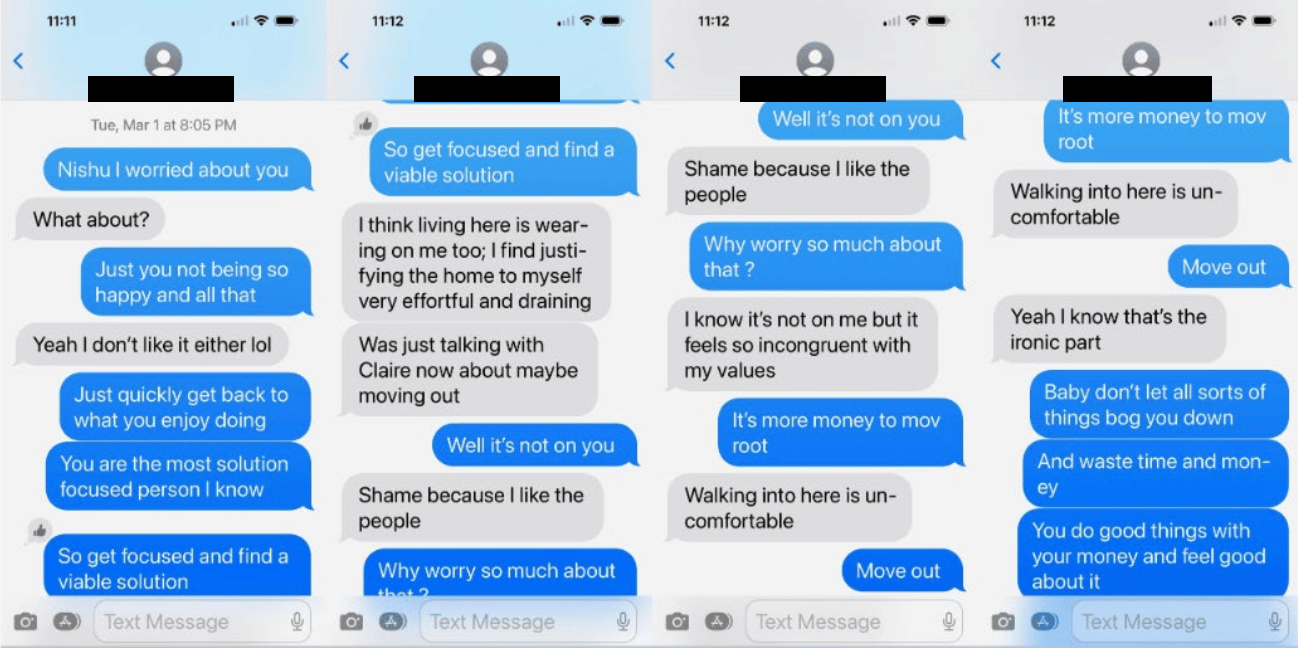
[The phone number in each header has been blacked out by this site. The messages are transcribed below. “Right” is a message on the right-hand side of the screen (the side of the person whose phone it is) and “Left” is a message on the left-hand side. Each screenshot repeats the last messages of the one before it. A thumbs-up mark sits beside the message “So get focused and find a viable solution”. The small symbols at the top of each screenshot and the grey words in the empty entry field at its foot are not typed.]
Screenshot 1 (clock: 11:11). At the top: [WITHHELD BY THIS SITE: telephone number]
Tue, Mar 1 at 8:05 PM
Right: Nishu I worried about you
Left: What about?
Right: Just you not being so happy and all that
Left: Yeah I don’t like it either lol
Right: Just quickly get back to what you enjoy doing
Right: You are the most solution focused person I know
Right: So get focused and find a viable solution
Screenshot 2 (clock: 11:12). At the top: [WITHHELD BY THIS SITE: telephone number]
Right: So get focused and find a viable solution
Left: I think living here is wearing on me too; I find justifying the home to myself very effortful and draining
Left: Was just talking with Claire now about maybe moving out
Right: Well it’s not on you
Left: Shame because I like the people
Right: Why worry so much about that ?
Screenshot 3 (clock: 11:12). At the top: [WITHHELD BY THIS SITE: telephone number]
Right: Well it’s not on you
Left: Shame because I like the people
Right: Why worry so much about that ?
Left: I know it’s not on me but it feels so incongruent with my values
Right: It’s more money to mov root
Left: Walking into here is uncomfortable
Right: Move out
Screenshot 4 (clock: 11:12). At the top: [WITHHELD BY THIS SITE: telephone number]
Right: It’s more money to mov root
Left: Walking into here is uncomfortable
Right: Move out
Left: Yeah I know that’s the ironic part
Right: Baby don’t let all sorts of things bog you down
Right: And waste time and money
Right: You do good things with your money and feel good about it
[End of the image.]
Then came the collapse of FTX – and Nishu with it. When he landed back in the US, I couldn’t get him in my arms quickly enough. I held him as tightly as I could, rocking him back and forth as he wept. I saw his pain pouring out of his eyes as the aftermath of what happened was unbearable for him. He quickly acknowledged his mistakes and accepted full responsibility for his role in what happened. He was [ECF p. 44] riddled with guilt and consumed by shame.
“I’m so sorry, Amma.” I heard him say, over and over, like a broken record. Our family kept a 24/7 suicide watch over him and he remained in a very dark place for months. His brother and I finally convinced him to meet with a psychiatrist who [REDACTED]. Even when he was prescribed medication, he refused to take it at first. He saw his pain as the karmically appropriate response. He couldn’t stop thinking about the people he’d harmed. He only began to take his medication once we convinced him it’d help give him the mental space necessary to fully cooperate with the government and work on making amends for his actions.
Over the past two years, I’ve seen Nishu work tirelessly to help the government agencies with their investigations. He spent so many nights scouring his notes, messages and documents to find any evidence that could be helpful. It was incredibly difficult for him, mentally and emotionally, to look back on what happened, now seeing so much of the history so differently than what it felt like in the moment, but he knew it was important and necessary.
In the early months after the collapse, when he wasn’t working, he was despondent. To help lift his spirits, his wonderful fiance Claire held his hand and took him to volunteer. They found a group that helps the homeless, and going there every week has helped bring him back to life. He started building a new life, volunteering his skills on a project relating to climate change and homelessness, working as a software engineer at a company that adores him, and tutoring a friend’s kids in computer science. After years apart, he is the most attentive and doting son a mother could ask for. He no longer aspires to achieve grand, abstract goals, but he now finds fulfillment through simple actions that improve people’s lives. I see so clearly how this refined focus has helped him rebuild his life with authenticity, and it gives me hope it will help him heal.
I know his life is now altered in a way none of us could ever have imagined, and I know that he has caused real harm, but I still believe that he has the potential to do a great deal of good in the world.
I count my blessings that my son is safe and back with our family. I pray we needn’t let him go. I hope these memories I’ve shared paint a picture of the Nishu I so deeply cherish. Your Honor, I thank you in advance for your consideration.
Respectfully Yours,
Anu Singh
[Letter from Raj Singh (Father)]
August 26, 2024
Dear Judge Kaplan,
My name is Gururaj Singh and I am Nishad Singh’s father. I hope this letter can help provide a view into the thoughtful, sensitive, and hardworking person Nishad is and the values our family holds dear.
I grew up in India in a lower-income home where my grandparents did not have the resources to go to high school and my father could not afford to go to an engineering college. My parents valued hard work and did their best to give me educational opportunities beyond what they were given. After completing my undergraduate degree in India, I was fortunate to get a Regents scholarship for graduate studies at UC Santa Barbara. I came to the US with only a suitcase and $600 in my pocket. After graduating, I began what became a long career in technology that has spanned over 40 years. Anu (Nishad’s mother) and I have worked hard to pass on the values of hard work and gratitude to our own two boys.
Nishad went to college on the same Regents scholarship that I did. When he graduated, he joined Facebook and worked for their Applied Machine Learning group, a coveted team. He planned on donating much of his salary to charity, but told me he thought he could do more.
Several months after he started at Facebook, he was introduced to Sam Bankman-Fried and the company he started, Alameda Research. Nishad was told about Alameda’s goal of donating a significant portion of the profits to EA charitable causes. Nishad was intrigued and began using his weekends and evenings to volunteer on a trial basis at Alameda. Over the next two months as he learned more about the company, Nishad told me he was considering leaving Facebook and joining Alameda.
Nishad talked with me about the pros and cons of making such a big move. At that time, I was not comfortable with him leaving his position at Facebook where he was working on cutting-edge technologies and was being well compensated. However, Nishad took me to visit Alameda’s office to see for myself.
It was clear this group of highly-motivated individuals felt they were on the cusp of an exciting business opportunity. And what made Alameda a great fit for Nishad was their mission to make an impact in the world of charitable giving. If I was Nishad’s age, I could see being drawn to work there, too. I spoke to Sam for a few minutes and found him to be very bright and someone who had the potential to make Alameda successful.
Nishad left Facebook to join Alameda as a junior engineer. At 22 years old, he was the youngest and least experienced member of the Alameda team, and was excited to learn from the brilliant people around him. I knew from my personal experience with startups that this move was risky. On the other hand, I was proud that Nishad was willing to take the chance to work somewhere where he felt more passionate.
Nishad would call me to talk on his drive to or from work at odd hours - sometimes two or three o’clock in the morning - because he put in 14-hour days six or seven days per week. He would speak with amazement about his colleagues, telling me how some came directly from nonprofits, and others were “savants” who previously worked at Jane Street, went to universities [ECF p. 46] like MIT, and were top competitors in math competitions throughout their lives. Nishad is very smart, but he would often tell me their thinking was on another level entirely. Working shoulder-to-shoulder with them made him feel invigorated.
Shortly after Nishad joined, there was a rift between the Alameda founders and half the employees departed. Nishad hadn’t even realized there was tension brewing and was caught by surprise. There were only four engineers left at the company. After a few months, Nishad called me with a dilemma. Sam asked Nishad if he would supervise and grow the engineering team as he needed someone who could provide hands-on management. Sam would set the engineering priorities, Gary would figure out how they should be done, and Sam needed Nishad to handle people-management and training.
Nishad was worried that without prior management experience, and being a junior engineer, he was not equipped for the role. He was inspired by Gary’s engineering talent and preferred to invest in growing his own ability to be more like Gary. I advised him this was wise - I had myself been a hands-on engineer for many years before I managed people, and if nothing else it made me a more capable manager later on. Nishad also has a personality that would make management difficult at such a young age - he had always had a hard time being assertive or confrontational with people older than him.
Nishad said as much to Sam, but Sam persisted. Sam told Nishad that he had the emotional sensitivity and interpersonal skills that were needed for the role. Sam said the company was at a critical juncture and needed Nishad’s help. Nishad listened to my thoughts and concerns with an open mind, but, at the end of the day, he was willing to accept the job and try his best. Nishad knew he had much to learn.
Shortly after becoming a manager, Nishad hired and onboarded three other engineers. He came to me for advice often in this period. Two of the three new engineers flourished. However, one underperformed, and Nishad struggled with the more confrontational aspects of the job including terminating the employee. Only after several months over which I reassured Nishad the employee would be okay in the long run did he eventually ask the engineer to move on from the company. I myself understand how difficult it can be to terminate employees, but Nishad's struggle with making the decision and taking action was particularly tough. At the time, I introduced him to a wise coworker of mine to help him navigate the challenges he faced with the termination process since it was so difficult for him.
Even as he grew as a people-manager, it seemed from our conversations that the hardest parts of his job were not improving. He felt he was isolated and missing the guidance he needed to grow. He wasn’t in regular meetings with the leadership, but felt even more out of the loop because they had moved to Hong Kong. He looked up to Gary and saw him as a genius, but he was often unavailable for days to answer questions. Nishad found it difficult to get the technical guidance he needed. Being responsible for guiding the other engineers only compounded the issue.
I was supportive of Nishad’s decision to move to Hong Kong because of his commitment to his team, but I didn’t know when I would see him next, especially given the pandemic travel restrictions that were in place at the time. So we talked on the phone often. He would do laps around Hong Kong Park and Facetime me, talking about his life abroad and showing me the birds in the park. There was much he loved about working at FTX, and it was a relief to be working beside his team after over a year apart. But over 2020 many of his previous difficulties with the company’s management structure resurfaced.
Nishad talked about how he wanted to provide stability to his engineers, but he needed to stretch himself thin to serve as a buffer from the chaos. Sam would go straight to Gary to handle critical engineering projects, so Nishad needed to figure out what tasks Gary wasn’t going to do to determine what the rest of the team should work on. All the while, Gary was less available to provide guidance to Nishad or the rest of the team. This felt unsustainable to me and did not seem to be an effective way to run an engineering organization. I advised Nishad to speak with Sam. Nishad, defeatedly, relayed to me that Sam reaffirmed that he should focus on taking work off Gary’s plate so he could concentrate on the crucial engineering priorities.
In the summer of 2020, Nishad was able to visit the US. Nishad had adopted a style of management that was focused on supporting his teammates by removing obstacles rather than directing their work. To spare his team the brunt of the unpredictable interruptions, he was the primary on-call engineer. I saw this in real life when I got to hear him take these calls, maybe five times per day or night, and triage technical issues and implement fixes. He showed me the biggest project he had coded himself: a ticketing system for the customer support team, that enabled a way for customers to submit questions, feedback or complaints. The project was impressive and I was proud of his engineering growth. But as he took perhaps his tenth Tums that day (Nishad struggles with acid reflux that gets worse with stress), I could also see the intense workload taking its toll.
On that same visit back, Nishad was offered equity options in the FTX if he forewent any future cash bonuses. We were actually in my apartment when he got the call from Sam telling him about the grant. Over dinner, Nishad relayed the advantages of donating equity over cash that Sam had explained. I had personally been through many difficult financial situations in my life, so I connected him to speak with a certified public accountant to help guide his thinking and provide direction on how to manage his newfound wealth. Nishad had multiple conversations with the accountant and ultimately ended up donating an eight figure gift to a non-profit organization whose mission was near and dear to Nishad’s heart. I admired his generous instincts, but this wasn’t my intention when I connected him to the accountant. I’d hoped he could be persuaded to take a more balanced approach to his giving and save some money for himself and his future.
In November 2021, Nishad was so busy that he couldn’t get away from work so I decided instead to visit him in the Bahamas. Over the course of a few days, I realized he was worn down in a way I had never seen before. On one hand, I appreciated the positive effect he seemed to have on everyone he worked with. However, his work was expanding to impossible levels, and he complained about how there were internal political battles around every engineering project. I was afraid this was an unsustainable work environment and worried about his personal well-being.
Close to a year later, the week before FTX filed for bankruptcy, Nishad called me sounding terrified. He said "Can you come here? I’m scared, I need you." Nishad frequently called me to ask for advice, but I had never heard him like that before. I immediately booked a ticket to the Bahamas, but the situation was very quickly spiraling out of control. I tried to keep in contact with Nishad, but he was mostly unreachable and when he was available he was totally distraught. I was very worried about his safety and the wellbeing of customers, the company’s future, and everyone at FTX. I coordinated with Claire, Nishad’s fiancee, to get them on a flight back home.
I picked up Nishad from the airport when he returned home after the company’s collapse. He was in total shock. It was gut-wrenching to see my child suffering and completely broken, but I held myself together so he knew he had family that he could rely on.
Nishad was a shell of himself, completely destroyed by his guilt. For four months, he was suicidal and our family took turns having someone with him at all times to make sure he didn’t harm himself. Every minute I was not next to him I worried that I would be told by someone that he had just ended his life. I knew I had to put all of my energy towards being there for Nishad, helping him get better and make amends, so I put my job on hold for the next five months to care for him.
Nishad deeply regrets not going directly to the authorities when he learned of the missing customer funds in September. Despite the magnitude of his transgressions, I admire the way he’s owned his past mistakes and I’m proud of how he’s worked tirelessly to do what he can to make things right. Within a few weeks of arriving home, Nishad and I began traveling to New York on a regular basis so he could meet with the Department of Justice and give them every piece of information he had on FTX and its systems.
I know Nishad is deeply remorseful for his role in the FTX collapse. The conversations we have about his hopes for the future tell me that his previous die-hard attitude about doing good have been replaced by something more measured. To him, this means a renewed focus on family, on getting married, becoming a father one day, and being the best friend he can be. He has nurtured his relationships at his new job, and has enjoyed returning to the creativity of engineering. Nishad and Claire visit me each week. We have a routine: we go on walks together, do crossword puzzles, chat about the books he’s reading or the newest health kick I’ve found.
I love my son and I'm happy he’s now pouring his heart into building a simpler life he can still be proud of. I hope the context I provide will help you to appreciate the potential he still has to make the communities around him brighter.
I humbly ask you to consider Nishad’s true character when you decide his fate and ask for your mercy and grace.
With Kind Regards,
Gururaj Singh
[Letter from Rajeev Patel (Stepfather)]
September 10, 2024
Dear Judge Kaplan,
My name is Rajeev Patel and I am Nishad’s step father. In the early 2000s, I began coaching marathons for a non-profit organization, Asha for Education, which raises money to educate underprivileged children in India. Over the last 22 years, I’ve coached over 1,000 athletes. I first met Nishad when he was seven years old and later became his running coach before becoming his stepfather. Over the years, I’ve had the privilege of watching him grow into a compassionate, selfless, and driven young man.
Growing up, Nishad wasn’t the most athletic child, as his asthma often made physical activity challenging. But he approached every challenge with remarkable determination. In 2004, when he was nine, I took him on his first run. Though it was difficult for him, the pride on his face at the finish was infectious.
In 2006, when he was eleven, he completed his first half marathon, and the following year, we ran one together. I watched in admiration as he took the time to personally thank all the volunteers at the aid stations. Nishad’s gratitude has always been one of his defining traits.
By the time Nishad was thirteen, I had developed a passion for ultramarathons, which are races longer than the marathon distance of 26.2 miles, along with his mother. He asked me if I thought he could run a 100-mile race one day. He was embarrassed for dreaming so big, but I could already see that he had the will and determination to make it happen. I told him it would take at least two years of dedicated training, but I would be with him every step of the way.
His training over the next two years involved ramping up to longer-distance ultramarathons. He was an eager student, always respectful of my guidance. He listened carefully, asked questions to clarify, and followed every piece of advice I gave him. He never took shortcuts, and I knew I could trust him to put in the work. Unlike some runners who might stretch the truth about their training, Nishad was always honest—if anything he would underreport his speeds and distances.
I distinctly remember a 2011 incident where he stood up to me for the first time. It was during a very hilly, dusty, and hot 31-mile race that he and I ran. The conditions were not ideal for a fifteen-year old asthmatic kid, but he had been talking about this race for months and had a specific finish time goal in mind. At around 28 miles we came across an older runner who was sitting down beside the trail on a steep, exposed climb and who looked to be in bad shape. We had no cell phone coverage in those hills. I suggested we get to the next Aid Station and ask them to come back to help this runner. In a rare moment for him, Nishad disagreed and insisted on not leaving the runner alone. He asked if I would get help and he would stay. When I came back, I happened upon a scene of Nishad lying beside the older man and giving him riddles to take his mind off the stressful health incident. Nishad went on to finish the event, missed his goal time, and never thought twice about it.
A few months later in his first 50-mile race, Nishad finished a few minutes behind the winner for his age group. The other boy’s father approached Nishad, shook his hand, and said something to the effect of, “You both did well, but my son doesn’t shoot for second place.” Nishad just beamed and said “The race was awesome, he really did well, didn’t he?” I felt Nishad was gracious in overlooking the slight, and, in typical Nishad fashion, shone the light on the other person.
There was something special brewing in this young man. It was quickly becoming apparent that Nishad’s inner fire did not manifest itself as a zero-sum, competitive drive. It was instead always community-focused. He took joy in his victories, but also took real pride in those of others. It made him a uniquely loved figure in the Bay Area ultramarathoning community.
Several months later in August 2011, he completed his first ever 100-mile race at the age of 15, becoming the second person in the US to do so at that age. He raised quite a bit of money for scholarships at his high school while doing so. Ten or so of his friends excitedly cheered him on and took turns pacing him throughout, and together formed a cherished memory they all hold dear to this day.
As Nishad grew older, he naturally gravitated toward helping others experience the same joy he found in running. Here are a few people whose lives were changed.
There was a socially isolated, young girl with developmental challenges who was inspired by Nishad and had expressed to her parents her desire to run. When Nishad learned of this from me, he invited her to do her first ever run with him. He took her under his wing. Even though he was in school and very busy with studies, he would wake up very early at 5:00 a.m. and take her out for a run around the neighborhood before leaving for school at 7:30 a.m. His kindness and patience with her were so beautiful to watch, as he treated her like he would anyone else, though perhaps with a touch more encouragement. She went on to complete a few 50K and 50-mile races. The transformation that we all saw in her self-confidence was so profound that not only her parents but others in the community noticed it.
He would often run from his home to his younger cousin’s after school, encourage them to join him for a few miles, drop them off, and then go to another cousin’s house.
He would ask some of his high school friends to join him at the Sawyer Camp trail before school, where they’d get an early morning run in and look for wildlife in the process.
Through Nishad’s encouragement, all three groups – the young girl, his cousins, and his high school friends – would go on to complete ultramarathons of their own over following two years.
Nishad was perhaps proudest of a young boy named Miguel that he met through another runner. Miguel was just twelve. He, too, wanted to run a 100-miler. Nishad mentored him, picking him up from [ECF p. 51] home and taking him on runs in the same park that would host the 100-miler they’d both go on to attempt.
That summer in 2012, Nishad ran the 100-mile race again, setting a then world record for the fastest 100-mile race for someone under the age of 17: just under 24 hours. Miguel did not finish that year. But he did the next year, at thirteen years of age. Where others might have felt a pang of jealousy at being overtaken, Nishad's heart swelled with pride. He celebrated Miguel's achievement as if it were his own.
We talked often while he was in college. The sweetest kid, he would never fail to thank me for all the formative lessons our running together had imparted. Through the grueling races, Nishad had discovered his unusual capacity for effort and dedication, seeing firsthand how persistence could overcome large obstacles. It became his modus operandi, guiding his approach to college, during which he transformed into a consistent A student, and later, professional life.
Years later, when we visited Nishad in the Bahamas, I saw that same sense of pride and humility in his work. He had built a community there, much like the one he had created in ultramarathoning. He introduced us to the Customer Support section of the office. I saw that same sense of pride and humility as he introduced us to engineers on his team, singing praises of each of them. Some of the older members – the lawyers, accountants, and others – treated him like a nephew, and he even babysat their children. Truthfully, a small part of me was jealous because we all missed Nishad and wanted him back home.
When he did finally return to California, I regretted having ever wished for his return. He was broken. He’s worked tirelessly to make a dent in the harm he has caused and I do not think he will ever forgive himself. But he has found a way to put one foot in front of the other and walk a safe, good path.
Just a few weeks ago (August 2024), at 28 years old, Nishad joined the same race in which he ran his hundred-mile runs. He brought along a new friend he has been training with. They completed a 50-kilometer race: the friend’s first ultramarathon ever, and Nishad’s first in years. I have hoped and prayed that he would return home in every sense of the word, and I feel that he has. I pray that Nishad is given the opportunity to continue on this path and rebuild his life.
Respectfully yours,
Rajeev Patel
[Letter from Malhar Singh (Brother)]
The Honorable Judge Lewis A. Kaplan
United States District Judge
Southern District of New York
September 8, 2024
Dear Judge Kaplan,
I’m Nishad Singh’s younger brother, Malhar, and I’m now 27 years old. It's a strange experience to reflect on my older brother when he was younger than I am now.
My brother Nishad is the most caring and loving person I know. This may sound like an empty phrase, but it’s not – his kindness truly defines him. He’s always been someone who thinks deeply about how others feel, giving people the benefit of the doubt and showing good faith. He’s the peacemaker, the cheerleader, and the mediator.
I’m grateful to have the opportunity to share with you my understanding of Nishad’s hopes and dreams and the motivations behind his actions since he graduated from college in 2017. But most importantly, I’d like to share why I admire him so much for what he has done since FTX’s collapse in 2022.
Our childhood, and how Nishad’s love manifested at an early age
We grew up in a shared home with our cousins, aunt, uncle, and two other family friends, learning early the importance of community and sharing what we had. Nishad had a deep sensitivity to the suffering of the people around him, especially after our trips to India as young children where we witnessed poverty up close. It stuck with him in a way that I think it didn’t with the rest of us. He would be the first of us kids to ask our parents to get food for an unhoused person he saw in San Francisco.
When Nishad was in middle school, we learned more about our parents’ upbringings. They had humble beginnings and their paths to the US seemed so unlikely and fortuitous. Nishad appreciates the opportunities he and I enjoy because we were born in this country, along with the responsibilities we have to give back as a result.
In high school, Nishad and I participated in Model UN together. While most other students wanted to debate in prestigious mock committees like the Security Council, Nishad always opted to join the humanitarian-focused committees – it’s where his heart was.
During this time, Nishad read Jonathan Safran Foer’s Eating Animals. I remember one afternoon after school watching him slowly flip through a multi-page visual section of the book, where each page was filled with dots, each representing a factory-farmed animal that the average person would eat in their lifetime. The book made a profound impact on Nishad. After reading it, he changed his diet and became a vegetarian. I eat meat to this day and never worry about his judgment. I know that Nishad’s decision to change his diet came from a deeply sincere and personal place.
College and beyond: navigating adult life
Nishad’s work ethic wasn’t always something to write home about, but a flip switched in him after he started running ultramarathons. It was as if he finally realized how much more he could accomplish if he applied himself and worked hard. Over time, I’ve come to see this characteristic as the second most remarkable thing about him (after his kindness). Nishad is extraordinarily dedicated and can put everything into achieving a goal once he sets his mind to it.
Nishad had never coded in high school. At one point, he was even discouraged from taking the high school computer science class because he wasn’t on the advanced math track. So it was unexpected when in college, through his hard work, he found a home in one of the school’s most demanding majors, computer science and electrical engineering.
Nishad often told me how beautiful he found computer science and, ultimately, he inspired me to major in it when I was in college, too. He graduated with “highest honors,” which earned him a spot in a special part of the graduation ceremony. However, he proactively opted out because he preferred to hang out with his “study friends,” to whom he credits much of his college success. In reality, I’m certain it was because he didn't want to place himself above his friends in any way.
Life at Alameda and FTX
During his time at Alameda and FTX, Nishad was logging 14 to 16 hour days and, much of the time, he slept in the office under his desk. In 2018, I visited Nishad in the Berkeley office. I remember being both impressed and intimidated by everyone’s multi-screen setups and the fast-paced trading action in the office. We had lunch together that day and he told me that he totally sympathized with feeling intimidated, and he felt lucky to be working with so many brilliant people.
After that visit, we talked about how he missed learning about and being engaged with the details of the causes he cared so much about. At one point shortly thereafter, he even applied to and went through a rigorous interview process at a nonprofit that made grants to effective charities. The job was not necessarily a great fit for his training – it was entirely nontechnical – but their mission was something he cared deeply about. The job would have paid about ten times less than he was making at Alameda, but after receiving the offer he was still an inch away from accepting it.
I understood why Nishad opted to turn down the job at the nonprofit. He explained that when he mentioned to Sam that he was considering leaving Alameda, Joe Bankman (Sam’s Dad) had a conversation with Nishad and convinced him that Alameda really needed him, at least for another year. At his core, Nishad is a people person whose deeply compassionate nature compels him to serve where he feels he is most needed. So he stayed, but he also remained on good terms with the nonprofit, often turning to them for advice on charitable donations he was considering.
Another admirable thing about Nishad is his genuine humility. As FTX grew and became widely popular, Nishad was uninterested in seeking any kind of recognition for his role in their success. He declined to do media interviews or participate in rankings like the Forbes 30 Under 30 list, which recognizes top young entrepreneurs. Even as his brother, I’d only find out about the company’s amazing growth through the news or conversations with our friends. Garnering attention for himself is just not part of Nishad’s DNA.
Filling his heart: the most generous person I know
I think what makes Nishad truly extraordinary is his selflessness, the fact that he’ll do things to help others without regard to his personal and financial well-being.
I remember one story Claire told me when I was catching up with her after she and Nishad moved to Hong Kong. An engineer that Nishad adored moved to Hong Kong but quit because he chafed with the personalities there. As part of the engineer’s exit, in lieu of paying his prorated bonus, Sam agreed to donate a large amount of crypto to a charity of his choosing. When the time came, the engineer reached out to Nishad, and Nishad requested Sam make the donation, but was repeatedly ignored. So Nishad used his own money to fulfill the promise and updated the engineer that the company had completed the donation. I asked him why he did this, or why at the very least he didn’t tell the engineer who really paid. Nishad told me, “[The ex-engineer] already likes me; why make him feel even more aggrieved at the company?”
It continues to blow my mind that Nishad gave away nearly everything he took home from Alameda and FTX despite the extraordinary wealth he attained. What kind of person would do that? Even the most well-known philanthropists you read about make sure they pay themselves first. Not Nishad.
Visiting Nishad and FTX in the Bahamas
After FTX moved to the Bahamas, my girlfriend and I got a chance to visit Nishad and Claire in 2022. I was excited to see him and meet his fellow engineers, who I’d heard so much about. When we arrived, it quickly became clear Nishad was uncomfortable with the luxury condo.
One evening we joined Nishad’s housemates in their apartment for some dinner being made. The table was divided: on one side, Sam and the others were having a discussion; on the other side, my brother, Claire, my girlfriend, and I were having a separate conversation. When Nishad tried to join the other conversation, his attempt was briefly acknowledged, but then ignored. We left shortly thereafter to spend time more comfortably elsewhere with Nishad’s friends – the people Nishad and Claire usually hung out with. He really did like some of his housemates, but outside the apartment, I felt him relax and be himself, and I felt more comfortable as a result.
On that trip, we had some of the meaningful and joyful moments I sorely missed from our time apart. But I left agreeing with my mom’s impression from her earlier visit: that Nishad was embedded and committed to the company, but wasn’t happy, and wasn’t at home.
The FTX collapse and its aftermath
I will never forget first seeing Nishad when he got back from the airport in November 2022. He couldn’t speak or even hug me back when I embraced him. When he finally found his voice, all he could say was, “I’m so sorry,” “I can’t believe how much this is going to hurt all of you,” and “we’ve hurt so many people.” I think he was in shock. We all were.
As he finally began to speak more, his horror about the magnitude of the situation became clear and he was consumed by remorse. For a long time, Nishad couldn’t face most of our family or close friends. He was deeply ashamed, and when he did finally begin to see people, all he could do was apologize.
In those early days after the collapse, I barely left his side. I remember him taking a call with the bankruptcy estate describing what it'd take, technically, to reboot the exchange. When he was called in to help triage the hack that occurred shortly after the collapse, he and Claire urgently called their old coworkers, asking about their safety in case they were being physically threatened into draining funds. In those days, when Nishad wasn't actively helping, he was in despair.
When the government engaged Nishad’s help, it gave him a renewed sense of purpose. Even if he couldn’t solve FTX’s problems directly, he could help them understand FTX’s engineering systems and provide whatever information he could.
As the months passed and Nishad’s mental health stabilized, he started volunteering and providing care to others in the hands-on way he had missed for so long. He now volunteers at a homeless shelter and has contributed hundreds of hours of coding to an affordable and sustainable housing non-profit. Nishad feels best when he’s helping others and being able to do so has helped him live again.
My hopes for Nishad
Nishad understands the gravity of his wrongdoings. I know he’s aware of the long-term consequences he will continue to face – his ruined reputation, the lawsuits, and the personal and professional setbacks that will follow him for years to come. He’s forfeited all of his assets willingly and is coming out of this experience without any gains from his time at Alameda and FTX.
As his brother, I believe he’s dealt with his mistakes with dignity and I’ve seen first-hand how this experience has changed him. He wants to focus on individual, hands-on projects that are meaningful to him and his communities. This isn’t just a hope, it’s actually what he is doing, and what I believe he will continue to do going forward. Nishad has found the spirit to live instead of simply crumpling into a ball or worse. In the months immediately following the collapse, I wasn’t sure he’d ever get to this place.
These days, we see each other all the time. Nishad was worried that I would be socially ostracized because of his actions, but that hasn’t been the case. My housemates love it when he stays over, and Nishad loves hosting them over the weekends in the apartment where he lives. I am so proud of him and I’m incredibly lucky to have him as my big brother.
As you consider Nishad’s future, I humbly ask you to consider not only the person he was when he made his serious mistakes, but also the person he is now and the person he’s striving to become in the future.
Thank you for your time and consideration.
Sincerely,
Malhar Singh
Letters from Teachers and Professionals
[Letter from Alan Waters (Accountant)]
July 18, 2024
Dear Judge Kaplan:
My name is Alan Watters. I'm a CPA specializing in tax planning for high-net-income and high-net-worth individuals and families. Based in San Francisco, I have had the opportunity to work with many successful technology start-up founders over my twenty-three years in practice. I first met Nishad over a Zoom call in 2020 during the COVID-19 pandemic. In many ways, he resembled other successful tech founders I have worked with young, smart, energetic, and idealistic. However, what immediately stood out to me about Nishad was his remarkable generosity.
Typically, founders I work with initially focus on securing their personal needs by selling enough founder stock to buy a house, an expensive car, or to have cash reserves in case of market downturns. Only after fulfilling these needs do they consider charitable planning. Nishad was different. Our discussions centered around charitable donations from the start, and I helped him make a sizable contribution to a local community foundation. Nishad has a kind heart, and his core is inherently generous.
I am writing to request leniency for Nishad. He is a very intelligent engineer who, I believe, naively fell in with the wrong crowd at a young age. Given the opportunity, I am confident Nishad can positively contribute to society.
Thank you for considering my perspective. If you have any questions, please feel free to call or email me at [WITHHELD BY THIS SITE: email address].
Sincerely,
Alan Watters, CPA
[Letter from Norm Epstein (Wealth Management Advisor)]
September 6, 2024
Dear Judge Kaplan,
I am a wealth management advisor who had my first opportunity to meet with Nishad one-on-one about 7 years ago. He was just beginning his professional career. We met at the request of his dad. The purpose of our meeting was to educate him about savings and investing so that he could become financially independent. What struck me early on our conversation was his preference to help others financially almost to the detriment of his own financial well-being. Whenever I would encourage him to understand the benefits of fully funding his 401k and setting aside more money for taxable investing, he would counter with how it was more important to give away that same money. His only motive was to benefit others. Enriching himself was not his goal nor desire.
This same desire to benefit others was made clear in a subsequent email that he sent me in October ’21. He wanted to set up a call to learn about how he can give away his wealth and Donor Advised Funds (DAF). His objective was stated as follows…”In the end, I want to donate ~all of what I have; I don’t care too much about the distinction between 95, 99, 99.5%, etc, but definitely don’t want the suggested approaches to assume I mean only 50%.”
He stated that he wasn’t seeking the limelight or public praise. The ability to give anonymously through a DAF was therefore a feature to him. He only wanted to talk about giving and went as far to state the following in that email in advance of the call:
“Topics I don’t want to discuss:
Preserving long-term wealth
Making sure enough is set aside for relevant milestones in my life
Remaining hedged against bad outcomes for crypto/etc / having a balanced portfolio.
Most of all, I want to communicate that I don’t care about wealth management in the standard sense.”
I hope these insights give you a solid view into Nishad’s heart.
Sincerely,
Norman A. Epstein
[REDACTED]
Hillsborough, CA 94010
[WITHHELD BY THIS SITE: telephone number]
[Letter from FTX MDL Plaintiffs (Counsel for FTX MDL Plaintiffs)]
October 14, 2024
Honorable Lewis A. Kaplan
United States District Judge
Daniel Patrick Moynihan
United States Courthouse
500 Pearl Street
New York, NY 10007-1312
Re: United States v. Samuel Bankman Fried, Nishad Singh
Dear Judge Kaplan,
We represent the putative class of FTX customers who filed suit against FTX Insiders, including Ms. Caroline Ellison, Mr. Gary Wang, and Mr. Nishad Singh, as well as the venture capital firms, law firms, accounting firms, banks, and other third parties alleged to have aided and abetted the FTX fraud in In re FTX Cryptocurrency Exchange Collapse Litigation, 1:23-md-03076, a multidistrict litigation pending in the Southern District of Florida (the “MDL”).
Mr. Singh has provided valuable assistance to the MDL Plaintiffs, and we write to inform you of his cooperation. To date, he has met with MDL Counsel for several hours, and has agreed to as many as ten additional meetings with MDL Counsel, to answer questions and to provide information helpful to MDL Plaintiffs’ cases against alleged third-party aider-abettors. In those meetings, Mr. Singh has expressed sincere remorse for the role that he played in the FTX fraud and for the harm that he may have inflicted on MDL Plaintiffs.
The information that Mr. Singh has provided to MDL Counsel thus far has proven very helpful to MDL Plaintiffs’ cases, in that the information not only substantiates, and supplements, the allegations set forth in MDL Plaintiffs’ complaints, but also should assist in defeating certain MDL Defendants’ jurisdictional defenses. For example, Mr. Singh shared with MDL Plaintiffs testimony supporting MDL Plaintiffs’ allegations that the FTX fraud emanated from Florida, including that:
• Several members of FTX’s payments team were based in the greater Miami area.
• After FTX US acquired Miami-based Blockfolio in mid- to late-2020, many of FTX’s publicity campaigns, including its many celebrity partnerships, generated from Miami.
• Later, in mid- to late-2021, FTX acquired Ledger X, which was also based in Miami, offered advantages such as licenses and technology that allowed FTX US to engage in futures trading, which, in turn, would have made the investment in FTX more attractive to investors.
MDL Counsel hopes that this Court will consider Mr. Singh’s expressed remorse and significant assistance to MDL Plaintiffs in rendering his sentence.
Respectfully submitted,
By: /s/ Adam Moskowitz
Adam M. Moskowitz
Florida Bar No. 984280
Joseph M. Kaye
Florida Bar No. 117520
THE MOSKOWITZ LAW FIRM, PLLC
Continental Plaza
[WITHHELD BY THIS SITE: street address]
Coconut Grove, FL 33133
Office: [WITHHELD BY THIS SITE: telephone number]
[WITHHELD BY THIS SITE: email address]
[WITHHELD BY THIS SITE: email address]
[WITHHELD BY THIS SITE: email address]
MDL Co-Lead Counsel
By: /s/ David Boies
David Boies
Alex Boies
Brooke Alexander
BOIES SCHILLER FLEXNER LLP
[WITHHELD BY THIS SITE: street address]
Armonk, NY 10504
Office: [WITHHELD BY THIS SITE: telephone number]
[WITHHELD BY THIS SITE: email address]
[WITHHELD BY THIS SITE: email address]
[WITHHELD BY THIS SITE: email address]
MDL Co-Lead Counsel
[Letter from Katie DeVaul (Psychiatrist)]
KATHERINE DEVAUL, M.D.
CHILD, ADOLESCENT, AND ADULT PSYCHIATRY
[WITHHELD BY THIS SITE: street address]
LOS ALTOS, CA 94022
TELEPHONE: [WITHHELD BY THIS SITE: telephone number] FAX: [WITHHELD BY THIS SITE: fax number]
July 13th, 2024
Judge Kaplan,
I am submitting a character reference for Nishad Singh. [REDACTED]
[REDACTED]
[REDACTED]
[REDACTED]
[REDACTED]
Sincerely,
Dr. Katherine DeVaul
Private Practice
[WITHHELD BY THIS SITE: street address]
Los Altos CA 94022
[Letter from Jeff Nichols (Teacher)]
August 28, 2024
Dear Judge Kaplan,
I am writing this letter on behalf of Nishad Singh who stands before you for sentencing. The German poet Johannes Von Goethe once wrote, “You can easily judge the character of a man by how he treats those who can do nothing for him.” Based on Goethe’s assessment, Nishad Singh’s character is beyond reproach.
I first met Nishad as a brilliant, compassionate, and empathetic 11-year-old student in my 6th-grade Humanities class. Among his peers, Nishad always stood out with his measured comments during class discussions, and accommodating nature during projects and field trips. It is not hyperbole to say that Nishad is one of the nicest people on the planet. To know him, you immediately recognize that he radiates goodness and compassion in a world where many of us are battling not to succumb to the bleakness and cynicism that surround us daily. In short, Nishad cares deeply about animals, and those less fortunate than himself. Nishad has from a young age recognized his privilege and to try to help those less fortunate than himself. As an 8th grader, Nishad was on a field trip with his class in San Francisco when he encountered an unhoused individual., In a moment he likely thought nobody noticed, he hung behind the class and gave the individual his lunch money for that day. This act is representative of Nishad’s generous nature and true character.
We lost touch during his high school years and when he was an undergraduate student at U C Berkeley. Luckily, Facebook allowed us to reconnect around the time he got his first job, ironically working as an Engineer at Facebook. At this time, I had asked Nishad to present to my class during our Computer Science week. Unfortunately, he was not able to do the presentation because he did not want to let down his team. Not surprisingly, this is another example of Nishad putting the needs of others above his own. After several conversations with Nishad who had metamorphosed into an accomplished adult, we were forced to switch our modes of communication to WhatsApp once he became an expat in Hong Kong. During WhatsApp phone conversations, I felt an enormous amount of warmth and curiosity from him, as he asked about my experiences teaching and humanitarian trips to Rwanda. He had retained all the intellectual humility he showed in his early years.
Nishad always sees the good in mankind. During the eighteen years I have known Nishad, I have never heard him say anything dismissive, insulting, rude, or condescending to or about anyone. Nishad is bright, and to his credit, he does not use his intellect as a weapon against the vulnerable in society. I am honored and proud to say that in my 31 years of teaching at independent schools, Nishad is one of the very few students who have welcomed me into their lives as adults. This is a privilege that I do not take for granted. I humbly request that you provide Nishad with as much leniency and compassion as possible. Regardless of his ultimate fate, I feel proud to call him a former student, mentee, and friend.
Sincerely,
Jeffrey Nichols
7th-grade Global Perspectives Teacher
Latin School of Chicago
[Letter from Simon Olavarria (Teacher)]
Character Letter for Nishad Singh from Simon Olavarria
Dear Judge Kaplan,
I’ve known Nishad since he was 12 years old. From his middle school years until his high school graduation, I was Nishad’s teacher in ethics, debate, international relations, and current events. I also had the opportunity to hire Nishad as an intern for our summer debate programs. Additionally, I have known Nishad as an adult.
Nishad has always been characterized by his kindness, hard work, and concern for the common good. For our end-of-year culmination event in 2013, Nishad was chosen to deliver a speech on a topic of his choosing to our students and parents. I distinctly remember how Nishad chose to elaborate on a metric seldom used in international relations: the Gross National Happiness index developed by the nation of Bhutan. Throughout the development, practice, and delivery of his speech, I was reaffirmed in something I already knew about Nishad: that he cared deeply about the common good and that he would likely devote his life to it. His speech selection was not a random choice; it was an expression of the life he lived and the heart he was endowed with.
Unsurprisingly, Nishad fostered his vocation toward the common good throughout his college years and into his professional life, becoming a well-known exponent of Effective Altruism. For those who met him later, this might have seemed like the idealism fashionable among many young people in technology; for those who knew him since he was a pre-teen, it was clear that this was a continuation of who Nishad always was.
I have also had the opportunity to witness how Nishad treats people. As an older brother to Malhar (also a student of mine), Nishad was kind, generous, and a wise mentor. He was a responsible and caring son to his parents, Anu and Raj. As a high school teacher-intern, he was responsible, patient, enthusiastic about people’s progress, and the kind of guide who does not lose hope in others. He has also been a faithful friend to those close to him, and an example of achievement and social glue for his extended peers. Finally, his determination to achieve something great for others is inspiring, such as when he ran ultramarathons to benefit causes.
In the near decade and a half that I have known Nishad, I have nothing but good things to say about his character, and I hold high hopes for his future.
With love for Nishad,
Simon Olavarria
September 8, 2024
[Letter from Gerlicelda Rudas Benag (Former Cleaner and Dogsitter)]
Good Day Judge Lewis Kaplan,
I am writing this letter on behalf of my former employer Nishad Thirumale Singh. This gentleman I work for him and his family as family house cleaner and to take care of his gentle giant dog name Gopher in the year of 2021 and 2022 in Hong Kong.
I move away from my family in Philippines to Hong Kong for work 11 year ago. I work for 3 other employer before Nishad Thirumale Singh and his family.
When Nishad Thirumale Singh left for Bahamas, I felt heartbroken I lost my very good employer who treat me like family. He very kind very generous and have a good heart. Also very hardworking man who work long hours but still have time to say hi! and ask if im ok?
Nishad Thirumale Singh is the best of all the employers I work for in Hong Kong. After he move he even have time to message and update me about gopher. He promise me that he always keep in touch with me. After his busy day he still have time to do his promise. That I never experience with any employer I ever had. Nishad is very good with all of the positive characteristic as human he have.
I ask if there was anything I do to help. I hope this short letter will help to know him and that he is a good person. I see Nishad heart and always pray for him. I pray for you too Judge Lewis Kaplan.
Regards,
Gerlicelda Rudas Benag
JULY 7 2024
[Letter from Charles Dunford (Physical Trainer)]
Dear Judge Kaplan,
My name is Charles Dunford and formerly a personal trainer to Nishad during the time that he worked in Hong Kong. I came to know Nishad during the early days of Covid 2020 when I started to provide personal training services to him, on average I would see him one on one for around 3 hours per week.
Nishad and I became friends and he in particular was fundamental in helping me build a client base to get me through the difficult covid experience that the Hong Kong Government had created for the fitness industry. This was more than kindness on his part; it was a concrete effort to introduce his friends and coworkers to me.
Nishad had shown a genuine interest in me and why I was still working at an age when most men would have retired. I formerly was a private banker, but after that I went into business with a friend and ended up in debt. He could have looked down on me but he did the opposite and I am very grateful for the friendship and support he gave.
As you consider Nishad's situation, I hope you will consider the aspect of his character that I have personally experienced.
Thank you for considering my testimony on Nishad's behalf. I am sure that he will continue to make a positive contribution to society, and I am honoured to stand by him.
Yours respectfully,
Charles Dunford
[WITHHELD BY THIS SITE: telephone number]
6 MAY 2024
Letters from Volunteering Community
[Letter from Andy McCabe (Manager, Gubbio Project)]
09/14/24
Dear Judge Kaplan,
I’d like to start by introducing myself. My name is Andy McCabe, and I’m the manager of a small non-profit here in the Mission. I’ve been in the nonprofit world for almost seven years now. I experienced homelessness myself, and thanks to city services, non-profits, and kind people who cared about what happened to me, I was able to turn my situation around. I found purpose in my life and was able to regain most of what I had lost. Now, I try to share my story with others, not only to give them hope but to show them that it is possible to break out of this terrible cycle of despair.
At Gubbio, our aim is not only to serve people experiencing homelessness, but we also try to help those who don’t quite fit into other programs in the city—such as people who get kicked out of other places due to severe mental illness, extreme hygiene issues, or other behavioral challenges. Sometimes our guests can be a handful, and often, it can be overwhelming for our volunteers.
Nishad reached out to me a little over a year ago via email, inquiring about volunteering with our program. He began by helping serve coffee and chatting with our guests. I first noticed that he was a little different from many of the volunteers I see. Most serve coffee and snacks for a few hours and then leave, but Nishad, even after his shift was over, would frequently stay to engage with our guests. Sometimes I’d see him listening and having conversations with one of our guests until we closed.
As time passed, I began to build a friendship with Nishad. He was kind, thoughtful, and truly enjoyed helping others. He has a curious mind and asked me all sorts of questions about how we operate at The Gubbio Project, what hurdles we face in the non-profit world, and how he could be of more help than just serving coffee. In my experience, people sometimes say this, but they aren’t always committed to following through. Nishad, however, was persistent. He kept checking in with me about how he could be more helpful beyond just serving coffee.
I shared some of the difficulties we’ve had in securing grants and other sources of funding. Since we’re a smaller program with limited staff, it’s not always easy to record all of our engagements and interactions with guests. Within about a week and a half, Nishad came up with a great idea: instead of using paper sheets to track how many people we engage with, what services we provide, and transferring that information from staff member to staff member [ECF p. 72] for input into a database, he suggested we try using an app. Not only was that a wonderful suggestion, but Nishad went even further and created it for us.
He developed an app that every staff member can access on their phone. When they engage with someone, they can just click a few checkboxes, and all the information is recorded automatically. This was a game-changer for us. Our staff quickly adopted the habit of recording everything now that it was on their phones. To date, we have a year’s worth of amazing metrics, which have enabled us to secure grants and attract new donors. For a small non-profit like The Gubbio Project, this is HUGE. It allows us to keep expanding our programming and finding new, exciting ways to engage with people.
I’d like to share another story about Nishad being the AMAZING human he is, and going above and beyond what we ask of our volunteers. Just for context our volunteers typically help serve our guests by serving coffee and snacks for 2 hours once a week. Many of our guests are regulars who come every day, and we engage with them over extended periods of time (sometimes months or years) to help them improve their situations. One of our guests, whom we recently helped get off the streets and into housing, had a serious infection. He could barely walk and was in extreme pain. He was hesitant to go to the hospital because of how people experiencing homelessness are sometimes treated by hospital staff. Often, they aren’t taken seriously, their pain isn’t managed, or they are brushed off with advice like “just take Tylenol.”
This guest had a severe case of cellulitis in both legs. They were swollen to three times their normal size, and he had to wear giant sweatpants that we gave him after cutting off his old pants. He also had a high fever of 102 degrees. We were worried that when he got to the hospital, he wouldn’t get the treatment he needed and deserved. Nishad went out of his way not only to take him to the hospital himself but also to stay by his side for several hours as an advocate. To be clear, this isn't something we had asked Nishad to do (or would ever ask a volunteer to do). He regularly has conversations with John and after John had told him that we were going to try and get him to the hospital, Nishad came to me and asked if it would be appropriate and/or possible if he could ensure John makes it by taking him there and being an advocate while he was there. Our executive director Lydia and I were both stunned, but amazed and grateful that he would go so far to help John get the care he deserved. While at the hospital, Nishad He made sure John ate, had everything he needed, and stayed focused on remaining in the hospital to get the care he needed. Sometimes, when you’re used to being treated like a second-class citizen, you feel defeated, and if you feel like the nurses and doctors aren’t helping, you give up. Nishad stayed with him, helped him verbalize his needs, and advocated for a level of care that all people should receive.
After this incident, John eventually got better, and we were able to get him into semi-permanent supportive housing. We got him off the streets. Meeting someone as kind as Nishad has been a blessing. He truly cares about helping people, showing patience and kindness above and beyond most people I’ve met, with a real desire to make a difference.
I’ve really grown to care about Nishad, not just as someone who volunteers at my program, but as a truly, genuinely kind human being.
Andy McCabe
Program Manager
The Gubbio Project
[WITHHELD BY THIS SITE: street address]
94103, San Francisco CA
[WITHHELD BY THIS SITE: telephone number]
[Letter from Brendan Taliaferro (Founder, Homeward Initiative)]
26 September 2024
Brendan Taliaferro
Dear Judge Kaplan,
I’m writing to you on behalf of Nishad Singh, a collaborator and friend of mine. I met Nishad two years ago through his younger brother Malhar, whom I befriended during undergrad. Malhar is widely regarded as a uniquely kind, thoughtful, and generous person in our community, and I was shocked to find in his older brother a person who matches his character and in certain ways exceeds it. Nishad is selfless in such a rare and special way, particularly for someone of his incredible talent.
Nishad and I began working together in 2023. My background is in homelessness advocacy and affordable housing development: I led the creation of a community-based housing program for LGBTQ homeless youth in Philadelphia after I graduated in 2019, then built a boutique real estate development and operations company that provides housing for single mothers in Newburgh, New York. My highest priority in my work has been to best leverage my privilege to improve the lives of those around me, which is what Nishad and I connected immediately and deeply over when we met.
In that vein, I reached out to Nishad last spring because I was looking for guidance on an idea for an affordable housing-related software project. Not only did he give me thoughtful, insightful feedback, he also volunteered to help me build the product. Amidst an extremely difficult and stressful time in his life, he has proven to be single-handedly the kindest, most supportive, and most capable person I have ever had the privilege to collaborate with.
In essence, our project focuses on identifying "climate havens"— geographies and communities that are most resilient to the intensifying impacts of climate change. As rising sea levels, larger wildfires, and extreme heat waves become more common, the United States is likely to witness the largest internal migration in its history. Current estimates project that anywhere between 15 million and 100 million people could be displaced by climate impacts by the year 2100. They will lose their homes, their livelihoods, and their connection to community. It is imperative that we proactively prepare for this impending disruption by directing our resources and funding for affordable housing and urban development towards the most climate resilient communities in our country.
Resilient communities in the U.S. can be compared to the biblical story of Noah’s Ark -- places we can go to endure chaos wrought by environmental destabilization. If we invest proactively in building housing and other infrastructure in these areas, we can create enough “arks” to accommodate the communities impacted by climate disasters. If we fail to do so, the limited space in safe havens will go to the highest bidder, and millions of displaced people will find themselves with nowhere to turn.
This is where our Climate Haven Index comes into play. Its mission is to empower climate-resilient communities to attract investment and plan for sustainable, equitable growth. We're equipping local leaders with actionable climate data to highlight their community’s advantages and redirect public and private funding toward the most resilient areas. Ultimately, this project aims to catalyze the intentional shift of housing and development resources to the safest regions, moving people out of harm’s way before disaster strikes. You can explore the latest version of Nishad’s outstanding contributions to this project at https://climate-trajectory.org.
When we began working on the project, I knew exactly nothing about data-related work. With Nishad as a most generous and patient teacher, I have gained a data literacy previously unimaginable as a student of literature with a fear of numbers. Before I grasped the basics of data formatting, he quietly put in countless extra hours of work cleaning and reformatting data I uploaded. He has voluntarily given me hundreds of hours of his time in the last eight months, working on top of a full-time software engineering job. According to various potential grantmakers, university departments, and real estate developers, the quality of his work equals or surpasses their current solutions and available alternatives. We are currently running user tests to further develop the product, and everyone we’ve shown it to has been incredibly impressed by the quality of the database Nishad has built - particularly given that he’s done it for free.
While significantly advancing my project he insists that I am the one helping him, by providing him the opportunity of meaningful work. He calls it his “food for the soul” and talks about how good it feels to get back to using his skills for good. Nishad lives on a street with an active construction project that will create hundreds of units of low-income housing. He tells me that he loves walking by it every day, watching its progress, and thinking about how our efforts may one day help make it easier to build many more instances of affordable housing in the future.
Beyond his talent and selfless dedication to our work, Nishad’s kindness and support has been pivotal to my sense of self-efficacy and possibility. From the first time I shared a fuzzy and vague outline of my aspirations, Nishad has been an invaluable investigator of the mechanics of the project and a cheerleader of its value. I feel that he genuinely believes in our work and in me, and that belief has helped me avoid the pitfalls of self-doubt that often trip me up. Having the support and buy-in of Nishad - who I know firsthand to be incredibly intelligent and dedicated to helping others - has given me faith that our goal is worth reaching for, even if we fail. Coming to know and work with Nishad has proven to be one of the greatest gifts and opportunities of my professional life, and I am grateful every day for what he has made possible.
I cannot emphasize enough how clear it is to me that Nishad’s highest values are service, integrity, and fellowship. I feel incredibly fortunate to know him, both as a friend and collaborator, and I have absolute confidence that the world will be a better place with him applying his remarkable intellect and exceptional character to make a meaningful impact.
Sincerely,
Brendan Taliaferro
Founder, The Homeward Initiative
[Letter from Marie O’Connor (Volunteer, Gubbio Project)]
7/1/2024
Dear Judge Kaplan,
For the past year and a half, I have been volunteering at The Gubbio Project, a non-profit endeavor housed in St. John the Evangelist Church on 15th and Julian in San Francisco’s inner Mission District. Gubbio offers daytime sanctuary in the church itself, where unhoused people can safely sleep, as well as an outdoor courtyard with offerings of coffee, tea, and simple food (pastries, fruits, pizza, etc) to those who are seeking safe shelter. I volunteer as one of the courtyard servers every week.
Another volunteer I see there most days is Nishu. I didn’t know Nishu before I began volunteering at Gubbio. At least as important as the simple offerings of safe sleep, and simple food and drink, is the manner in which they’re offered by volunteers and staff. A friendly, non-judgemental, kind regard matters enormously to those unaccustomed to experiencing it elsewhere. The population we serve are more familiar with being ignored, and worse. I’ll be 69 years old before the end of July. I’ve lived in San Francisco since the beginning of 1976: I remember the City before the crisis of homelessness began to grow in the late 80’s, so I know personally that homelessness is largely a consequence of conditions rather than of human beings who are subject to them.
Our society seems a long way from coming to terms with these conditions. In the meantime, we are left with responses such as the Gubbio Project, which although do not solve homelessness, do offer some genuine compassion and respect for our terribly many brothers and sisters who live unsheltered. There are many people who visit Gubbio for a little breather. Some are regulars I’ve come to recognize and “know” to some degree, others come and go and are not seen again. All are given welcome, and some, after repeated experiences of friendly regard, begin to let down their guard, and seek help from staff to begin the process of connecting to services beyond those that Gubbio can offer.
Nishu, one of the very few younger volunteers at Gubbio is instrumental in offering this kind, humane regard. I’ve never seen him be anything other than gracious to the guests of Gubbio. He’ll often sit and talk and listen to those we serve, as they sit on one of the benches or chairs in the beautiful courtyard. He even recently drove one of the “guests”, a young man with long untreated cellulitis to the hospital clinic. Nishu called ahead to make sure our Gubbio guest was handled by a team known for their compassionate treatment of drug users. Nishu assisted with check in and stayed with him in the lobby for several hours until he was admitted. This man had been afraid to take that step himself, until after being able to trust Nishu, through the rapport built together week after week—to begin at least, the journey into much needed basic health care.
This is only one anecdote describing Nishu’s essential character, and his patient commitment to making a positive difference in a very concrete way for our most vulnerable neighbors. If this wasn’t something genuine about Nishu, he wouldn’t continue to volunteer week after week: and I know that when his work schedule conflicts with Tuesdays, he volunteers on a different day of [ECF p. 77] the week. Nishu gives me hope that our young adults really do care about our basic human needs for food, shelter, health care, and respect.
I worked at St. Anthony Foundation from 2000-2020. Our ED, Barry Stenger used to say “We don’t give people dignity; dignity is from God, innate.” It’s our ‘job’ to recognize each other’s dignity, even in very distressing conditions. Nishu recognizes this dignity of each person served. We need Nishu-his example, his influence. This regard cannot solve all our problems, but it sure does make them easier to face, and gives those most lacking in their daily lives, a respite.
Sincerely,
Marie Clare O’Connor
Letters from Extended Family
[Letter from Pam Watanabe (Future Mother-in-law)]
August 9, 2024
Dear Judge Kaplan,
I am writing to offer my wholehearted and heartfelt support regarding the character of Nishad Singh, my daughter’s fiance.
As a mother, my daughter Claire and her brother hold the most sacred place in my heart. Her father and I have strived to instill in them the values of integrity, kindness, and trustworthiness. Fred Rogers' words, "It’s not the honors and prizes of life which ultimately nourish our souls, it’s the knowing that we can be trusted," resonate deeply with me, and I have watched my children grow guided by these principles.
Since 2015, I have had the pleasure of getting to know Nishad. He has consistently demonstrated not only intelligence and capability but also kindness, gentleness, and pure goodness. I have always seen Nishad treat everyone and anyone with respect and warmth, whether they are his co-workers, my friends at church, or a checkout clerk at a grocery store. There are so many instances of Nishad’s caring nature that it’s hard to distill his essence, but one recent instance sticks in my mind. This past summer, Claire and Nishad were visiting when a friend of ours came over, very animated, wanting to share some exciting news. She/he had just finally recognized and accepted that they were nonbinary. This was a newer concept for me, but after celebrating what was so obviously a joyous moment for her, I needed to go upstairs to get dressed for a dinner that evening. When I came down 30 minutes later, I found Nishad on the couch with our friend in a meaningful discussion about finding our true identity and our place in the world. A few days later, our friend told me how helpful the time with Nishad was and how genuinely inquisitive and supportive he is. Our friend was in a vulnerable space, and Nishad showed up for them in such a powerful way.
In November of 2019, Nisahd and Claire met us in Kentucky to attend the funeral of Claire’s thirty-year old cousin. After the funeral, the group of cousins decided to go grab some fast-food and come back to the apartment to eat. As they went out the door I noticed Nishad was taking his backpack. Puzzled, I said: “You are only going to be gone for 30 minutes, you surely don’t need to do any work!” He mentioned something about being available if his team needed help fixing a bug or problem in the system. I never saw him without his backpack over the next three years.
[REDACTED], I found a renewed sense of hope and determination to find a solution before my son’s wedding in the fall of 2020. [REDACTED] After three prior attempts though, our finances were strained. That's when Nishad stepped in. He reached out and told me that he wanted to help pay for whichever program I thought I’d [ECF p. 80] receive the best care. He said how he was just happy to support me in some way. Claire didn’t even know he reached out until the following day.
[REDACTED] extended far beyond my son’s wedding. It means that I have enough energy and strength to travel to see my family. I no longer worry about embarrassing my kids. Most importantly, I’ve been present and fully available for my loved ones – especially Claire, who calls me multiple times a week. I’m grateful beyond belief that she has her mother’s support during this trying time. Without Nishad’s gift, who knows what would have happened, but I continue to give thanks for his support – not just in words, but in action – as I found my way.
In February of 2022, I was excited to visit Claire and Nishad in the Bahamas. I noticed that his normal easy-going and light-hearted personality was replaced with a respectful but exhausted shell. I asked him what was going on. It took some coaxing. It seemed that for every aspect of the company he was proud of, there was another he was frustrated or ashamed by.
He lit up when he talked about the coding team, and he was clearly proud of how the team had grown while remaining familial. But he also talked earnestly about how embarrassed and alone he felt over the amount and kind of spending at the company. He disagreed completely with the choice of buying residences for tens of employees to live in the Albany resort, especially theirs, for example. But he also spoke about how proud he was of the company foundation and its grants to help prevent diseases like COVID19 through policy and new types of vaccines. He shared that some of his philanthropic heroes had recently joined the team and was grateful that seasoned professionals in the space would be thinking about the company’s donation strategy full time now. He was so relieved they were finally getting to what this was all about: donating to great causes (or at least what it was all about for Nishad).
Over the course of the trip, I saw what Claire had described over our phone calls. Nishad left for the office early and came back late, every day. He seemed overwhelmed by the enormity of the job, but still felt resolute because of the good he believed they could achieve. I was torn between feeling proud of him and worried for him. It was clear he was exhausted and lonely.
Six months later, Nishad would learn of the missing customer funds. Eight months later, FTX fell apart. The day after Claire & Nishad came back to the US, they were advised to go to an undisclosed location. Claire relayed that until it was publically understood that Nishad didn’t have access to FTX’s funds, that the two of them could be in danger. They both had already received death threats. When I got to speak with Nishad on the phone, he could only apologize for putting Claire and our family through this. His sense of horror [ECF p. 81] made me fear he might harm himself. I still have trouble thinking of that time. I was terrified. The only thing I knew to do was to keep praying for their safety and wellbeing.
Most thankfully, those prayers were answered, and they made it through those particularly dark times. We spent long periods with them in the months after. Nishad continued to wrestle with himself, and I think always will, but we never doubted his character.
I know he deeply regrets his actions and will never make the same mistakes. It’s been a long road, but I’m so proud of how he found and committed to the things he could do: help the government, find much less demanding work with good people, and rebuild his life with Claire, his family, and home community. I am delighted to officially call him my son soon.
I hope this letter has helped to describe the Nishad I know, a person of exceptional character. Thank you very much for your consideration.
Warm regards,
Pam Watanabe
[Letter from Keith Watanabe (Future Father-in-law)]
September 6, 2024
Judge Kaplan,
My name is Keith Watanabe. My daughter, Claire Watanabe, is currently engaged to Nishad. I’ll share my perspective of Nishad, as my daughter’s chosen person, and much that I’ve observed, over 9 years now.
I worked at Eastman Kodak for 25 years – starting my career in Rochester, NY before moving to Los Angeles, CA where we started our family. One aspect of my work was developing decades-long business relationships. I like to think that I developed the skill of reading people quickly and understanding their true character, which I hope lends some weight to my perspective.
Claire and Nishad’s story begins at University of California, Berkeley. Every University has its own DNA that it injects into their students. For Cal, academic excellence is at its core. Another is ‘changing the world for the better’, rooted in the 1960s counterculture movement. My observation is that both these ideas were woven deeply into both Claire and Nishad’s education, amplifying these already present values.
My first impression of Nishad was: young, very bright, polite, idealistic, capable, and hungry-to-help-the-world – so much of what we want to see in our young people. Most importantly though, he was selected by my daughter whose judgment I trusted. He fully embraced the idea of earning a lot to then give it away. To me, it sounded like an overly grand plan but maybe I was just seeing it through older eyes.
In the days of FTX, I recall Nishad saying, “I’m not the best coder or smartest person but I am a very good employee”. Everywhere Nishad went, there was the ever present backpack. I witnessed his workload evolve from challenging to difficult to near impossible as the FTX ever-growing demands of the 24/7 global marketplace also loomed larger, dominating his life - like a marathon with no end.
Reflecting back on all of this now, the horse in the book Animal Farm comes to mind: “Boxer’s incredible strength, dedication, and loyalty play a key role in the early prosperity of the Animal Farm. Quick to help and devoted to Animal Farm’s ideals. He naïvely trusts the pigs to make all his decisions for him. His two mottoes are ‘I will work harder’ and ‘Napoleon is always right.’”
After the collapse, I could feel the pain and remorse Nishad carried. His regret for what he was complicit in – like the passion that got him into FTX. This seemed extra sad because it was not his nature to be self-serving.
Today, I see Nishad consciously putting his life back together pointed in a dramatically different direction than before. He and Claire live a simpler, more balanced life with consistent work and volunteering. They are blessed with family and lifelong friends who are around to support and guide them along the way. My wife and I are grateful to be spending much more time with Nishad and Claire these days. Some of my favorite moments are the quiet early mornings with Nishad, sipping coffee and chatting with just us two – sometimes for hours – before the day begins. Nishad is returning back to an earlier version of himself but holding those who truly care even closer.
During the days of FTX, it was difficult to predict Nishad and Claire’s future – we didn’t know what country they’d be living in or when they’d start a family. While their immediate future remains in your hands, I see their path afterwards much more clearly now. I envision a tear-filled wedding attended by the dozens of loved ones whose words you’ll read today. I foresee my wife holding Nishad and Claire’s future child in the hospital as I embrace the two of them as new parents. I picture Christmas’ 20 years from now where we continue to fly up to spend it with Nishad’s family, a tradition that was started this past year. I imagine a bright future for them, firmly grounded in their family, closest friendships, and local community—where the seeds they are planting and nurturing today will blossom into things they treasure most in life.
Nishad remains one of the most deeply caring, bright, and gracious people I know. He has long been considered a part of our family, and I truly believe that every day he is able to invest in his new life is a benefit to all those around him. While I fully recognize the gravity of this moment and the seriousness of your decision at hand, I humbly ask that you take this perspective into account as you consider Nishad’s sentencing.
With sincere respect,
Keith Watanabe
[Letter from Bridgette & Evan Schroader (Fiancé’s Cousin)]
Tuesday, September 3, 2024
Dear Judge Kaplan,
I am writing today on behalf of myself and my husband to provide a character witness for Nishad Singh. We first met Nishad approximately 8 years ago at our wedding. Nishad was the “plus one” for my husband’s cousin, Claire. Since then, Nishad has become part of our family, and we consider him a friend as well as cousin. We’d like to share a few stories about Nishad that exemplify his commitment to family as an extension of the compassion and kindness we believe defines Nishad as a person.
In my husband’s family, there are 8 total cousins. As someone who grew up with 35 cousins, the size of his family felt more like the size of an immediate family. And similarly, they act like one. Entering such a close-knit set of cousins (ie, best friends) is an intimidating experience. When we invited Nishad to our wedding as the first time he would meet “the family”, I truly did not expect him to come. The wedding was well across the country and not a small financial commitment for then college students. However, Nishad understood the importance of family and the unique bond between the cousins, and he leaned in and showed up. We had a great time getting to know Nishad that weekend, bringing him into the fold, and celebrating.
After that, Nishad became a staple at family gatherings. Between outings at the family farm in southern Indiana and making sure to see Nishad and Claire whenever we were in California, we became closer with Nishad over time. Some memories that stick out distinctly are Nishad’s early trips to the family farm and his willingness to join in on farm or house work, no matter how unglamorous. Despite the fact that Nishad was a guest of Claire, his devotion to her and his kindness for others frequently found him as the resident late night snack chef or the designated dish do-er. No one ever asked Nishad to do these things, but he volunteered because he wanted to contribute to the group and enjoyed caring for others.
I specifically remember when one of my sisters had moved to San Francisco, where Nishad was currently living. First, Nishad and Claire made sure I knew they were around to take care of my little sister if anything came up – a huge relief for a big sister living in Kentucky. When my other sisters, my dad, and my husband and I were planning a trip, we reached out to Nishad and Claire to see if they wanted to meet up with my husband and me. Of course they did, but more than that, they invited my entire family out to share a meal. Truly, as my husband’s blood cousin, Claire had little responsibility to see my side of the family and even less so Nishad. But again, their core values include prioritizing family, showing up, and building relationships. Nishad went out of his way to make sure to choose a restaurant that had a wide variety of pescatarian options, as I had casually mentioned my dad’s dietary habits and Nishad made sure to accommodate as part of his planning.
Over the years, we certainly felt like Nishad and Claire were great life partners and were anxiously awaiting the phone call that they were taking the next steps to get engaged. True to form, Nishad made sure that Claire’s family was included in the engagement. He wrote a beautiful letter to friends and family explaining his love for Claire, reflecting on their relationship and how he came to decide to propose, as well as outline his plan for the proposal. When the day arrived, he kept us all in the loop by sending out heartwarming updates and calling upon us to shower Claire with text messages right after she said ‘yes!’. We loved the way he included us in their momentous occasion. It was a perfect reflection of how he not only understands Claire and her relationship with family, but also fits so naturally into it.
What I personally enjoy most about Nishad is his calming presence and passion for the pursuit of knowledge. As an introvert prone to panic attacks, Nishad is one of the few people I am never worried about spending time with because he is quiet, calm, empathetic, and asks insightful questions. I’ve enjoyed competing for best time in the daily NYT Mini crosswords from across the country as well as in person discussions about his thoughts on a huge variety of topics. It was during these discussions that I came to understand Nishad’s drive to consciously guide his career towards doing good…and no, I don’t mean doing well – I truly mean doing good. This was a clear reflection of the open-minded, dedicated, and mildly naïve spirit that guides Nishad in all aspects of his life. From the time we first had these conversations while he was in college through his time at FTX, his spirit and purpose had remained unchanged.
There are no words to express the sadness and devastation we have all experienced during this time. Seeing Nishad after the collapse was heart breaking because he was the same caring soul we had known all along, but now plagued by shame. There was never a doubt in our mind that we would be there for him and Claire as they reckoned and rebuilt. In their most recent visit with us this summer, we were all able to breathe a small sigh of relief as we began to see Nishad’s spirit re-emerging. He rolled around with the kindergarteners and braided their hair (and let them braid his hair), coded (and updated in real time!) a collaborative word game we played for hours, and cemented his tradition of doing crosswords projected on the TV as a family. It’s important to note he started this tradition because he noticed one of the matriarchs of the family didn’t have a lot of activities tailored to her interests, but Nishad knew she loved crosswords and made sure to incorporate them so she would have a family activity to participate in and look forward to.
While the examples above are certainly small examples and perhaps may be considered insignificant by some, I think the little things add up to the big things and it is in someone’s everyday actions where their character can truly be found. As a board-certified oncology pharmacist, I have spent much of my career with patients at the end of their life or facing the uncertainty of a prognosis and have truly seen the best and worst of humanity. I believe that Nishad is firmly in the “best” category – he is kind, compassionate, and dedicated to his family.
To know him is to love him.
We would be happy to provide any additional details or answer any questions you may have. Thank you in advance for your time and consideration of our character witness.
Best,
Bridgette Schroader, PharmD, MPA, BCOP ([WITHHELD BY THIS SITE: email address])
Evan Schroader, PE ([WITHHELD BY THIS SITE: email address])
[Letter from Ellie Schroader (Fiancé’s Cousin)]
September 18, 2024
Dear Judge Kaplan,
I am writing to attest to the resounding character of my friend and future family member, Nishad Singh. My name is Ellory Schroader, and I am a Registered Nurse residing in Lexington, Kentucky. Nurses have been consistently recognized as the most compassionate and trusting of people, yet, everyday over the past eight years, I have been inspired by the generosity, authenticity, and humility of Nishu. In every capacity, Nishu exudes a strong sense of morals and displays tremendous amounts of love for those around him.
For some background, I first met Nishu through my cousin Claire. Nishu and Claire are now engaged, and, although we are not officially family, I have considered him as an integral part of mine for years.
Some of my favorite times with Nishu have been at our biannual family reunions. My memories always include him toting his work backpack around everywhere. For years! It wasn’t uncommon to see him coding away at the most ungodly hours in the middle of the night. Despite the demands of his job, he always strived to be present for important family activities. This dedication to his work and family is a testament to his discipline and commitment to making a true difference in the world, big and small. I recall asking Claire how she felt about his work/life balance in the earlier years of FTX, and she was often torn. She wanted to spend more of him, but she knew he felt a strong sense of responsibility to do everything he could to leave the world a better place than how he found it. Claire, myself, and most everyone around him saw his potential to do exactly that.
When I first met Nishu, my impression was, “Wow, this guy is really interested in my thoughts and opinions and seems genuinely engaged.” He’s always been curious about my job and consistently expresses deep respect for my career choice. He’ll ask, “Gosh, this probably isn’t even the right way to phrase this question, but do you know how (insert something about neurology) works?” I respond with what I know, and we’d dive into a 10-15 minute discussion, eventually huddled over a phone looking up articles because we’ve reached the depths of our understanding. This interaction, spanning various medical topics, happens every time I see him. He’s the only non-medical professional with whom I can “nerd out” over modern medicine—fueled by his inquisitive mind and genuine interest in me and my work. Nishu has a knack for making others feel welcome and valued, always eager to understand the passions that drive those around him.
In 2022, I visited the Bahamas to advise Claire and her operations team on an emergency medical protocol for FTX’s employees. I was excited for the opportunity to see Nishu and Claire and meet their community. I assumed they were close friends with their six other housemates, including Sam and others, but I was surprised to find that Nishu wasn’t particularly close, nor felt totally comfortable, with anyone except two of the engineers (Adam and Andrea). When I joined them for a meal at the penthouse apartment, I felt like a fish out of water amidst the highly rational, heady conversations and fast-paced logic games. The group there mostly ignored me, the new person. The environment didn’t match what I knew of Nishu and Claire, who are deeply caring, warm, and easygoing souls. Nishu, in particular, [ECF p. 87] ensures everyone feels part of the conversation, often taking the time to bring others up to speed in social settings.
I remember worrying about whether Nishu and Claire could be themselves in that environment. Later in the trip, I saw Nishu with some of his engineering team—it was then I felt relieved. With them, he was clearly at home: he was relaxed, cracking jokes, and smiling. I was glad to see there was a place where he felt comfortable.
As someone who loves both Nishu and Claire deeply, witnessing the fallout of FTX’s collapse has been heartbreaking. I know in my core that Nishu was never in it for self-enrichment; his genuine intention was always to help people and make a positive impact. He carries with him every day the knowledge that the exact opposite happened. Through our family gatherings and my visits, I can tell Nishu continues to harbor a deep sense of remorse for his role in what happened.
In conclusion, Nishu’s presence enriches all of our lives. I sincerely hope this letter conveys the depth of my respect and admiration for him. He inspires me to strive for goodness in the world, and I am beyond grateful to have him in my life.
Thank you for considering my perspective.
Sincerely,
Ellory Schroader
[Letter from Jacob Whitsitt (Fiancé’s Cousin)]
4/4/2024
Dear Judge Kaplan,
I am a family friend of Nishad and I am the first cousin to his fiancé, Claire. As such I have had the pleasure of knowing Nishad since before he joined FTX. Through all of this Nishad has been an extremely kind and caring individual.
Since 2020, our extended family has held a family reunion at another cousin’s house in Kentucky. Nishad joined us for most of these events despite his demanding FTX workload. During these gatherings Nishad has always been unassuming and Kind. Then and to this day, he’s the first to sleep in the least desirable area. One year it was on an air mattress in an unfinished room, and others it was a RV travel trailer behind the house; he never requested or indicated interest in having one of the 3 private bedrooms or the 4th private converted room. He’s consistently the first person to offer his seat at the overcrowded breakfast table and can always be found doing the dishes after a meal. His only request was for access to the internet to support the FTX site in case of emergency.
Spending time with Nishad each summer has highlighted one thing over and over; his overwhelming kindness. He’s engaging and gentle with the children, who are now between ages two and six. They tug at him to play, and he happily obliges, pretending to be a shark or train conductor or whatever else the moment calls. One of the most common places to find Nishad is sitting on the ground playing with the 5 children (all 6 or younger). One of the favorite family videos of Nishad was him playing Rock Paper Scissors with my oldest daughter, 5 at the time.
He’s not just great with the kids. Nishad engages our parents in discussion in a way I think they’re often not used to: he’s curious about their lives in a playful and encouraging way. Discussions with Nishad reliably get to the heart of something meaningful or interesting. Normally I’d be worried that my dad would bore people half to death with stories about the farm, but Nishad has an endless appetite for hearing about it. In the mornings, my dad seizes on the first chance to talk and hang out with Nishad before anyone else can.
In addition to his unassuming and kind nature, it is necessary that I highlight the utmost remorse Nishad demonstrated this past summer. July was the first time that our extended family had connected directly with Nishad since he left the Bahamas. During this family gathering Nishad requested a time to address the adults in the family. He apologized profusely about the ordeal, and accepted full responsibility for what he had done. He said that he would have understood if we’d advised Claire to leave him, but was so grateful for the love and support he’s felt from us instead. Because of whom we know him to be, advising Claire to leave was something none of us had even considered.
Nishad has been and will always continue to be a cherished member for our extended family. This is due to the wonderful person that Nishad is; kind, thoughtful, selfless, and engaging; if one was able to see the way my two young daughters look at him when playing there would be no doubt of Nishad’s character.
Thank you for your time.
Sincerely,
Jacob Whitsitt
[WITHHELD BY THIS SITE: email address]
[WITHHELD BY THIS SITE: telephone number]
[Letter from Debi Binford (Fiancé’s Aunt)]
June 13, 2024
Dear Judge Kaplan,
I am writing to give you my opinion of Nishad Singh.
I am a retired school counselor and at 70 years old, a mother to a young one once again as I raise my five-year-old grandson.
Claire Watanabe, Nishad’s fiancé, is my niece. We see them maybe 2-3 times per year as we are in Kentucky, and they are in California. In all these visits, Nishad has been an exceptionally kind and unassuming young man. He is always very respectful and willing to pitch in for whatever needs to be done.
The second time I saw Nishad was the summer of 2017 at our family’s farm in Indiana. We all stayed at my mother’s small farmhouse that my family built in 1966. As my mom was getting older and less mobile, we’d help with larger home maintenance projects when we’d visit. That year, we decided to tackle cleaning out the nasty, neglected cellar – rot, heaps of dead bugs, you name it, it was there. It was not a pleasant job. We all put on our rubber gloves. Nishad was right there with us. I was rather embarrassed for this to be his impression of us. I said, “You really don’t have to help with this.” His reply was, “Of-course I do” and dove in.
In 2019, my 30 year old daughter, Elizabeth, was diagnosed with incurable brain cancer. It was another farm trip at my mom’s house, one that happened to be my daughter’s last. As the disease progressed it became more difficult for her to do things for herself. At the time of this trip, she was having trouble eating something on her own. The rest of the family was likely playing with my grandson, Elizabeth’s son, in the other room. I came to check on her, and I found Nishad spoon feeding her. No one else was around. No one asked him. He saw the need and stepped up to help. It almost brought me to tears.
This unassuming helpful attitude has remained consistent through the seven years I’ve known him. When he was working for FTX, we knew he were working hard. I didn’t fully understand what they did, but I saw his dedication to making the world a better place. It wasn’t until after the collapse of FTX that we discovered that Nishad had made more money [ECF p. 91] than any of us could imagine. But of course, he wasn’t planning on keeping the vast majority for himself. Either way, I would never have known. From my eyes, Nishad remained the same before, during, and after.
This is a guy who wanted to use his God given intellect and skills to help others. It was heartbreaking to see him after the collapse. The weight he still carries with him almost two years after is immense.
Thank you for your time.
Respectfully,
Debi Binford
[WITHHELD BY THIS SITE: email address]
[Letter from Erick Watanabe (Future Brother-In-Law)]
Erick Watanabe
[WITHHELD BY THIS SITE: email address]
[WITHHELD BY THIS SITE: telephone number]
8/24/24
Dear Judge Kaplan,
I’m Erick Watanabe, and I’ve known Nishad for over 9 years as my sister’s partner. I want to share some stories about Nishad, or Nishu to me and my family, which I hope demonstrates his caring, hardworking nature, and overall stand up character.
Claire is my sole sibling and baby sister. We’ve always been close, and I’ve been opinionated about whoever Claire chose to date. I gladly took up the protective, no-one-could-ever-be-good-enough-for-her, big brother role. While there were one or two people who passed as acceptable, Nishu has earned my glowing endorsement. There’s not one specific time that made me think this, but it’s all the little interactions that I’ve seen over the years. From being Claire’s dedicated assistant in the kitchen, holding her hand as they walk down an icy road, or just gently checking in with her when she seems a little off. Even as I list these, each individual act does not convey the significance that comes from the consistency of these acts over the course of 9+ years.. Potentially even more notable is that he doesn’t just do this with Claire, but everyone he’s around.
For New Year’s in 2022, my wife Erica, my sisters-in-law, and their partners visited Nishu and Claire in the Bahamas. When we asked what to do on the island, they had no idea—they were always working. The luxury apartment, as nice as it was, didn’t really feel like a home. It felt more like a shared community space with other employees freely coming and going, desks set up in the living room, and board games sprawled across the dining table. Despite its use, Nishu was clearly ashamed of the place. When we marveled at how beautiful it was, he said that it was all too much and felt incongruent with their mission.
We met many of Nishu's colleagues during our visit. They all loved him, praising his work ethic and readiness to help with any problem. It was not uncommon to see him working at 2am or leaving dinner to handle work emergencies. This is just the kind of person he is.
After FTX collapsed and even as Sam Bankman-Fried’s trial was approaching—when Nishu was incredibly busy and emotionally taxed—Nishu still made time to help me transition from academia into software engineering. I’d been teaching physics at Loyola Marymount University, but I was burning out. With Claire’s encouragement, I decided to switch careers, but after months of applying with few interviews, I turned to Nishu for help. Despite everything on his plate, he met with me weekly for over a year, creating a personalized list of practice problems and running mock interviews. His attention to detail and commitment, even in such a difficult time for him, was extraordinary.
A few months ago, Nishu was volunteering at his regular spot when someone needed help finding medical care. Nishu personally took the man to the hospital. Despite the timing—this was just hours before we were scheduled to meet—he reached out to reschedule, making sure we had a new time set up. I can easily see why Nishad’s former colleagues held him in such high esteem. Yes, his work ethic is incredible, but he really does care about the person he’s helping and remains incredibly considerate of anyone he crosses paths with.
Nishu is honestly one of the best people that I know—caring, intelligent, and dedicated to helping others.
Sincerely,
Erick Watanabe
[Letter from Erica Djen (Fiancé’s Sister-In-Law)]
August 18, 2024
Dear Judge Kaplan,
I have known Nishad Singh for nine years now. My sister-in-law, Claire Watanabe, is his partner. Since I’ve known him, we’ve been able to go on family trips together, attend music festivals and ski trips, and just sit and talk. He always has thoughtful points to contribute and questions to ask on any topic, but especially about my job as a nurse. He has always been interested in learning about me, my hobbies, and my life. I feel lucky that Nishad has always made me feel like a big sister that he looks up to, even when he was accomplishing so much.
When I first met Nishad, he was an adorably nerdy, idealistic, college student. He was so kind and thoughtful; he was vegan because was anti-factory farming and how it harmed the environment while also treating animals poorly; he did little things to make people happy, like surprising Claire with a flower crown for something like their 5-month anniversary. He also had incredible willpower and was able to race 100-miles multiple times. He spoke about wanting to make a difference, and I remember thinking that he would, and being glad that someone so kind and compassionate had his level of ability.
Throughout the time that Nishad worked at FTX, he was tied to his work and his laptop. On family vacations, he would regularly be up at 4am doing work, in an attempt to be present with us during the day, but he never complained about it. We were able to visit Claire and Nishad in the Bahamas in 2022, and on that trip, we barely saw him because he was working so much. When we asked what to do and where we should go on the island, he had no idea, because in the months that he had been there, he had really only gone to and from the office.
The job was extremely stressful, but that wasn’t the only thing that was starting to make him unhappy. He mentioned several times that he was uncomfortable with the opulence of it all, and that he thought that living in a luxury condo set the wrong tone for the company, and went against their ideals. He also slept on the couch while we were there, which we learned was not out of the ordinary, and was actually out of consideration for Claire, since he would often have to take late-night calls, and didn’t want to disrupt her sleep.
After everything came to light about FTX, Nishad became a shell of himself. The guilt that he felt was so profound, that it was crippling. He didn’t want to go outside, he lost his previously sunny disposition, and all he wanted to do was sleep. He had always said that the goal of working at FTX was to help people, and he was absolutely mortified that the company that he worked so hard for had hurt so many people.
Nishad is still that kind and thoughtful person that I met years ago. I see it in his everyday interactions with the people around him. From taking the time to help my husband with his job search, even when Nishad has been so busy dealing with his own life, to always making sure to always clear the table and wash the dishes after family dinners, to volunteering to run whatever errand anyone asks, Nishad always wants to help.
Nishad is incredibly remorseful about the events that happened at FTX. I truly believe that he is a genuinely good person. I hope this letter can give some positive insights into his character, and that you’ll take this into consideration upon his sentencing.
Sincerely,
Erica Djen
[WITHHELD BY THIS SITE: email address]
[WITHHELD BY THIS SITE: telephone number]
[Letter from Brian Moyer (Fiancé’s Extended Family)]
[This page of the PDF is an image. Its text was typed out from the image.]
Brian Moyer
[REDACTED]
Washington, DC 20009
[WITHHELD BY THIS SITE: telephone number]
[WITHHELD BY THIS SITE: email address]
10th May 2024
Hon. Lewis A. Kaplan
Daniel Patrick Moyniham
United States CourtHouse
500 Pearl Street
New York, New York 10007
Dear Judge Kaplan,
I’m writing to you on behalf of Nishad “Nishu” Singh and his sentence related to his involvement with the collapse of FTX in 2022. I was introduced to him in 2015 and although he’s connected to me through a meandering list of extended family members, I’ve promoted him to brother in-law status.
My wife and I were blessed with our first child, Paxton, in July 2022. Now that we’re past the difficult late nights and grueling feeding schedules we’re getting into the delicate parts of his spongy socialization. I set the best example I can for him, but there are a select few out there that can offer him even more. This is where I look to Nishu because Nishu is everything I want my son Paxton to be.
• Nishu takes the idea of the golden rule and reimagines it as the platinum rule; treating everyone better than he expects to be treated.
• Nishu is the last man standing at a party because he’s cleaning dishes and making sure everyone gets home safely. Nishu asks you questions about the esoteric conversation you had with him last time because he’s genuinely curious.
• Nishu is the guy that makes such a good impression with your own parents they’re constantly asking when they’ll be able to see him again.
Nishu has an ethos radiating from him morning to midnight that lifts our family, our community, and our society. Please take this into consideration during your deliberation.
Thank you for your time and consideration.
Sincerely,
Brian Moyer
[Letter from Dennis Whitsitt (Fiancé’s Uncle)]
May 6, 2024
Dear Judge Kaplan,
My name is Dennis Whitsitt. I am an Uncle to Claire and have known Nishad for about ten years. We farm in Indiana and although we have only seen them once or twice a year, I've always been struck by Nishad's curiosity and kindness.
On a visit to the farm, while on a "tour" around the farmstead Nishad had a special interest in the young calves we had in a barn. The other young people wanted to see them, but Nishad wanted to feed one out of his hand even though the mother cow was with the calf. Cattle, as with some other animals, can sense a person's demeanor and intent and they trusted him enough to lick the ground feed in his hand. To a lifelong farmer, this made an impression on me of a "city boy's" first encounter with farm animals.
On another family get together while Nishad was working at FTX we went on a walk and I was able to question him closely about his work. While we had been reading news about the great amount of money being generated by the company, Nishad showed little interest in it. His concern was in making sure that the user interface was functioning and he took that VERY seriously. Even though he was "on vacation" he always had his laptop nearby in case there were problems. He was not "making trades", his job was to make sure the worldwide site worked correctly. His concern was for his co-workers and the customers.
Nishad has never been motivated by money; his concern was always to do his job well, support customers and his team, and donate as much money as he could to charity to make the world a better place.
Sincerely,
Dennis Whitsitt
[Letter from Gina Djen (Fiancé’s Extended Family)]
May 12, 2024
Dear Judge Kaplan,
Thank you for giving us the opportunity to share with you what a spirited, kind, and selfless man Nishad Singh has been and more importantly still is. My name is Gina Djen and while Nishad is not directly related to me, I would still consider him extended family – my sister is married to Claire Watanabe’s brother. Most of our interactions have been during vacations and holidays, which, in a way, is where you can really get to know a person’s character.
The first time I met Nishad was spring of 2015. We had rented a house in the desert with a large group of family and close friends. Nishad came as Claire’s date and it was the first time he was meeting most of the group. We all quickly grew to love his energy and presence. It happened to be Claire and Nishad’s first anniversary and what most people will remember is the gift he bought her, but what struck me the most was the card he included with the gift. Not only did he write a heartfelt message to her, he also asked everyone in the house to include a message as well. This brought all of us closer together and proved to be a collective memory that we still bring up. It also made Claire extra happy. He really was an addition to the house that weekend that brought so much love. Spirited. Kind. Selfless.
The last time I met Nishad was in April of this year, 9 years later. This time we were at a farm in Indiana with Claire’s family to watch the solar eclipse. I was paired up with Nishad to play a group card game called Nurse. It’s pure chaos – a combination of speed and solitaire, in teams, with multiple decks of cards. Obviously, no one wanted to be paired with the new player and have to explain all the rules, and most likely lose, but he took it like a champ. Teaching is not easy, especially in a fast paced, high stress environment. Nishad was patient and encouraging at all the right moments. Spirited. Kind. Selfless.
It's no secret that it’s been a rough couple years for Nishad. What happened and his role in it has weighed on him heavily and for a while it seemed that he may have lost that spirit, but luckily, with the support of his family and friends, it’s come back. Many of these letters will have the same themes because he is genuinely a kind person. We are fully supportive of him during this difficult time because we know he means well. As long as I’ve known him, he’s also always wanted to leave a positive footprint on the world. It’s in his character to not just care about himself, but all things living. He makes everyone around him happier and wanting to do better. That’s the Nishad that we’ve all grown to love.
Thank you for your time,
Gina Djen
Vertos Medical – Clinical Training
[WITHHELD BY THIS SITE: email address]
[WITHHELD BY THIS SITE: telephone number]
[Letter from Lynette Neu (Whitsitt) (Fiancé’s Cousin)]
April 2, 2024
Dear Judge Kaplan,
Today, I write to you in full confidence of the upstanding character of Nishad Singh.
As extended family of Claire, we are grateful to have met Nishad 10 years ago. Our family has always been close. Each Christmas and 4th of July, my grandmother’s eight grandchildren gathered from California, Indiana, and Kentucky to spend the week together on her southern Indiana farm. One family gathering, Claire brought her partner, Nishad, home to the farm. The rest is history. While I can recall a time before Nishad, I cannot recall the specifics of him joining us. Likely, this lack of recollection resulted from him blending in so seamlessly. Nishad always regards all our family members with kindness and patience.
An example of his patience was shown this last summer. In addition to romantic partners, us cousins have also welcomed the addition of multiple “great grandchildren.” In the summer of 2023, many of us were swimming in a lake by my cousin’s home in Kentucky. My eldest niece was 5 years old at the time. I had played with her for a while in the water before resigning to an afternoon of floating in the shade.
Slowly, the other members of the family joined me until only one person was left with my niece: Nishad. He spent the better part of an hour patiently and enthusiastically playing games with her. Now, I cannot recall whether they were dolphins, mermaids, or sharks, but I can still picture the smile plastered on my niece’s face. This example of Nishad’s thoughtfulness is one of many; however, if you have spent time with an energy-filled five-year-old, then you know the pricelessness of this interaction.
Sincerely,
Lynnette Neu, PhD, NCSP
[WITHHELD BY THIS SITE: telephone number]
[Letter from Chad Songer (Fiancé’s Extended Family)]
[This page of the PDF is an image of a handwritten letter. The text below is a reading of the handwriting, and it may be wrong in places. Words that are crossed out are left out. Words are given in their usual spelling, also where the letter spells them differently, and where a word is written over, the likeliest word is given. Two readings are uncertain: the day in “June 1st”, which may be the 15th, and the word “talking”, which may be “talked”. A sentence written at the foot of the page, to the left of the closing and the signature, is given before them.]
July 24, 2024
Hugo C. Songer
[WITHHELD BY THIS SITE: street address]
Huntingburg, In. 47542
Dear Judge Kaplan:
I am writing about Nishad Singh. I understand he is to be sentenced soon, regarding his involvement in FTX.
I first met him because he is married to my niece, Claire. Since then, he has been to my home and we got acquainted better, and have gotten to know him better. I found him to be an engaging personality and we became friends.
I last saw him at a recent memorial for my wife, who died June 1st. We talking for a few minutes and he expressed sympathy and was very kind.
I’m now a retired attorney and Judge. I understand fully, because I have had to make judgment about people many times. I want to vouch for Nishad as a person and know you will give your best judgment.
If you need to know about me, please Google my name.
Very sincerely
Hugo C. Songer
[Letter from Julie Songer (Fiancé’s Extended Family)]
[This page of the PDF is an image. Its text was typed out from the image.]
JULIE SONGER
[REDACTED], Bloomington, IN 47401 | [WITHHELD BY THIS SITE: telephone number] | [WITHHELD BY THIS SITE: email address]
July 17, 2024
Re: Nishad Singh
Dear Judge Kaplan,
I am writing regarding Nishad Singh. I am a first cousin of Pam Watanabe. I have known Pam all my life and have known Pam’s daughter, Claire Watanabe, who is engaged to Nishad, since she was born. I have known Nishad since he and Claire started dating in 2015 because they attended many family events in Indiana.
The first time I met Nishad he was playing ping pong in the basement with my kids and other cousins. Nishad was very friendly and easy to talk to. Even though he is highly intelligent and has an elite technical education, he relates well to people from many different backgrounds and educations.
My most recent interaction with Nishad was at my stepmother’s funeral, June 29, 2024, in Indiana. It was very kind of him and Claire to fly from California to Indiana to attend the service and to show their sympathy for our family’s loss. I had a long conversation with him, and he was generous and kind with our family members, young and old, ranging from 3 years old to 91 years old.
Nishad and later, Claire, got involved with FTX because of its emphasis on Effective Altruism. They were sincere in wanting to make a difference in the world with the money they made through FTX. I believe Nishad will continue to devote his talents and generous nature to altruistic causes.
Currently, I write about technology and cybersecurity at Indiana University. Before that, I worked in marketing communications for a defense company, Northrop Grumman, for 13 years. I have an MBA and more than 40 years of experience as a professional communicator.
Nishad has learned a painful lesson from his association with FTX, but I believe he will take that experience and use it for good going forward in his life. Thank you for the opportunity to share my thoughts about Nishad.
Sincerely,
Julie Songer
[Letter from Janice Guevara (Fiancé’s Family Friend)]
[This page of the PDF is an image. Its text was typed out from the image.]
Janice L. Guevara
[REDACTED]
Long Beach, CA 90807
[WITHHELD BY THIS SITE: telephone number]
[WITHHELD BY THIS SITE: email address]
August 19, 2024
Re: Nishad Singh
Hello Judge Kaplan,
Thank you for the opportunity to provide my thoughts about Nishad Singh. I am a good friend of Keith and Pam Watanabe. Their daughter, Claire Watanabe, is engaged to Nishad Singh. It is through my friendship with the Watanabe family that I met Nishad Singh.
Nishad would often accompany Claire on her trips to visit her parents. It was on these occasions, from 2016 onwards, that I had a chance to get to know Nishad. I have always found Nishad to be incredibly respectful and humble. As the relationship between Claire and Nishad deepened, the number of times I saw Nishad each year increased. With each interaction, I have been able to get to know Nishad better and my high regard for him has intensified. It has been a pleasure getting to know this bright, kind young man. Nishad’s open and sincere nature enables everyone around him to feel included and relaxed.
In the early stages of FTX’s development, I observed Nishad openly embracing the significant positive attributes of FTX’s Effective Altruism philosophies. Nishad seemed genuinely grateful for the opportunity to make significant positive contributions throughout the world. After the collapse of FTX, the extreme pain and remorse that Nishad felt was evident to everyone around him. It was truly heartbreaking to observe Nishad experience such intense grief and remorse.
I cannot claim to understand the complexities of cryptofinance, but I consider myself to be an excellent judge of character. Prior to my retirement in 2019, I worked for 32 years for the City of Los Angeles, primarily for Los Angeles World Airports, Airport Police Division. As the Commanding Officer for the LAX Security Credential Section, I was entrusted to administer and enforce complex security mandates. At times the process was linear and straightforward but often I was required to apply careful analytical judgement and discernment. I am applying these same skills as I share my thoughts about the personal character of Nishad.
With all that I know and have observed, I continue to consider Nishad Singh to be a person of outstanding character. If I may provide further information, please do not hesitate to contact me. Thank you for this opportunity to share my thoughts about Nishad Singh.
Sincerely,
Janice Guevara
[Letter from Vivian Djen (Fiancé’s Extended Family)]
April 29, 2024
Dear Judge Kaplan,
I’m lucky to call Nishu Singh part of my family. (I was introduced to him as Nishu, the nickname of his family and friends, so he will always be Nishu to me). I met Nishu through Claire Watanabe, who is my sister’s sister-in-law.
Though we have only seen each other in person a handful of times—as we have lived on different coasts, then in different countries—I know that Nishu is a good, kind, caring person. I recently had a great trip with Nishu to Claire’s family’s farm in Indiana to see the eclipse with her extended family. And during the trip, I couldn’t help by notice all the times Nishu was being Nishu---while everyone else was chatting by the TV, Nishu was washing the dishes and tidying up after almost every meal; when we took a walk outside, he stayed behind to help an older relative down the stairs; when we would see relatives or friends he had not seen for a while, he would ask them what they’ve been up to and get into deep conversations about their lives and interests. I work at a small art museum—a world very different than the one Nishu was in—but he was genuinely interested in my work, showing his curiosity and compassion. He was also so kind and thoughtful about playing with my 18-month old, not complaining one bit that his crying kept him and everyone else up at night.
Nishu is kind and humble. I am certain of this because I know the Watanabe family well, and the Watanabe family is extremely welcoming and warm. The way that they treat him like a family member and deeply care about him, to have helped him through the past few challenging years, is very telling of his character. Even when he could have, he did not buy lavish gifts or extravagant vacations, but focused on doing a good job for his company and helping his family in practical ways. I hope that you will also see Nishu as a smart, creative, and hard-working person who has much to offer society.
Please feel free to reach out to me for further information.
Sincerely,
Vivian Djen
[WITHHELD BY THIS SITE: email address]
[Letter from Suchitra Vaidya (“Aunt”)]
The Honorable Judge Lewis A. Kaplan
United States District Judge
Southern District of New York
September 4, 2024
Dear Judge Kaplan,
I’m a very close family friend of the Singh family. I’ve known Nishad since the day he was born. Nishad and his brother were very (still are) close to my two sons and they practically grew up together in each other’s homes, participating in community events, and doing sleepovers.
From the time Nishad was a toddler it was very obvious that there was a side to him that was bright, a side that was quirky, and a side that was very compassionate, kind, and empathetic.
In his elementary school years, Nishad loved to play board games and solve puzzles (still does). At times he was so intense in trying to explain these “complicated games” that his younger brother and my two sons would take off to play their own “age relevant” games… much to Nishad’s frustration. Today he has gotten much better at roping people into playing games with him. Nishad got me hooked on Wordle and now I play it and text him my score every day!
The silly side of Nishad appealed a lot to my sons… like the time he slurped spaghetti straight off the plate.
The most endearing and noteworthy side of Nishad was and still is, his innate compassionate nature… so kind, so loving, so respectful, and so caring.
Growing up these traits would show up in group activities and games. It was almost reassuring to parents including me (and we often talked about it) that if Nishad was in the play group, their kid would never be left out or feel alone. It was interesting and sometimes even heartwarming (and heartbreaking) to see how much he would pick up on another’s sadness or loneliness and would be so focused on finding solutions.
We always knew we could count on Nishad to be accountable when the boys were growing up and even as adults. One memory I have is of an incident when there was a terrible mess made in our house. No one was really owning up. Nishad spoke up and took responsibility. He said something like,“I’m so sorry. I will clean up the mess” and he rallied the boys to help clean up. It was after he spoke up that the other boys began apologizing. It became clear Nishad had not made the mess, but he didn’t bother clarifying that or pointing fingers. This is who he is.
He and my younger son are particularly close. Nishad is 5 years older. My younger son was a home body with hardly any friends for a few years growing up. Nishad being Nishad made it a point to visit him and include him in activities. They decorated the house for halloween with their own drawings, made up board games together hilariously featuring their uncles as the antagonists, and when Nishad got his license to drive went on a trip with just him and my son to an amusement park. My son adores and looks up to Nishad to this day.
Nishad grew up with severe asthma and allergies and as a result relied on inhalers and medications to get through the day. By his teenage years he had been to the hospital for asthma attacks maybe 7 or 8 times. He couldn’t play organized sports. He took up running. He realized that it was helping with his asthma. He wanted to help other children with similar issues and he did that by running with them. I also remember that he helped a neighborhood girl who was born with a slight disability. I remember her mother talking to Nishad about the difficulties her daughter had finding a sense of self in teenagehood. Nishad encouraged her to take up running . Since I live in the same neighborhood, I would often run into them. Nishad would stop, give me a hug, and tell me how great the girI was doing. I was in awe of this young 15-16 year old who could have spent his very precious “free time” doing things that most other boys his age would do. I now see this admirable girl running in our neighborhood. I heard she completed an ultra marathon and running has become her passion!
The Nishad I’ve known as a child and as an adult, never liked being in the limelight.
I remember when he graduated from Berkeley, his mother was expecting him to be in a special part of the booklet and ceremony because of his GPA. When Nishad was offered this he was proud and told his mother, but during the graduation, he wasn’t in either. Afterward we asked why not, and he laughed and asked us to be quieter about it, and said he didn’t want to be separate from his friends.
Even when he was working, I remember a conversation when we visited him in the Bahamas right after he moved there, when his mother and I asked him whether he would be given a more advanced title (than what he currently had) at work. He said he had the right title and didn’t need a bigger one, but we pressed if it would happen eventually. I distinctly recollect what he said even if these were not his exact words… because it brought tears to my eyes.. I was full of pride …. He said he found the ego battles over titles very tiresome, he didn’t want to be known for a title anyway, and he wanted to stay close to his engineering team.
I will share a very endearing moment on that same trip. I was not keeping good health and my fatigue and pain was perhaps too obvious. I was sitting down and quietly listening to a conversation between his mother and him. Without looking at me, he pulled his chair close to me while still talking to his mother. He took my legs, put it on his lap and started rubbing my feet gently. He had sensed that I was tired. That is my Nishad ..I was so touched but definitely not surprised. He senses when someone is not themselves and does whatever he can.
I have so much pride in Nishad. Always have and always will. He cares from his heart, he believes in fairness for all, he is honest, takes accountability when appropriate, and he truly wants to make a positive difference without wanting the limelight or attention. He is like a son to my husband and me and he is an older brother to my sons. We all love him dearly.
Suchitra Vaidya
[Letter from Seth Redmore (“Uncle”)]
Greetings, Judge Kaplan;
I am Seth Redmore, a lifelong uncle and friend of Nishad Singh. I met him as a child way back when I married his mom's best friend and was adopted into the family and Indian culture. I would like to talk to you about how he saved my life, and what I've learned about my friend as I've watched him go through one of the most difficult things imaginable.
Let me take a moment to place myself into the scene that is Nishad's life. I am American. I am also about 10 years younger than his parents. I watched him grow up. I watched him change from a pleasant, intelligent, curious 5-year-old to an intelligent, self-assured, still-curious teenager. He was always happy to see me; being slightly formal he was the only one of the kids in the family that would still call me Seth Uncle. I have yet to break him of that habit.
As he grew up, I noticed two behaviors that always set him apart from the other kids.
First, that Nishad tended to put other’s happiness at the same level as or above his own. Let me illustrate this with an example. My son is the youngest of the “kids” by a few years, and so didn’t have a natural playmate. Nishad inevitably took it upon himself to make sure that our son was enjoying himself.This behavior, in and of itself, wasn't particularly noteworthy. What was interesting was that he would do it exclusively and completely - not really leaving room for his own fun unless our son was asleep or we stepped in. I did not just see it with my son. I noticed it again and again with the other kids - just the sheer energy he had put into watching out for the people around him.
Second was his unique lack of cynicism. I especially see it in his reflexive need to help people. Never is it "Hmmmm, what are they trying to get." He immediately offers help, unreservedly and without any questions about ulterior motives. He just stands up, wanders over, and says "Hey. What do you need?"
There was a night where I was that person who needed help. That night was a dark and stormy night. (No, really.) Both metaphorically and literally. I was depressed and nursing some wounds. I was both painfully lonely and afraid of talking to anyone. I was both cooped up and agoraphobic. Over the years, he has been calmly accepting of my mental health problems. Not making a thing of them, but also not ignoring them either.
In the past, he has congratulated me on my successes and given me a little grimace when I would talk to him about something not so great in my life. But, that night he helped me with something more. I was in a very dark place. Usually, I would just isolate and stuff it deep down inside; waiting until it passed. I've gotten exceptionally good at isolating, but he'd heard something, and it felt wrong to him and he found me.
I'm not going to make this all about me. Nor do I want to go into the details of what we discussed. But it would be difficult for me to overstate the importance that this conversation had on my life. There is a quote from Christopher Reeve (Superman, paralyzed after he was thrown from a horse): "Once you choose hope, anything is possible." In a moment when everything seemed truly hopeless, he helped me crack the door open and let a little hope in.
I carry another unfortunate and unique status in the family as I am the only one who has faced any sort of significant legal trouble as well as (and exacerbated by) the sort of mental health trouble that leads to a very real desire to take one's own life.
I was privileged to talk with Nishad during some of the most vulnerable moments of his life, where he expressed to me the sheer grief he had, and the frustration at his inability to truly fix the loss that he had a part in. Of course for what this was going to do to his family, but we showed him that we were going to be just fine. But, and this surprised me, never about the money, except in the sense that he felt that maybe he could have done some good with it. Most of all was the depth and rawness of the hole he had in him for the breathtaking scope of pain he had caused others.
I saw the pure hopelessness he felt at having been a part of something he perceived as being "terrible" in the dictionary sense of the word. The sense of the word that you use when you talk about the worst of kings or queens. As in "Ivan the,". Again, I didn't *really* get it until I managed to get enough of the facts of the situation out of various people. When I finally understood, my heart just sunk. Because I got why he was just so devastated. Devastated enough that he was occupying a headspace I knew intimately, a headspace that tells you in such a seductive voice that, yeah, the world really would be net positive without your soul around to weigh down the balance.
I have never known him to have a flexible moral compass, as annoying as that might have been when I was trying to stir things up with the kids. I have always known him to dream big and to hope to help on as big a scale as possible. And to, even if completely accidentally, to have even just bumped into a button that had hurt so many people, it would tear him apart. And to have done so as a result of a flawed series of decisions? Again, "terrible."
I like to think that I helped him work through some of the worst of the weight of this. Maybe I did, maybe I didn't. But I know that I at least watched him choose to live. He has never stopped grieving, he has just managed to make some sort of terms with it, to realize that, maybe he is better if he is around to actively contribute. That grief, the pain, still - he hurt the people he worked with and he helped hurt the world, and he knows that, and he has to actively manage those emotions every day. Because it went against everything he was as a person.
I've watched him change during this time, too. Watched the scope of his dreams change, but I still hear him talk about wanting to at least make some strides towards paying back his karmic debt But amongst all of that, the thing he still struggles with is that in any realistic world, he is largely powerless to make things right for the people who got hurt. I know that, in those truly lonely moments when you're by yourself, even with someone by your side, I know that this is what he's going to be thinking about. And that's a very cold companion indeed.
Seth Redmore
06/20/2024
[Letter from Vasudha Redmore (“Aunt”)]
April 4, 2024
Re: Letter for Nishu Singh
Dear Honorable Judge Kaplan,
I am writing this reference letter to provide a glimpse of Nishu’s character. I have known Nishu all his life. We lived in the same house until Nishu was four years old. I proudly consider myself to be one of his aunts who cared for him and played with him as a baby, a toddler and a pre-teen. It was because of Nishu that I knew what it meant to be a mother. My heart expanded because of how much I bonded with him. When Nishu was a teenager and couldn’t drive yet, I spent many an hour talking with him on school runs. Nishu showed me how I wanted to be as a mother and what I hoped to foster in my own child.
I was babysitting an eight-year old Nishu, while his parents were out of town. By this time, unfortunately, he had been diagnosed with Asthma. He suddenly developed breathing difficulties.I rushed him to the hospital. Internally I was freaking out and called his parents to inform them. Somehow Nishu sensed that I had never dealt with Asthma or a medical emergency with any child for that matter. Despite his own condition, he held my right hand, while he was in the back seat, assuring me that he was going to be all right. Repeatedly he said – Vassu Maushi don’t worry, I am going to be okay. We are getting to the hospital soon. I will be getting the medication and I will be alright. It always works. Once again, his keen awareness and the desire to alleviate my anxiety and thus extend kindness and compassion to me, a grown adult, astounded me and has always stayed with me. Nishu thanked me for taking care of him and being there for him.
Nishu, like most other teenagers at that age, could get upset and frustrated with his parents or younger brother. He would often come talk with me about these situations. If I pointed out where Nishu could have done better, he understood quickly and took responsibility for his part in the situation. Further, he would take the necessary actions to make it right with his parents, brother or friend. I have seen Nishu’s ability to be open, honest and take accountability for his actions. This is another trait that I cherish about him dearly. These dialogues with Nishu showed me what integrity could look like at such a young age, and made me a better parent to my son.
As a senior in high school, I witnessed Nishu prepare for his 100-mile run despite his Asthma. While Nishu was running, my son joined along on his scooter and Nishu excitedly included him in the fun with his other friends who were pacing him. What could have been an event that would be all about him, Nishu made [ECF p. 111] it a community event that my son remembers so fondly to this day. As he crossed that finish line, I remember feeling so proud of him – his dedication and the hard work, and his humility in what he had achieved. In what should have been rightfully a shining moment for Nishu and Nishu alone, he displayed grace in action that day, by including my son.
Nishu, as a 24-year old, stood by my and my son’s side as a rock when I was going through a very rough time in my life. Nishu was at FTX and was visiting home from Hong Kong at this time. My son was a freshman in high school and was constantly falling sick and by the end of the year, he had terrible grades. I reached out to Nishu and poured my heart out. Even with the weight of his work on his shoulders, my Nishu had not changed. He listened lovingly and asked to come and spend time with my son, and slept the night at our home, despite his intense reaction to his cat allergies. Luckily, my son’s go-to person was and still is Nishu. Nishu listened to him and made him feel finally understood, but also provided him comfort, warmth and wisdom way beyond his years. It sparked something within my son. They stayed in touch throughout the time Nishu was in Hong Kong. I believe Nishu’s regular guidance, humor, and friendship completely turned my son around and he graduated high school with stellar grades and is now getting ready to graduate from college, once again, with stellar grades.
I respect our judicial system and its processes and I know that Nishu does too. I also know that the matter at hand is a very serious one with severe consequences. The gravity of what has happened at FTX is not lost on Nishu. I have seen him beyond distraught about the devastation this has caused for all those who lost so much because they trusted FTX. It has taken a village to bring Nishu back from being inconsolable and constantly replaying what else he could have done in those weeks between finding out and the collapse. We will always be there for him.
Nishu is a simple human being with an enormous heart. His desire to be of service to others started very early on in his life, as is evident in this letter. It is a huge part of him that truly makes him tick. He has the profound capacity to be 110% present for an adult, a teenager or an animal or a cause. I believe he is able to do this by blocking out extraneous noise.
I sincerely urge the court to take into consideration Nishu’s character traits that I have described here – perseverance, tremendous work ethic, his principles, values, kindness, compassion, empathy, being responsible, the ability to be there for another human being, humility and the ability to hold himself accountable.
Sincerely,
Vasudha Redmore
[REDACTED]
Los Gatos, CA – 95032
[WITHHELD BY THIS SITE: telephone number]
[WITHHELD BY THIS SITE: email address]
[Letter from Antara Rao (Cousin)]
March 31st, 2024
Dear Judge Kaplan,
My name is Antara Rao, and I am Nishad’s cousin. I have known Nishad all his life. During his first two decades, we were raised together as near-siblings.
After they moved to the United States, our parents knocked down the fence between our adjacent homes to create a joint household, one that was also home to any relative or friend who needed a place to stay. The one thing you should know about Nishad is that he cares about other people’s wellbeing more than anyone I have ever met. When we were kids, our parents raised us in an environment that prioritized community, and nobody embodies that principle better than Nishad. Though he doesn’t always convey it out loud, everything he does speaks volumes about his passion for his family, his friends, and making the world a better place.
Like most kids, Nishad always wanted a dog. Unlike most kids, Nishad suffered from a crippling combination of severe asthma and severe allergies to anything with fur. For a long time, his parents refused to get a dog–his allergies and asthma couldn’t handle it, and they were certain that he would soon find a new interest or diversion anyway. To their surprise, year after year Nishad persisted, politely but firmly insisting he wanted to take care of a pet. Finally in 2005, they learned about hypoallergenic dogs and adopted Simba. All of the children in our family were absolutely thrilled. My sister, our cousins, and I would come visit the new puppy as often as we could, and we all delighted in petting him, playing with him, and feeding him treats. But only Nishad went above and beyond. At the tender age of ten, he diligently took Simba on walks, trained him to sit, bathed him with painstaking patience. Even when Simba grew older and suffered from epilepsy, lipomas, and (very) bad breath, Nishad’s steadfast devotion never wavered. He rubbed Simba’s throat to ensure he swallowed his medicine, took special care to carry him without pressing his lumps, and let Simba snuggle right up to his face. This is just one example, but it’s a pattern he demonstrates with everyone he cares about. Though Nishad’s love is often quiet, it is resolute and responsible.
And as much as Nishad loves hard, he is loved even harder. In high school, when he decided to run a 100-mile ultramarathon race, he initially trained solo. But as he told more people about his new passion, he was surrounded by a growing pool of people offering to pace him, time him, hydrate him, anything he needed. When my cousins and I showed an interest in long-distance running, Nishad immediately offered to coach us and slowly built up an entire running community within our family group. Perhaps because he never thought of himself as an athletic child, he always took extra care with our younger cousins who had never run before, making a game out of training to keep them motivated. By the time he did one of his final training events, a 24-hour run on a local school track, he had a crowd the size of a small festival that came out to support him, many of us doggedly keeping him company through the night with small headlamps and large cups of coffee. In fact, despite our initial dislike of running, five of my cousins and I were inspired by Nishad to run ultramarathons of our own, all with Nishad steadfastly by our sides. With patient determination, Nishad has always inspired love and dedication just as much as he doles it out.
When Nishad cares for something or someone, he has a tendency to go above and beyond. As an advocate and science policy organizer at the University of California, San Francisco, I like to think of myself as passionate and dedicated, but Nishad is truly on another level. For years, it [ECF p. 114] was through working and donating generously toward larger meaningful causes. These days, he focuses on supporting his family and helping people in his community directly.
I could go on endlessly about Nishad. As essentially his older sister, I will be the first to admit that he could be stubborn and naive in his beliefs about how to do good in the world. But what I assure you is that Nishad is also an incredibly, persistently, inspiringly, fixedly caring person. I hope this letter has demonstrated how firmly I still believe that. In the months after FTX’s collapse, I have seen an incredible change in him. In contrast to his previous extreme attitude toward making change, he is now hyper-conscious to apply common sense to every action. He hasn’t stopped caring for others, but he does so in ways that he knows will enrich his community–phone banking for animal welfare organizations, volunteering at homeless shelters, and bringing our family together simply to enjoy each other’s company. I am happy to provide further information or answer any questions you have about Nishad. Please reach out to me at [WITHHELD BY THIS SITE: email address] or my number [WITHHELD BY THIS SITE: telephone number]. Thank you for your time.
Best,
Antara Rao
[Letter from Meghana Rao (Cousin)]
September 15, 2024
Judge Kaplan,
My name is Meghana Rao and I’m Nishad’s cousin. As kids, my twin sister Antara and I spent a good deal of time with Nishad as our families were (and still are) quite close. We even grew up in adjoining homes that shared a backyard until we were four. My sister and I are only a year older than him and I can tell you with confidence that even from a young age, Nishad has consistently been a thoughtful, compassionate, and idealistic person.
Nishad has always noticed and cared about people who are vulnerable to being excluded. His family used to host a lot of gatherings and eventually all of us cousins would escape from the chaos and hang out in the basement playing games or doing puzzles. Every now and then, his parents would invite some new acquaintance or friend they’d made, which meant there would often be one or two children who didn’t know the rest of us and would sit shyly in the corner, unsure of how to approach our tight-knit group. Nishad would stay back to talk to those kids and gently offer them a way to join our game. They didn’t always take him up on it, but he’d always notice and ask.
Nishad is a rare breed, incredibly mission-driven, and sometimes the weight of that responsibility drives him to a sort of tunnel vision. His work at FTX meant a lot to him. He truly felt he was on track to making the world a better place. In fact, as he sank deeper and deeper into his work with FTX, there were years where I barely saw him at all.
Our larger family group often travels together and, since joining Alameda and then FTX, Nishad had always been too busy to come along. In 2022, he joined us for the first time in a long while. Though he could only stay for two days, we were all excited to spend some quality time with him. One of the main things I remember from the trip was that Nishad had his laptop with him almost the entire time. We were literally on a bus driving through a forest and he had set up his portable wifi so he could solve a problem that one of his team members had brought to him. The road had potholes, we were nowhere near a technology center, I was getting motion sickness just watching him work, but he refused to stop until he resolved the issue. He knew his team could use the support and he never wanted the burden of dealing with these problems to fall on the customers. And with the constant undercurrent in his mind that his work was driving positive change in the world, the last thing he wanted to do was let people down.
I brought this up to Claire, his fiancée, and she told me that he’s carried his laptop everywhere–truly, everywhere–for the past several years. He had planned his life around being accessible to address each and every problem, question, or issue that came up, to the point where he refused to go on plane rides without wifi or go camping with friends because it might prevent him from accessing his work even for a few minutes. What’s even more telling is that no one else at FTX did this. It wasn’t some absurd company culture or peer pressure environment that drove him to these extremes. That was simply who Nishad was: someone who would literally figure out a way [ECF p. 116] to conjure up wifi in between family vacation activities because there were important problems to solve.
It’s not surprising to me that the collapse of FTX hit Nishad hard. When I saw him after he came home, he was devastated. Devastated about the customers who had lost so much after placing their trust in FTX. Devastated that there was nothing he could do to fix this. And devastated that this mission he’d dedicated so much of his life to had, in fact, not changed the world for the better the way he thought it would.
Since 2022, I’ve seen Nishad re-evaluate his values and priorities. He chooses care and connection over achievement and ideals. After years of us barely seeing each other, he now reaches out regularly to spend time with me and my sister over dinner or board games. He shows up for every family gathering and always volunteers to help set up or clean up. I’ve seen him support his mother with empathy and compassion when she lost a beloved pet this year. He volunteered at a homeless shelter to drive change in small but meaningful ways. I’ve seen him reconnect with the small things that bring him joy like playing with his dogs and reading fantasy books. To me, it reflects a profound shift in his approach to life and how he plans to move forward.
I hope this letter has been helpful in piecing together Nishad’s character and profile. If you’d like any further information, please contact me at any time. I will always be available to speak on his behalf. My number is [WITHHELD BY THIS SITE: telephone number] and my email is [WITHHELD BY THIS SITE: email address].
Thank you for your time.
Sincerely,
Meghana Rao
[Letter from Murli Thirumale (Uncle)]
Dear Judge Kaplan,
I am Nishad’s uncle and have seen his outsized conscience, his ownership of issues and intense desire to fix things from a young age. His desire to prevent cruelty to animals and inclination to treat everyone exceedingly well are examples I am sure you will hear about from others. I thought I would share a few other examples that shed light on his character:
In middle school, Nishad participated in Model United Nations (MUN) for many years. He started at first as a way to be with his friends, but the activity itself quickly grew on him. I would drop him off or pick him up for many sessions and would ask about his day. I was surprised to see that he viewed these issues as a real discourse versus just an intellectual debate game like most other students. Solving the problem of getting fresh water to India and Africa, revitalizing Laos which was not strategically important to any wealthy country, transitioning third world economies that depended on low cost exploitation labor to a different economic solution; these were not just toy problems to him. I listened transfixed as he passionately talked about these topics, having researched them but still aware of how little he knew. Our conversations didn’t involve him preaching some select facts, but instead they followed both of our curiosities. This was not just some resume item for him, he had grown to really find some meaning in it.. Nishad, even then, was one of the few “real and genuine” people in a “fake and pretentious” world around us. Made of saintly dust.
Around that same time, Nishad suffered from severe asthma attacks. He later dramatically improved his asthma through a disciplined regimen of training, going on to finish a 100 mile ultra-marathon. I remember going on an overnight stay as a large family group for Christmas. The weather was smoggy and an asthma attack hit Nishad. Much as he tried to prevent the attack, he could not and it got bad very quickly. While we rushed him to [ECF p. 118] the hospital, and though he was breathing raggedly, he was more distressed at disrupting the evening and ruining the vacation for others than about his own condition. Nishad has always been fixated on others rather than himself. He has continued this intense focus on others rather than on his own needs ever since and it has had a big effect on me in putting others’ ahead of myself and a focus away from self-centeredness.
In 2019, we were on a family vacation, when Nishad was working for FTX. At first, it looked like he could not go because of work but he ended up joining the group. It turned out that Nishad was constantly on his computer remotely logging in fixing technical issues when the exchange had problems and getting on calls to help solve problems. I talked to him about why he was working so hard when his cousins and friends were enjoying their time off. He told me that FTX had no moat over other exchanges and that its success depended on hard work. He wanted FTX to succeed because he viewed this success as a vehicle to helping others in various causes that he cared deeply about. This was a distinctly different attitude than what I had heard from the rest of FTX and cemented my view that he truly believed that FTX depended on his own personal effort and his support for his technical team. He viewed it as his moral obligation.
Finally in 2023, during the months before the trial, he was racked by remorse.. I traveled with him in those early days to New York, dropping him off to meetings with his lawyers, and observing his reactions to the unfolding catastrophe. He was distraught at having impacted the savings of so many customers, and at how the country of the Bahamas was suffering materially and in reputation due to no fault of its own. His remorse is genuine and authentic like everything else about him.
From his childhood to this day, Nishad has had great moral sensitivity and the courage to act on his morals. I watched his intense dejection and anguish as the FTX moments were replayed [ECF p. 119] during his deposition and the FTX trial. I am proud of my nephew and know that he will always be a positive force in society and to the people around him like me.
If you would like to contact me for more information, please feel free to call me at [WITHHELD BY THIS SITE: telephone number] or email me at [WITHHELD BY THIS SITE: email address].
Sincerely,
Murli Thirumale
[Letter from Vandana Thirumale (Aunt)]
September 19, 2024
Dear Judge Kaplan,
My name is Vandana Thirumale and I am Nishad Singh’s maternal aunt. I have known him since he was born, and he spent nearly every evening and several weekends for the first 13 years of his life with me. Our families are very close and we have always made it a point to spend time together.
Nishu demonstrated his loving and caring nature from an extremely young age. He suffered from asthma and severe allergies from infancy and was always excluded from group games in his preschool. Whenever this happened to him, he would tell me how sad he was, and I think this made him very empathetic towards other kids who might be similarly excluded. Our families had very large gatherings almost every week which included lots of young children. All the cousins would gather together and play board games while other children who were new to the group would hover nervously nearby. Nishad was the only child who always made sure that these children were included and welcomed. He would spend time talking to these children, finding out what they liked, and then making sure that everyone played those games as well. His nature is such that he wants everyone to get a chance to do well and shine.
Our next door neighbors had two daughters who were around his age. He and the younger one just didn’t get along and throughout elementary school. Years later when they were in high school, he met her at our place during dinner. He apologized to her for being such a brat when they were younger, taking the time to sit and have a very meaningful conversation with her. At the end of it, they had resolved much of the angst from their younger days and started a new friendship. When I asked him about it, he said that he was actively trying to build new friendships from childhood relationships he might have overlooked at the time.
He and I spent a lot of time alone together while I prepared dinner or gardened. He was always curious about my life, what I enjoyed doing, what things made me sad or angry, and how I went about dealing with conflict. I could talk to [ECF p. 121] him about anything and he would respond in a surprisingly mature and caring manner. He was a very earnest and serious child who wanted to make this world a better place by being a better human being. He would read and try to learn how to be responsible towards people, animals, and the planet.
Nishad has a way about him that makes everyone love him. His innate kindness and extremely loving nature means everyone has a good word to say about him. No one who has met him and spent any length of time with him can doubt his kindness and his genuine desire to make the world a better place. I also know how incredibly devastated he was after all that went down with FTX. His deep sadness for all the people whose trust had been violated still remains. He has reevaluated his life choices and is moving forward with much more care and choosing to contribute in more concrete and practical ways rather than focus on being intensely idealistic.
I, for one, cannot tell you enough how much I love and respect this young man. If you would like to contact me for more information, please feel free to call me at [WITHHELD BY THIS SITE: telephone number] or email me at [WITHHELD BY THIS SITE: email address]. Thank you for your time.
Sincerely,
Vandana Thirumale
[Letter from Samir Vaidya (“Cousin”)]
July 1, 2024
Dear Judge Kaplan,
My name is Samir Vaidya and I have known Nishad Singh since my first day on this earth. He is like a brother to me in every sense except blood. Trying to distill down all the good Nishad has done for me and others into a few stories is an impossible task, but hopefully you come to see the wonderful person he is.
Both of us have asthma and used to relish any opportunity to use it as an excuse for our total ineptitude at anything physical. When he was going into high school Nishad decided he wanted a change. He was set on running cross-country, but his asthma was making it difficult to stay competitive. So like he always does, he figured out a different way to solve his problems: by running longer but slower. Nishad not only went on to be extremely successful at this, running hundred mile races despite his pulmonary challenges, but also found the time to call his chubby friend Samir to get some direly needed exercise with him. Nishad’s gentle but constant encouragement for me to get active transformed me from an overweight preteen into a highschooler who ran half-marathons in his freetime. It is no exaggeration to say this was one of the most important health choices I have ever made and it is all thanks to Nishad who showed me the way.
After I went away to college I became very focused in my biology studies (a subject that Nishad tutored me in during high school). We did not have as much time to speak once he joined FTX--he was busier than ever before. The time we did spend with each other during holidays was cherished but even then, with so many people relying on him at the company, there were often Christmas mornings where Nishad had to work on his laptop to help solve a problem.
When I had the opportunity to visit Nishad in the Bahamas I did not know what to expect. Would he even find time to see me in his busy schedule? When I landed and saw him waiting at the airport, I knew that Nishad had not let the immense workload change his character. Normally when people are working 100 hour weeks they don't have the time nor the energy for pleasantries. Every single person who I saw interacting with Nishad from co-workers to store clerks were treated with the highest level of respect. Those who knew him personally told me in private that they held him in the highest regard. To say I was impressed would be a gross understatement.
One interaction which stuck out to me in particular was when I was talking with an FTX colleague who had just moved to the Bahamas and was feeling homesick for the USA. These feelings of isolation were compounded by the rapid pace of the company. That next day Nishad took the time out of his extremely busy schedule to set up a pizza party where we all played the game RockBand, belting out classic American tunes. I could see the expression of the isolated [ECF p. 123] coworker softened with every slice and musical note; it really showed me once again that Nishads caring and inclusive personality was strong enough to show even in an ultra focused environment.
When FTX collapsed; I would not get the chance to see Nishad again for quite a long time. When I was finally able to reconnect with him, all that was left was a remorseful shell of the person I once knew as Nishad. That light and ambition that drove him to accomplish incredible physical and mental feats was snuffed out. Only the gloom of regret and deep despair remained in its shadow. After convincing him to talk about it, I saw his pain stemmed not from fear of punishment, but from anguish at the idea of hurting others.
I am proud to be a friend and family to Nishad in his time of need like I have seen him be to so many others during their lowest moments, including me. I know that I and hundreds of others are so lucky to call him a friend and mentor. If given the opportunity I know that he will continue to positively impact the lives of the people around him just like he has in my life.
Please feel free to reach out to me if you’d like any additional details.
Samir Vaidya
[WITHHELD BY THIS SITE: telephone number]
[WITHHELD BY THIS SITE: email address]
[Letter from Ahir Redmore (“Cousin”)]
August 12, 2024
Dear Honorable Judge Kaplan,
I am reaching out to you today to share my insights and personal experiences regarding Nishad, whom I have had the privilege of knowing from the very moment I entered this world. Nishad and I share a deep bond, rooted in a long-standing family friendship that has always made me see him as an elder brother, especially since I grew up as an only child. My childhood was enriched with numerous gatherings at his family’s home, where we celebrated various holidays and special events such as Christmas and Thanksgiving. These occasions were filled with amazing conversations, engaging games, collaborative cooking sessions, and a shared joy that knit our lives closely together. A lot of time I look back at the best times of my childhood, and there aren’t a whole lot of memories without Nishad in them.
In our circle of family friends, particularly among the children, there was always an extremely vibrant culture of intellectual curiosity. All of the kids were and are exceptionally well-read and keen on exploring complex subjects and new topics. Despite my occasional struggles to keep up with such discussions, Nishad never hesitated to include me. He always took the time to explain concepts and share his knowledge. His approach was never patronizing; rather, it was filled with humility and an eagerness to nurture a love of learning in others. This aspect of his personality is not just admirable but profoundly inspirational.
One fantastic example of this is when we went on a family beach trip together. After a day of rafting, Nishad encouraged me to write an essay about the experience. Initially, this task frustrated me, as writing was not my forte. At the time, I absolutely hated the experience. “Writing an essay? While I’m on vacation? Why would anyone ever do this?” is what I was thinking at the time. I hated every second of holding that pencil and writing that paper. However, looking back, I realize that his intention was to open my mind to new expressions and experiences, which was a typical manifestation of his caring nature, even if I didn’t recognize that at the time.
Capturing the essence of Nishad’s impact on me and others through mere words on a document is a formidable challenge. His actions and character have left quite the mark on my life. During our childhood, I often felt slightly out of place within our group, perhaps because of my status as an only child or because of my age. Yet, Nishad consistently went out of his way to ensure I was included in every group activity. Further illustrating his character, there was an incident during the same trip when I found myself in trouble for talking back to my parents, a rather common occurrence for me as a kid. As a result, I had been excluded from group activities for the whole day and I was sitting there, on the sand, all alone. While all the other children immediately rushed to jump into the water play, Nishad chose to stay back and advocate on my behalf. His [ECF p. 125] successful persuasion of my father not only allowed me to join my friends but also highlighted his innate sense of fairness and his propensity to always stand up for what is right, irrespective of the personal cost.
Beyond these personal anecdotes, Nishad has demonstrated an extraordinary resilience and drive. He completed a grueling 100-mile run despite battling asthma, a condition that would deter many people, including me. His unwavering determination in the face of such physical challenges is nothing short of inspiring. I remember that day. I initially didn’t want to come as I was not going to be participating, but my mom convinced me to anyway. Now, I absolutely detest running, or really any sort of cardio, but Nishad’s friendly suggestion that I join for just a small portion of it (just one lap), turned into me joining them for a whole 16 miles. I look back on it as some of the most fun I have ever had in my life, despite my initial hesitancy. Nishad didn’t just push himself to take on something new that day, but he also persuaded me into joining him.
Several years ago, during a tumultuous period in my family life, Nishad's support was invaluable. He took the time to take me out for lunch on several occasions, providing a respite from my struggles. We talked about nothing related to anything, we simply enjoyed each other's company. I bet he didn’t know it at the time and still probably doesn’t know it, but those short and temporary escapes from reality really helped me. It was a simple gesture, yet it helped me in ways that he couldn’t have imagined. His ability to offer solace and distraction through genuine conversation exemplifies his compassionate nature.
Regarding the situation at FTX, I must confess that I am not familiar with the details of the case. However, I can speak with utmost confidence about his character. Nishad has always acted with the best intentions, aiming to make a positive impact on the world. I can say with 100% confidence that at his core, Nishad is a simple person, with altruistic intentions and a big heart.
Your Honor, as you deliberate on this case, I respectfully urge you to consider these reflections of Nishad's character—his kindness, empathy, inclusiveness, resilience, and moral integrity. Thank you.
Sincerely,
Ahir Redmore
[REDACTED]
Los Gatos, CA - 95032
[WITHHELD BY THIS SITE: telephone number]
[Letter from Shaunak Vaidya (“Cousin”)]
July 1 2024
Dear Judge Kaplan,
My name is Shaunak Vaidya and Nishad has consistently been one of my most influential role models throughout my life. Our parents grew close many years before we were born and as such I haven’t known a birthday, holiday or other family gathering without Nishad. I consider myself extremely fortunate to have learned from him as a part of my most intimate family.
Nishad has always had a profound knack for acts of quiet kindness; he doesn’t seek applause, only wishing for confirmation that his deeds achieved positive results. There are countless instances that stick out in my head where he has created small, private, and powerful moments of connection with others, such as inviting a child whom he has never met to play with him when he sees they are feeling excluded or lonely in a large crowd. I distinctly remember one such time when I was very young, probably 6 or 7 years old, that had a profound effect on me. Nishad and I come from a large and boisterous extended family, where he found himself the “host” for numerous children visiting his home. One evening, one of the children who had come over had mannerisms that were different from the rest of the kids – unable to make eye contact, fidgeting with his hands, speaking with unexpected intonations– and I later found out that he had autism. I had never encountered someone with autism before and found myself avoiding him entirely because I didn’t know how to interact with him and, frankly, felt a bit uncomfortable. Nishad, on the other hand, walked right up to him, smiled, and started pointing out different areas of the room to ease him into a conversation. While, as a preteen boy, he may not have had much instruction with handling leadership like this, it was clear from the beginning that he had a special ability to include and uplift people. It was through Nishad’s leadership and kindness - being patient while they found their words or thought through their emotions, encouraging them and smiling - to put them at ease that I saw the person open up, smiling and [ECF p. 127] laughing with the rest of the crowd. I think about moments like this because, without Nishad, I might have stayed apprehensive about interacting with people who seemed different than me. But because I was taught that invaluable lesson, the power of inclusive compassion has stayed with me. In years to come I found myself reliving this moment in efforts to do good in small moments just like Nishad had that day. In 9th grade, an individual moved to the United States for the first time and joined our school. They appeared apprehensive and nervous about their unfamiliar environment, perhaps overwhelmed by all of the new conventions. I thought about what Nishad would do here. How easy it would be for him to be kind and help someone. I introduced myself simply as a friend, whom they could reach out to if ever they were confused or lonely. While I might not have been as adept as Nishad was, as a 14 year old I felt proud of myself for applying what I knew to be right. The new student was grateful that I reached out and eventually did contact me with a few questions. I went on to graduate with this person a few years later, at which time they approached me in thanks for that small gesture and conversation. I smiled, and in my head, thanked Nishad. His lessons to me are lasting, optimistic, and powerful. I believe Nishad would do things like this because they lead him to be the most helpful and virtuous version of himself; in this case, simply a friend.
In other instances, Nishad’s impact in improving my character was through leading by example, without judgment. I distinctly remember moments years ago when Nishad took extra time to go running with me, an overweight, exercise-averse 10-year old at the time. He was training seriously for his 100-mile race and had an intense running schedule as it was, but it was clear to me that he thought it was worth sacrificing valuable training time to share his joy of running with me. I lacked discipline early on and I hated running. But I took Nishad up on his offers to run because I loved spending time with him and admired how deeply he believed in bettering ourselves. More than a decade later, physical fitness is a core tenet in my life that I can fully attribute to his early belief in me. To this day, hearing of other folk’s struggles with [ECF p. 128] staying in shape reminds me of the empathy that Nishad had for me. I wish to recreate Nishad’s inclusion for anyone who has trouble believing in themselves the way I did. It is a true joy of mine to encourage someone who is struggling, and work with them to demonstrate that anything is possible if you are patient and committed. And that one day maybe they can do the same for someone else in their shoes. I think about Nishad in those moments. I still wish to emulate his effortless, yet intentionally uplifting spirit. Nishad’s character is unquestionably virtuous, punctuated by an aversion to acclamation and a commitment to definite good.
Shaunak Vaidya
[Letter from Alamelu Iyengar (Great Aunt)]
Character Reference Letter for Nishad Singh
To the Honorable Judge Kaplan,
I am writing this letter to vouch for the character of my grand nephew, Nishad Singh, who will sit in front of you. I have known Nishad since his birth, and I can attest to his kindness, generosity, and compassion that has been present day one.
Nishad was an adorable, ever-smiling child who grew up to be a bright teenager with the kindest heart I have ever seen. He always makes sure I have a chair to sit on in any of the parties we are together. He never lets me carry any heavy things whenever we are. He is respectful, polite, and helpful to everyone he meets.
One example of his kindness that I will never forget is from a Thanksgiving party that my niece, his mother, hosted. Every year, we all, including the children and pets, go for a long walk after the meal. My niece has a couple of dogs that also walk with us. One year, one of the dogs could not walk because he was getting old. We thought of leaving him at home. But Nishad could not bear the thought of him being left out and carried him all the way there and back. He is so kind and generous that he always puts others ahead of himself and helps them in any way he can.
I hope you will consider Nishad's character and his positive impact on the people around him. He is a good person who I very much believe deserves a second chance. I sincerely request you to show him leniency and mercy.
Thank you for your time and attention.
Sincerely,
Alamelu Iyengar
10 May 2024
[Letter from Anil Vaidya (“Uncle”)]
April 3, 2024
Dear Judge Kaplan,
I have known Nishad Singh very well since his birth in 1995. My wife, Suchitra Vaidya, and I are close friends of Nishad and his parents for the past 30 years.
I personally know Nishad to be an extremely bright, principled, and generous person; this aspect of Nishad's character has not changed in the 25+ years I have known him. Nishad, his brother and my two sons are separated in age by 4 years, my sons are 3 and 4 years younger than Nishad. Over the years, I have taken Nishad and the three boys on hundreds of weekend trips, from skiing in the Sierra Nevada to day trips to the beaches in Santa Cruz. As the oldest of the boys, I relied on Nishad to lead the boys and he showed his outstanding character every time.
To illustrate the strength of his character and humility, here are two anecdotal memories of Nishad; I hope these demonstrate Nishad's true, humble, nature.
* Natural Bridges - as mentioned, we made dozens of day trips to Natural Bridges state park in Santa Cruz. I would make these trips by myself with 4 young boys with me and Nishad was always my reliable helper, organizing and making sure the other 3 boys were safe. To get to the far end of the beach, we would hop across an open spot on a cliffside trail where erosion had washed the trail away. I was trying to help my older son, Samir, across the gap when Samir slipped and Nishad, without thinking of his own safety reached across and grabbed Samir to safety from the other side from where he was watching. To save Samir, Nishad definitely put himself in significant danger, and averted a much bigger problem or injury to Samir or himself. His only thought at that moment was to save his friend. He refused to take credit for doing something heroic, the other 3 of us know how he saved the day, but he was ready to move on while deflecting our praise.
* Ski trip to Boreal Ski resort - As above, it was just the 4 boys and I on a skiing trip to Boreal resort in Tahoe. Nishad is a good skier however, it was stormy on the mountain that day and he fell on a rock. While protecting himself in the fall, he fractured his hand. I reached him quickly and got to him for care, however Nishad insisted he was well enough to go with me to get the younger boys to safety before I could get him to the Medical station. It turned out he had a severely broken hand that needed screws, a cast and painkillers to help the healing. In the 3 hours of the episode, he never admitted the pain or that he needed care. He just wanted to keep helping me! He is the most responsible, caring, and selfless young man I have ever known.
In 28 years of knowing him, I have never seen him ask for something for himself. He has always been a selfless, generous person, and honest to a fault. I hope this testimonial illustrates Nishad Singh's true character of being a humble, caring and generous person. Thank you for reading this.
Respectfully and sincerely,
-Anil Vaidya
m: [WITHHELD BY THIS SITE: telephone number]
e: [WITHHELD BY THIS SITE: email address]
[Letter from Amrit Singh (Cousin)]
15/06/2024
Dear Judge Kaplan,
My name is Amrit Singh Rana, and I am writing to you regarding my cousin, Nishad Singh.
I know Nishad as someone who has always demonstrated tremendous kindness towards the people around him. He goes out of his way to make people feel welcomed and supported. I experienced this when I moved to the United States for college. I was living with my uncle, Nishad’s father during the winter break. During that time, Nishad visited us and took me around the town. We went bouldering and had lunch with his friends from college who were also incredibly warm and welcoming. These gestures made me feel at home in a new country and eased my homesickness. He consistently extends this warmth to everyone he meets.
I respectfully ask that you take into account Nishad’s longstanding history of positive contributions and strong moral character. I believe he will continue being a valuable member of the community.
Thank you for taking the time to read my letter.
Sincerely,
Amrit Singh Rana
Letters from Friends
Letters from Childhood Friends
[Letter from Connor Hegarty (Elementary School Friend)]
May 3, 2024
Judge Kaplan,
It's been my pleasure to have known Nishad for over two decades now. We met on the first day of second grade, when he arrived as a new student at our school. I would like to say that he was immediately accepted among his peers, but unfortunately, kids are not always so kind and accepting. Nishad was a bit awkward, a bit of an outsider to our insular group of 37 students that had been together for 3 years already, and it wasn’t until we were 10 or 11 that I began to see him as a real friend, a peer amongst us.
He integrated himself into our group of friends by demonstrating persistence, showing kindness, and meeting us where we were. I think of the first time I went over to his house, and how even at a young age, he played the role of host with grace. While we all played video games and ate snacks, I remember him attending to everyone, making sure they were comfortable, making sure they ate before he did, taking the worst sleeping bag for himself. We played a James Bond game on his GameCube, and I vividly remember him volunteering to sit out, as we had 5 people and only 4 spots to play. I thought he had lost his mind. In his own house, a perfect environment to put himself first, he instead put himself last. Madness, I thought.
As I age, I realize in hindsight what his “madness” was, the first demonstrations of Nishad’s defining traits; his lack of self-aggrandizement, constant consideration for the needs of others, and willingness to sacrifice his own wants for what he thought others wanted, or needed. I think, in my childhood ignorance, I viewed him as perhaps a bit weak, a bit of a pushover. It was my shame to realize with age that his behavior wasn’t indicative of weakness, but rather his desire to put others first. It was strength.
In high school, he ran his first ultra-marathon, and he asked myself and some other friends to run along with him to help motivate him to continue. At the end, when he successfully completed his 100 miles almost a full day after he started, I remember him shooing away our praise for his frankly incredible achievement, and heaping praise upon us for our own commitment and fortitude in pacing him. Ignoring the fact that I followed along on roller skates. I’m not much of a [ECF p. 135] runner. Our meal became a celebration of all of us, of our shared achievement, our shared experience, despite the fact that he was the clear star of the show.
When Nishad was working at Alameda, we and two other friends went on a backpacking trip. I came in unprepared, to say the least, missing gear with no insoles in my shoes! It was only a few days after the trip that I pieced together all the ways Nishad had silently lightened my load, literally and figuratively. Without drawing any attention or keeping score, Nishad carried my share of the heavy shared equipment, like our bear box, to ease my suffering feet, shouldered the majority of the driving both there and back, and injected some much-needed levity and sense of adventure into our trip.
This letter has taken me some time to write, since I have found it difficult to encapsulate in short form what makes Nishad such an unusual person. I wish I had some single moment in time that illustrates the depth of his compassion, some time when he threw himself in front of a bus for me, or pulled me from a burning building, but that’s simply not how his compassion manifests. My perception of his kindness is not the result of any one event, but an accumulation of decades of consistent behavior. Years and years of consistent small actions and words that have resulted in my tremendous respect for his character. He’s not kind in performative ways, or generous only when convenient. His consideration for others permeates his thinking and his actions, and I’m honored to consider him one of my best friends to this day.
- Connor Hegarty
[Letter from Phillip Korolog (Elementary School Friend)]
September 2, 2024
Dear Judge Kaplan,
The task of attempting to distill my feelings and opinions about Nishad down to a short letter feels impossible. I’ve known Nishad since the second grade, and he has remained one of my closest friends throughout my life. He is endlessly kind, the first to self-sacrifice for others, fiercely loyal, and is somebody I’ve always loved and admired. I’ve thought for an uncomfortably long time about what to include in this letter. I have no doubt that other letters you receive will describe, in detail, Nishad’s lifelong generosity, empathy, and strong moral bearing. Qualities that, because of my proximity to him, I have had the opportunity to learn from firsthand. Instead of drowning the page with the endless stories I could include detailing all of these traits, I will include a few shorter personal anecdotes that I hope will assist you in building a more complete picture of Nishad’s character.
When I met Nishad in elementary school, he was a shy but kind boy, who was attempting to navigate the process of acclimating to a new school. At every sleepover he was the first to volunteer his bed to another and sleep on the floor, or the first to give up his spot in a game to let somebody else who was sitting out play. One day after school we had a group of friends roughhousing on a trampoline, and one boy launched Nishad into me and we collided in a painful tangle. Despite the contact being very little fault of his own, he immediately attempted to comfort me. I, being a headstrong 10 year old in pain, wouldn’t listen to him and was resolved to remain furious. Nishad stood in the middle of the trampoline and told me to do anything in retribution so I wouldn’t be the only one in pain. While melodramatic, I think that moment goes beyond a few kids being kids. Even then, Nishad’s instinct was to find a way to mitigate somebody’s pain and distress, and was willing to put his 10 year old body on the line to make it happen.
During my last year of college I sustained a traumatic brain injury. It was by far the darkest period of my life. For almost three years, I fought a long, slow, battle back to a place where I could live my life again. During the recovery, I was hugely depressed, had lost much of my sense of self, and had very little hope for the future. Nishad was one of the most important of my short array of personal anchors I used to avoid being swept away. For years when I was at my lowest I would call Nishad, regardless of the time. Despite the fact Nishad was regularly working 16 hour days at Alameda and then FTX, he would pick up,listen without judgment, and comfort me. I recall a time somewhere around 3am when I was particularly low, when I woke him up with a call. I struggle to describe, lost and fragile, how special it was to have somebody [ECF p. 137] whom it was always safe to bear my unfiltered fears and doubts. He talked to me as long as I needed, absorbing my hardship onto himself until he had built me back up to a place where I could take my next step down the road of recovery. Without his unfaltering support, I don’t know where I would be today. Even on the other side of the planet, his ardent loyalty was on full display, and his first thought was almost always for his friend, and how he could help. I would later learn of how, through this period, he would worriedly check in with friends and family about how I was doing, and ask how he could help. While this is no surprise to me given the lifelong context I’m lucky enough to have, I felt it was an apt and beautiful example of Nishad’s instinctual willingness to do whatever he can for the people he loves.
When Nishad and I were kids our friend group used to talk about having a place off in nature where we could eventually take our future families in the summer, creating the time and space for our partners and our children to become as close as we were. This dream stayed with our group throughout high school and college.
In 2021, he told a group of us friends that he’d been advised to get some real estate, and the only version of that he actually liked was making our ages-old idea a reality. It seemed too generous to accept, but he assured us he wanted this. His two requests were that it be driving-distance from one of us that was afraid of flying, and that we help him by finding the location because he had no time. I remember he once worried he was asking too much of us, which was laughably ridiculous given the magnitude of the offer. Even if he wasn’t busy, we knew how much he hates logistics and wanted to spare him the work. Over the next year we searched, and as expected, Nishad was checked out. We needed to prod him just to look at the photos of options online. We found a home in the summer of 2022 and Nishad closed on it but the owners ended up backing out. Later he finally signed for a different home in August, paying for it in October. Nishad learned about “the hole” in September. I cannot count the number of times Nishad has apologized to us and wondered what he was even thinking. He regrets it immensely.
I also want to share my perspective on Nishad’s mental state following the FTX collapse. I was so worried about him because I knew, even before understanding the facts, that if he shared even partial responsibility for the loss that so many people suffered, he would be internally assuming almost all of the responsibility and guilt regardless of how much belonged on his shoulders. Given the magnitude of the disaster, I remember thinking how impossible it would be for anyone to take on such a huge emotional burden. In the initial weeks I was unable to contact him, and I was so scared that he would choose to commit suicide. When we finally did talk, he was a shell of his former self. He was beyond distraught; barely able to go through the motions on a daily basis. Everyone close to him that I spoke to shared the same opinion:
Inwardly he was putting all of the guilt onto himself, and it was too much to bear. It drove him to write a suicide note, and he came incredibly close to ending his own life. The only reason I would share this story is because I think the pain and anguish he endured, along with the fact that it was borderline unmanageable, colors in the moral standard of Nishad’s character.
When we were able to get in contact with him, some friends and I quickly traveled to be with him for a week. If he sat or lay down, he would sometimes lose himself to his emotions and have trouble even standing back up. We tried to show him that there was hope in his world, and that we would be there for him through whatever would come. This was so important to both me and our friends, because despite the limited information we had about the FTX collapse, we shared an unshakable belief in Nishad’s “goodness”.
I wish there was a way for the countless memories I have of Nishad could be transferred to you, so you could see him the same way I do. Because that’s impossible, I hope that you will believe me when I say that Nishad was a kind, caring child who was always extremely mindful about doing “right”, who grew into a kind, caring man who continued to have a deep connection to his morals. For whatever it’s worth, I can honestly say I have never known anyone who is genuinely kinder to friends and strangers alike. And I hope you will take this letter into consideration in respect to your judgment.
Phillip Korolog
[Letter from Colin Smith (Elementary School Friend)]
Dear Judge Kaplan,
My name is Colin Smith, and I am writing on behalf of my dear friend Nishad Singh. Nishad and I have been close since childhood, attending the same schools until college. I now live in Tennessee, but though we live far apart Nishad and I speak on the phone regularly about our lives and jobs, often for hours at a time, and we did so before, during, and after the years Nishad was at FTX. Nishad is like family to me.
It is impossible to express how strange it is to write this letter. Nishad is, simply, kind; he doesn’t have obvious character flaws or any hidden motives. The better you know him, the more evident this is. Among my lifelong friends, he is perhaps who I’d least expect to write this letter for.
Because he is such a kind person, a character reference focusing on this quality might be redundant with other letters. Instead, I want to focus on the parts of Nishad that only those closer to him may have seen. Nishad has an unyielding selflessness that was evident throughout the life and death of FTX. Observing the case from afar, this selflessness came to influence my understanding of events.
Finally, an apology. I am a research scientist by both profession and temperament, and I feel much more comfortable writing about facts and data than I do writing about character. This letter has been a challenge to write; I hope my perspective is useful.
Self-Esteem and Sam
Nishad is brilliant, well-spoken, and extremely likable, but he doesn't always see himself that way. He reflexively views others more positively, especially compared to himself, and has a dim view of his importance and talents.
Nishad testified during the trial that he was intimidated by Sam, which made headlines. Honestly, I thought this understated their dynamic, based on the conversations I had with Nishad while he was at FTX. Maybe in the beginning, when Sam was simply Gabe s genius older brother, it was sufficient to say Sam intimidated Nishad. Over time, I felt this relationship evolved into something different.
Nishad saw Sam as immeasurably smarter than himself. Nishad assumed he was usually wrong, his wants unimportant, and that he had to live with these differences. It seemed to me that Sam cultivated a relationship where dissent was not tolerated and that Nishad was by nature inclined to accept this dynamic.
I told Nishad multiple times that I thought Sam must be mistaken to be so dismissive of him, but Nishad, sadly, insisted otherwise. There seemed to be a culture at Alameda and later FTX that prized mental quickness over all other traits, including strength of character or effective deliberation. Nishad told me there was a running joke among early employees about how he was the only member of their cadre who wasn t able to get a job at the hedge fund Jane Street, a firm famous for difficult interview puzzles. My impression was that Nishad also thought this joke was funny. It wasn t just that Nishad s colleagues didn t seem to appreciate what makes Nishad so special, he didn t either.
As time went on, Nishad would frequently complain about Sam's actions, such as FTX s excessive advertising spending or extravagant living arrangements. Nishad didn’t seem to win many arguments over these disagreements, at least in the stories I recall.
I once asked Nishad directly why Sam didn't listen when he pushed back on his questionable decisions. Given his position as the manager of FTX s engineering team, Sam must respect his opinions, right? Nishad replied, "I think he tolerates me because I'm useful."
Caring by Nature
A unique aspect of the FTX saga was the company's charitable mission. A particular oddity was the mathematical, unemotional way some of the leaders approached charity. It seemed they didn't care about people, rather they thought in terms of dehumanized numerical abstractions of their well-being. Understandably, this perspective is hard for many people to relate to or even believe.
Nishad isn t like this at all. Nishad cares deeply and is happiest when he is making others happy. It upsets me that this core trait of his wasn t more visible to the public.
Nishad sees others' unhappiness as his personal responsibility. This has been true since childhood. I remember a birthday party in elementary school where friends teased Nishad for apologizing too much; he felt responsible for things that weren't his fault. Nishad s close friends still tease him for apologizing too much.
During his time at Alameda and FTX, Nishad's care for others showed in his self-sacrifice. Once convinced that the companies’ success meant helping people, he worked harder than anyone I ve ever met. Nishad was on call every night. We joked about how when he wasn t sleeping in the office he had been relegated to the couch; Claire was tired of being woken up by calls. In early 2022, about a year before the collapse, a small group of friends convinced him to take a vacation together, Nishad s first trip with us in years. He worked every day and was on call each night.
Nishad loves coding but found managing people stressful and emotionally draining. His deep care for others made him an excellent manager but caused this work to take a heavy personal toll. He valued the happiness of others more than his own.
In his testimony, Nishad stated he stayed at FTX after learning of the hole both because he couldn't live with himself if his exit caused the company's collapse and because he felt a responsibility to attempt to avoid enormous losses, no matter how unlikely. This is entirely consistent with the Nishad I know.
Usually Billionaires Enjoy Being Rich
Most rich people I know enjoy having money, but Nishad didn’t. He only enjoyed giving it away. He became a reluctant billionaire, which would be funny to write if this letter wasn t to a judge.
Money makes Nishad uncomfortable. He loathes thinking about it and always dreaded salary discussions. He once told one of our friends he didn't know how much money he had and hated being known as wealthy to extended family and acquaintances.
Spending on others is fine for Nishad. He loves spending on charity and making his loved ones happy. Spending on himself, however, is awkward, uncomfortable, and ultimately shameful.
Nishad’s unusual aversion to money didn’t change as he grew wealthy. On the previously mentioned vacation we took in 2022, Nishad flew home economy class from the Bahamas. The ticket he bought for me was business class. On countless calls, he complained about how sickeningly unnecessary he thought fancy yachts and cars were, and how frustrated he was when other FTX employees spent excessively on such luxuries.
Nishad told me about several personal financial decisions that made absolutely no sense unless he didn’t care about wealth. As one example, one of Nishad’s favorite engineers quit because he didn’t get along with Gary. As part of the exit, Sam agreed to donate a large amount to a charity of the engineer’s choosing. When the time came, the engineer reached out to Nishad, but after Sam repeatedly ignored requests to follow through with his promise, Nishad told me he made the donation with his own money.
I can t speak for other FTX employees, but I know Nishad s stated charitable intentions were genuine. Starting in late 2021, Nishad told me he felt the company was finally delivering on its promises to make impactful donations. I could feel how proud this made him. Charity was the reason he worked so hard—giving to causes he cared for was what brought him the most joy.
The House
In 2021, Nishad was a billionaire on paper, though I did not know it at the time. He hadn’t changed at all, and he certainly wasn’t bragging about his money. But it had apparently been suggested to him to set aside a relatively small portion of his wealth in real estate. Nishad, not someone to spend solely for his own benefit, decided to purchase a house for the communal use of his close-knit childhood friends, including me, intended to be a gathering place for our families for years to come.
The search for a house began in early 2022 and was far from typical. Swamped with work, Nishad had no time to spare for house hunting, so he asked friends and family to help him find a place to purchase. The strangeness of this arrangement was not lost on us, but those of us who know Nishad well understood it was perfectly in character. Nishad cared about working hard so he could help people. He had little interest or time for the details of the house; in fact, he was genuinely grateful to avoid thinking about it.
In July 2022, Nishad contracted to buy a house, but the sellers backed out. After another search he was not involved in, Nishad purchased a different house on August 30th. He made a downpayment then, and completed the payment for the house in October. Nishad never saw either house in person.
I am now aware that Nishad paid the balance of the house after he was aware of the customer fund shortfall, and it was clearly wrong to do so. But I don’t believe the purchase was a last-ditch act of greed, it just isn’t the friend I know. My impression is that Nishad was focused on work, exhausted, and did not give enough thought to an action he now regrets.
While I understand how these events might raise suspicion that Nishad had a hidden motive for personal enrichment, I cannot recall Nishad ever intentionally acting to enrich himself at others' expense, and I don't think he started in 2022.
Why Nishad was Suicidal
Nishad testified that he was suicidal after the FTX collapse. Because it has not been extensively reported on, I think it's important to understand why Nishad was distraught, from someone who spoke to him about it.
First, Nishad told me he understood that he d been part of something that harmed people. He had spent years working crushing hours with the goal of earning to give and helping others. Realizing he spent this time helping to build a company that ultimately hurt people was unspeakably painful. Charitable causes he cared deeply about and had dedicated his working life to support were dragged through the mud, and [ECF p. 142] he felt overwhelming responsibility for his role in damaging their reputations. As he saw it, both his actions and his inactions had harmed customers, employees, and others he cared deeply about.
Second, Nishad told me he felt helpless in the days after the collapse. Coworkers were texting and calling, seeking explanations. Many were unable to leave the country, and he couldn't help them.
We had multiple conversations about this awful period. Never once has Nishad mentioned losing money or status; I could not count the number of times he has reflected on mistakes with shame.
Nishad has been in anguish. And while in some ways he is moving forward – he no longer is suicidal – it is clear to those close to him that he will never fully get over or forgive himself for his role in the damage FTX caused.
——————
As this case has unfolded, it has been difficult, if not impossible, to reconcile the Nishad portrayed in the press with who I know my lifelong friend to be. It has been humbling to reflect on how I may know less about the character of public figures than I thought I might.
I would understand if the Nishad I've described stretches believability, but this is the only Nishad I know. There are no cultural touchstones for a person like Nishad; I’ve never seen a TV show where the guilty party is a nice guy trying to help people and feels such deep, genuine remorse for his actions. I m proud to call Nishad my friend.
Thank you for your consideration,
Colin Smith
[Letter from Gabe Bankman-Fried (High School Friend)]
Hon. Lewis A. Kaplan
Daniel Patrick Moynihan United States Courthouse
500 Pearl Street
New York, NY 1007-1312
Dear Judge Lewis Kaplan,
My name is Gabe Bankman-Fried. Sam Bankman-Fried is my brother. Nishad Singh is my friend. Nishad is one of the kindest people I have ever known, and I’m writing to ask that you show him the same compassion he has shown others his entire life.
I met Nishad in high school. I immediately appreciated his sense of humor and intellect. But it took me a while to appreciate the depth of his kindness, because his kindness wasn’t performative. It was sincere. He was always quick to ask how I was doing, particularly if he could sense that I wasn’t doing well. He would cook for me when we went over to his house. He would congratulate me on my small achievements, and keep his large achievements – like running 100 miles in 24 hours – to himself. He would ask about my parents and offer to play the board game he knew I wanted to play. With every act of kindness, we grew a little closer. By the end of high school, when it came time for everyone to design their yearbook pages, Nishad and I combined ours so we had a bigger canvas to commemorate our friendship.
Nishad had his struggles, but he handled them with grace. When Nishad felt insecure, instead of bragging to compensate, he would apologize for the tiniest of missteps – and when his friends would tell him to stop apologizing so much, he would apologize for that too. When Nishad felt stressed, he would bottle it up to avoid burdening his friends. When Nishad felt tension with someone, he would often blame himself, working tirelessly to get along with him even when others could see that they didn’t deserve the effort.
Even in his lowest moments, Nishad cared about others. In November of 2022, I learned as the world did about FTX’s crash. As it was happening, Sam called me, and told me that Nishad needed me, so I flew to Nassau to comfort Nishad. What I found was a broken man. He was unable to speak. Unable to cry. He was shocked by the weight of what was happening. For a man that had lived a life of kindness, both to friends and strangers, he never could have imagined he would play a role, however small, in something that hurt people. I never could have imagined that either. As we held each other in his room in Nassau, he told me that the only thing keeping him from killing himself was that he couldn’t do that to his family and friends.
We parted ways at the airport in Nassau two years ago. We haven’t spoken since, but I think about him most days. I know Nishad has made mistakes, and I know those mistakes will haunt him for years to come. But I also know he can move beyond them if given a second chance.
I hope you see fit to give Nishad a second chance. Because if someone as kind as Nishad doesn’t deserve compassion, then what hope is there for the rest of us?
Sincerely,
Gabe Bankman-Fried
[Letter from Peter Buckley (High School Friend)]
April 27, 2024
Dear Judge Kaplan,
Thank you for the opportunity to write on behalf of Nishad. He’s been a good friend since high school, and I’m grateful for the chance to vouch for his character.
I wholeheartedly believe that if you knew Nishad well you would know that he is worthy of compassion. No one who knows him would say any differently. With that in mind, here are some things that I think might help someone understand Nishad.
There are some people for whom anyone who knows them, even acquaintances, will jump at the chance to say good things. Everyone knows one or two people like this. Nishad is one of those people.
Nishad is notoriously humble. He will never be the one to play up his own accomplishments -- you will have to ask his friends and colleagues to find out he has some exceptional talents.
He is an excellent drummer, and can frequently be found conducting intricate finger drumming performances on tables and desks. If you listen closely you may also hear him playing an imagined double bass drum on the floor.
He is extremely kind towards animals and feels a personal responsibility to prevent their mistreatment. This comes from a deep instinct to be concerned for those who cannot voice their own concerns. He has been a vegetarian since middle school.
When someone has particularly impressive deadpan humor I’ll often describe it as “almost Nishad-like” in delivery. Almost. Nobody else can get away with saying something as ridiculous as he can while I nod along for one beat, two beats, three beats – before clocking the joke as he finally cracks a smile.
Nishad has on many occasions been the one to pull me aside and ask how I’m doing when I’m having a particularly bad day. He pays attention to the people around him and when he notices something is wrong he will feel it’s his responsibility to do something about it.
I once went to briefly keep Nishad company while he ran a 100 mile race. After not very many miles, I was losing steam and told him to go on as I was beginning to slow him down. (At this point he had “only” been going for 30-odd miles.) He insisted on accompanying me to the next rest stop another mile ahead, chatting away while making sure I was at a comfortable pace. He dropped me off and with a wave accelerated to his normal speed. In the middle of one of the most physically challenging experiences I can imagine, his priority was making sure I felt welcome.
I happened to be visiting Nishad and other friends in the Bahamas for vacation the week FTX declared bankruptcy. Finding myself in spaces with many of the employees, I saw dozens of different reactions: fear, anger, sadness, outright disbelief. From what I saw the person who took the situation the hardest was, by far, Nishad. He was deeply devastated, and clearly not because he had lost personal wealth or the fact that he might be in legal trouble. He felt terrible that all of the effort he had put into building a company that was meant to improve the world would instead cause pain, disappointment, and devastation.
[This page of the PDF is an image. Its text was typed out from the image. The line in square brackets near the end is the letter’s own.]
I have no doubt that, then and now, he would give anything to undo what happened. I imagine you are reading many similar letters and ultimately I can only say: I too believe Nishad to be an unusually kind, caring person who would never intend to cause harm. It’s not who he is.
Thank you for your consideration,
Peter Buckley
[Please redact the below from anything ending up in public record]
For further information -
[REDACTED]
[Letter from Baylor Odabashian (Middle School Friend)]
July 28th, 2024
Dear Judge Kaplan,
I have known Nishad Singh since he was 13 years old. We have been Model United Nations delegates, bandmates, and close friends. I believe I have about as long a perspective on his personal development as anyone outside of his immediate family. Nishad is a patient, thoughtful, and kind young man—traits recognized by his FTX coworkers, who nicknamed him "the king of kindness." He's one of the last people I'd have expected to be involved in any kind of scandal, and I truly believe that, whether or not he’s offered any leniency, he will never again commit a crime.
From the ages of 13-18, Nishad and I went to the same schools and attended Model United Nations conferences together, spending most lunches, and 3-4 long weekends away from home together in a paradise of minimal adult supervision. While other high schoolers were using their newfound freedom for the predictable wildness, Nishad and I were thrilled just to be able to stay up until 2 or 3 AM laughing and talking. In our state of exhaustion, we poured out our hearts to one another. This is what I saw of the young Nishad’s inner life and emerging worldview.
Nishad had serious and practical concern not so much with how to appear virtuous as with how to actually be good. This extended beyond the ordinary scope of adolescent thoughtfulness—genuine laughter, a sympathetic ear, or an insightful mirroring of another teen’s woes (although these were offered generously)—and beyond the limits of teenage utopian thought. He empathized deeply with the suffering of our classmates, and people in war-torn countries around the world, and with animals living on factory farms. Tellingly, he cared enough about this last group to change his behavior three times a day – forever. He was a sincere and committed vegetarian—the only one in his family or circle of friends. Though he never resorted to shame or blame towards others, his passionate defense of voiceless creatures moved me. His arguments were convincing enough that I also became vegetarian for several years. And these dietary choices reflected the multitude of humane perspectives Nishad held. Whether discussing a war between states or a petty dispute between classmates, Nishad always argued for nonviolence and non-harm. Perhaps this was why he won so many awards for best delegate at these Model United Nations conferences, or perhaps it was because of the patient sympathy with which he listened to other people’s needs, and because of his earnest efforts to change his own proposals to accommodate the needs of others.
The teenage Nishad was also the only person I knew who was as passionate about music as I was. In the 10th grade, we formed an ill-fated but surprisingly good band called The L33tles. While I (inveterate attention hog) played screaming lead guitar, and howled [ECF p. 148] about my angst into the microphone, Nishad supported me, deftly navigating my extreme dynamic choices with percussion that was by turns furious and sensitive—and always, of course, exactly what the song needed. He was incredibly encouraging of my singing and songwriting at a moment when no one else in my life really cared. I am a professional musician and teacher today. I might have given up if I hadn’t had Nishad’s generous, perceptive, and supportive presence at my side at that young age.
Nishad and I were close friends when he started training for an ultra-marathon to raise money for the scholarship fund at our high school. He was only 16 and suffered from asthma, so it must have been exceptionally hard. Nonetheless, after 23 hours of running, he succeeded at running 100 miles. Though this was a remarkable feat written about in various newspapers, it was even more remarkable that I never once heard him brag about it. In fact, I barely heard him talk about it at all. Nishad never seemed to be motivated by external praise. He always just tried to do what was right as he saw it, quietly, without focusing on external rewards. Imagine my surprise then when I learned in October of 2022 that Nishad had become incredibly wealthy.
This was doubly shocking because, though we had seen less of each other as adults than we had as teenagers, it wasn’t as if we had become strangers. Throughout our early and mid-20s, we’d annually hop on the phone or meet at a diner for an extended catching up. During these meetings, we’d mention our careers in passing (Nishad would usually say something like “I’m working crazy hours in crypto, but it’s raising money for causes I really believe in, so I am happy to do it”) and then get down to discussing what we always had—international relations, our old classmates, moral philosophy, and music. I witnessed no external change whatsoever in his character during this time. He did not become a petty tyrant to waiters or impatient in line, or too important to talk to a broke musician like me. He never made me feel unworthy to be his friend—quite the opposite, always. I think that the very qualities which make Nishad a good member of society under ordinary circumstances—his extremely hard work, his receptiveness to other people's ideas, his serious commitment to protecting the lives of others—became his Achilles' heel in the unique and unprecedented context of a multi-billion-dollar cryptocurrency exchange run by a nonviolent psychopath.
In November 2022, FTX collapsed. Nishad became suicidal and disappeared into a legal labyrinth. When he finally got back in touch with me two years later, I was immensely relieved to know that he was alright, and happy to hear that he had found some contentment in a much slower, quieter life after his conviction.
He tells me now of the happiness he feels writing code for a low-income housing project, going on long walks with his dogs in San Francisco, and of how he is deeply in love with his fiancée Claire. He also tells me that the hardest part of coming to terms with his [ECF p. 149] mistakes has been his guilt at the damage his actions have done. This is not the behavior, and these are not the thoughts of a hardened criminal or of a man who is a danger to society. Indeed, this is the profile of a man who is ready to return to a quiet life with a job and a family.
Nishad is not even 30 years old. He has deep and meaningful relationships with his brother, parents, and fiancée, friends who love him, and now has a healthy relationship with a job again. He made great mistakes, but the person I know so well did not do so out of greed or malice. He is not someone who ever wants to hurt other people—he only wants to help. And if he is imprisoned, his friends, his family, and my own world would be the worse for it. Please consider this perspective when determining your sentence.
Sincerely,
Baylor Odabashian,
Schoolmate, bandmate, and old friend of Nishad Singh
[A photograph appears here in the original. Its caption follows.]
Baylor and Nishad, 2008
[Letter from Greg Etzbach (Elementary School Friend)]
July 2, 2024
Dear Judge Kaplan,
I’ve known Nishad since I was 5 years old. He is the older brother of one of my closest friends, and we went to the same schools together for 11 years across elementary, middle, and high school. We were in the same Model UN organization for another 7 years.
Though I imagine that many older brothers come off this way, I’ve generally regarded Nishad as someone with an extreme sense of responsibility to those other than himself. Being older is a good test of patience, as your kid siblings and their friends are usually more interested in playing with older kids than vice versa. When I was in elementary school, Nishad found out that his younger brother's grade no longer participated in a tag game which had been ‘passed down’ through the grades at our middle school for years. He then gathered up his too-old-for-this group of friends and convinced almost 20 8th graders to teach us this tag game during recess. In 2020 I spoke to an old teacher who confirmed that the game is still being passed down grade-to-grade like it was for us.
I first spent time alone with Nishad on a Model UN trip in middle school. On this trip I was by far the youngest student, and everyone else invited was already in high school. We were renting a tiny house which consisted of two connected cottages. One cottage was big enough to house all the students except for two, and the other one would house our chaperones and one group of two students. Initially, Nishad and his roommate were going to be in the ‘fun’ cottage with the other kids, and myself and the second youngest would have been in the not-so-fun teachers cottage. Nishad could tell I was bummed out by this, and not only did he offer to switch with me, but he convinced his roommate Eliott to switch with him so I could be in the fun cottage with a roommate I was most comfortable with. This is a young high schooler giving up precious unmonitored time to a middle schooler just so that he’d feel more comfortable away from home, and it is a darn perfect example of the kind of person I have always known Nishad to be.
I have many memories of Nishad that speak to his kindness and generosity. There were times Nishad helped me with my position papers on that trip and times he would go-over entire years of high school experiences to answer questions like: ‘how do I choose Junior year classes at Crystal?’. I didn’t choose to focus on those examples because recounting moments where it cost Nishad nothing to be kind are not enough to reveal the character I’ve known much of my life. Instead, I am hoping to illustrate that Nishad is the kind of person who takes care of others even when it does cost him something. Nishad is someone with a remarkable sense of duty, and you can see that sense of duty inform everything in his life from his career choices to his cruelty-free eco-friendly salad toppings. I would confidently say that Nishad puts more thought and effort into facilitating human happiness than anything which could benefit him. We need people like that in our world as much as possible.
Sincerely,
Gregory Etzbach
Letters from College Friends
[Letter from Corey Zumar (College Friend)]
Corey Zumar
August 10th, 2024
Dear Judge Kaplan,
I am writing on behalf of my very close friend and former university classmate, Nishad Singh, for the purpose of detailing the immensely positive impact that Nishad has had on my life and the lives of those around him.
Nishad and I met as college freshmen on our first day of calculus class, and we shared several courses together during our first semester. While many of my peers quickly adapted to the academic rigor of UC Berkeley’s computer science department, I struggled significantly in my first several months of university. Fortunately, Nishad was an unwavering voice of encouragement and, as a study partner, was profoundly generous with his time. On multiple occasions, Nishad spent many hours helping me and several other students grasp unfamiliar concepts, such as recursive programming, that came to him quite naturally. It was very clear to me that the vast majority of Nishad’s study time was spent for the benefit of his classmates, despite a highly competitive environment with hundreds of students vying for a limited number of spots in the computer science major. Nishad always exuded an understated and humble brilliance, downplaying his impact and emphasizing the intellect and abilities of those around him. Nishad’s selfless guidance and time investment in my success were instrumental to my acceptance into the major and to my career as a software engineer today.
Beyond helping to ensure my academic success, Nishad has always been a role model for immense kindness and inclusivity. After Nishad joined UC Berkeley’s triathlon and consulting groups during his freshman year, he invited me to almost all of their social events, despite my lack of involvement in either of these activities. This gracious pattern continued through all four years of university, with Nishad routinely organizing gatherings of his diverse community of friends. Thanks to Nishad, I met several of my closest friends who I continue to cherish to this day. Nishad also demonstrated a level of commitment and empathy in his relationships that was remarkable for a 20-year-old college student. When Nishad first met his fiancee, Claire, during our junior year, I was struck by how Nishad described her foremost as a caring, compassionate person. This is emblematic of Nishad’s value system, which emphasizes good character above all else. For nearly a decade, Nishad has always displayed unwavering commitment, affection, and support for Claire. Nishad’s early demonstration of what it means to be a dedicated partner contributed significantly to the success of my relationship with my future wife, which began several months after Nishad met Claire.
After more than 11 years of friendship, Nishad remains as charitably brilliant, socially magnanimous, and deeply invested in the prosperity of others as he was the day I met him.
Nishad regularly invites me to movie nights with his extensive friend group, and he always [ECF p. 153] makes himself available for a meal or phone call. After one of the most enjoyable evenings in my recent memory, during which Nishad enthusiastically introduced me to Gödel’s incompleteness theorems before playing Qwirkle (a board game for ages 6+) with me and my wife, Nishad expressed how happy he was that I had found my soulmate and built a future with her. I am extremely grateful to have Nishad in my life, as is everyone who is fortunate enough to have met him. Thanks to Nishad, I am a more curious learner, a better partner, and a more generous friend.
Thank you for your consideration,
Corey Zumar
[Letter from Isabel Yang (College Friend)]
September 1, 2024
Dear Judge Kaplan,
I have had the honor of having Nishad Singh in my life for almost eleven years, since we were freshmen in college at UC Berkeley. Since then, he’s served many roles in my life, from friend, to roommate, to exercise companion, and numerous others. In our over one decade of friendship, there are some key memories I have that really show the kindness, generosity, and dedication Nishad has toward his friends and the people around him.
As college freshmen, we were lucky to find each other in a group of friends that were all studying engineering. This group of floormates became fast friends because everyone was able to not only study together, but also play boardgames and socialize together. During one particularly frustrating problem set, one of our classmates made a poorly-timed joke about how much I was struggling, which caused me to burst into tears and leave the room. Despite there being many other people around, and not being involved in the conversation, Nishad was the only one kind enough and conscientious enough to follow me out of the room and comfort me. He stayed with me to make sure I was feeling better, and apologized profusely about the situation, though it wasn’t his fault at all. It was through that experience that I first realized what a generous and caring person Nishad was, cementing our friendship.
As new college graduates, Nishad moved in with a group of us in San Francisco, including me and my partner. Despite being a recent college grad, Nishad was very passionate about the work he was doing at Alameda Research and worked long hours, leaving little time to relax. He would only be home about three nights a week, sleeping in the office for the rest. Even though his time was limited, he made sure to make it to the important things – birthday celebrations or “family dinner” with the whole house – ensuring he spent quality time with his friends. Though I didn’t realize it at the time, Nishad must have made a concerted effort to spend time with us and continue to foster our friendships. The time he put in all those years ago helped us all stay close even as folks moved to different states and countries, and helped build the foundation of our relationship today.
Eleven years later, Nishad is still one of the most kind-hearted people I’ve ever met. Every Sunday, we go on a group run together in Golden Gate Park, and he happily listens to everyone’s stories and complaints of the week, always an expert at knowing when to give advice, or just be a person to rant to. He’s the one to alert the group to slow down if he notices one person is struggling at that pace. He’s also the one to either speed up or slow down to a walk to keep anyone who’s running alone company. Nishad does these kinds of things without a second thought. It’s his nature to constantly think of and care for the people around him.
Most recently, I and some other friends paced Nishad for his 50-kilometer race this past August. Fifteen miles in, Nishad was still cracking jokes and telling stories as we ran through the night. With Nishad’s stepfather as one of the race directors, there was a large group of friends and family there to cheer him on. This was Nishad’s first ultramarathon race since high school, and [ECF p. 155] everyone was so excited to be there for him. Since the track was a 2-mile loop, we got to see Nishad come into the aid station to be greeted by his people - with his mom and his dogs always first to reach him. Despite the challenge of running 50km, Nishad had a huge smile on his face the whole time, clearly happy to be back home, doing what he loves, surrounded by the people who love him.
I am so grateful for Nishad’s friendship, and so thankful that he is such a big part of my life.
Please reach out if you have any questions, or if any additional information can be provided.
Best,
Isabel Yang
[WITHHELD BY THIS SITE: email address]
[WITHHELD BY THIS SITE: telephone number]
[Letter from Rohit Mukherjee (College Friend)]
May 23, 2024
Dear Judge Kaplan,
My name is Rohit Mukherjee - I've known Nishad since our freshman year at Berkeley together, nearly 10 years ago.
The first real message I sent to Nishad when I learned the news of FTX's financial collapse in November 2022 was this (11/16/2022, verbatim):
I'm sure you're getting flooded with messages so I don't expect a response
Whatever twitter or reddit say about you or your character, I don't give a shit. I have absolute faith in your character and ethics despite whatever monumental errors in judgment you may have made. You are a good person. Don't stop believing that for a second.
I know who you are and what you stand for and you can consider me your friend no matter what man. We are behind you.
By the time I sent that message, Nishad had shut down his online presence, so he didn't see it or respond. Knowing now what his mental state and view of himself was at the time, I find that truly regrettable. That aside, I stand by what I said then and I'd say it again now.
My first impression of Nishad was a super bright guy with a penchant for asking questions, without any trepidation over looking stupid or exhausting his interlocutor until he was satisfied that he truly understood the subject at hand. We bonded immediately over our shared interests in philosophy, physics, and the board game Avalon, which we'd play till dawn most Saturdays in our first semester.
Nishad is emblematic of "put your money where your mouth is". I have an extensive background in values debate (Lincoln Douglas), so I'm very familiar with moralistic navel gazing. The difference between people like me and Nishad is that Nishad didn't stop at moralizing - he actually made tangible, real-world and (often) inconvenient changes to his life to align with his values.
Nishad was always willing to talk through problems with extreme candor. I struggled a lot in college with my identity, feelings of intellectual inadequacy, social exclusion, and garden-variety ennui. Nishad had infinite patience in these conversations, willing to get to the true bottom of things, and was absolutely unflinching from the truth, even when it was extremely harsh for me (or him) to hear. I valued his opinion highly because I knew it was what he truly thought - albeit expressed invariably in the kindest and most empathetic terms.
I remember the phone call when I received my full-time job offer in our senior year, studying together with a few others during finals week. At the time, I didn't know whether I was going to be accepted or rejected - the recruiter had told me that she had "an update", so my friends knew I was awaiting a call. Everyone else was concentrating on some technical problem and barely noticed my absence or [ECF p. 157] return - except Nishad, who immediately asked whether that was the recruiter, and how the call went. He was almost more excited than I was upon hearing the result.
Nishad is also one of the most self-perceptive and humble people I know. We'd often have discussions over whether "true" altruism was possible, or whether we always have some subliminal, self-serving motive for charitable acts, even anonymous ones. Whether doing was actually about performing for one's own superego. Nishad would jokingly lambaste himself in these discussions. The point here is that even when he was unquestionably the best person in the room (by a country mile) at actually making the world a better place, Nishad would find a way to downplay his own actions.
In an environment when everyone was competing for clout and differentiation, Nishad never once mentioned that he set a world record for the 100-mile run at 16. I only learned of it in our junior year when I googled his name and came across his TED X talk. I remember our friend group doing extremely well, collectively, on the final exam in our Computer Science Networks class. I remember conceitedly announcing getting the 4th highest score in the class, with others in our group having taken 6th or 9th place out of a few hundred students.
Nishad, who had scored 1st, hardly said a word until we asked him directly.
Nishad and I share a tendency to put utter faith in our friends, trusting them to have intentions as good as ours, and believing in those we perceive as smarter than us to make the correct choices. I've been wrong in this (often naive) tendency, and have learned to be more doubting. I've never made a mistake as expensive as Nishad's, but they've been of the same flavor.
It's maybe this level of shared loyalty that pushed Nishad to ask me to join Alameda research in July of 2018 (FTX was not yet in existence). At the time, the engineering team was Nishad, Nishad’s boss, Gary Wang, and a few others. I was not the smartest in our friend circle, nor the best coder. I think there were two reasons he asked me over others - one was that he knew we had rock-solid mutual trust, and the other was that he thought I could be persuaded to give away 80% or more of my income, which was the cultural norm that Nishad was hoping to cement at Alameda, at least at the time.
He didn't just want someone who could code - he wanted someone who would be aligned with making a functional difference in the world, whether that meant tuberculosis vaccines or investing in green energy and AI. Over time he would tell me that he had concerns about the company experiencing “value drift” away from its charitably-minded origins, and I could see just how much it pained him.
I interviewed to be engineer #4 over the course of a few weekends, which involved waking at 5 AM, driving to Berkeley, working through 6PM, ordering vegan takeout, and driving back home to fall asleep by 10, exhausted. I got a picture of what my life could look like for the next few years.
I ultimately declined the offer. I'd like to say it was because of some penetrative foresight, a [ECF p. 158] premonition of what would happen with Alameda and FTX. But once again, it was because I didn't have the moral injunctive to do what Nishad did - to leave behind a guaranteed, safe ride to a successful and lucrative career at a FAANG company. To trade leisurely 6-hour workdays and multicolored bikes for frenetic weekend on-call shifts, years-long stints in Hong Kong, and a threadbare social life. Nishad did all of these things - without complaints, bragging, self-importance, or even much awareness - in order to make a meaningful difference by giving back. I don't doubt for one instant that this mission was the driving force behind Nishad’s insane work ethic and self-sacrifice. If he'd simply wanted to get rich, all he had to do was stay at Facebook and wait, or cash out of FTX much earlier.
A friend of mine from Berkeley recently called me to inquire about how Nishad is doing. despite only having met him a handful of times, she was adamant that he was fundamentally a good person, and not the evil mastermind or even complicit henchman behind the financial crime of decade.That's the kind of impression Nishad left, and it wasn't unwarranted.
Since FTX's shutdown, I've seen much more of Nishad than in the years before. In some ways, it's like nothing has changed - we have the same nerdy conversations about science fiction and physics. At the same time, nearly a decade has passed since we first met, and we're both very different people. Nishad's hair has grown out; he's happily engaged and a proud dad to two energetic dogs. He's as apt to talk about children and marriage as he is World of Warcraft or number theory. Despite putting so much effort into an endeavor that turned out terribly, and despite the awful anxiety of the consequences (both for those who were hurt and for himself), he's still optimistic about the world and about people. He's attended a few social events and the phrase "so nice" is ubiquitous in people's recollections of him.
Throughout the FTX saga, people have asked me all sorts of questions upon learning how close I was to being involved, and how close I was to one of the players at the center of the story. And what I concluded with, again and again, was something to the effect of: "I don't know the details, but Nishad has a heart of gold and I'd trust him with my life savings".
There aren't all that many people I would say that about.
-Rohit Mukherjee
[WITHHELD BY THIS SITE: email address]
[WITHHELD BY THIS SITE: telephone number]
[Letter from Sahil Chinoy (College Friend)]
September 7, 2024
Dear Judge Kaplan,
I met Nishad in our first week of college and was his roommate during our sophomore year at Berkeley. My best memory of Nishad comes from the following summer, when I was working in LA and drove to the Bay Area to meet with him. I was a little lost, and a little lonely – the end of a relationship and living for months alone in a new city had unmoored me.
We went for a drive and sat on a ledge in the hills, talking for hours. Nishad is a curious mix of wise beyond his years and a little naive, and the advice he offered seesawed between impossibly idealistic and serene – almost grandfatherly – support. He is one of the most patient listeners I have met, and he listened to me drone on about my new job and my barely-livable apartment without a hint that he wanted to direct the conversation to himself. I think that some who are good at listening and giving advice can sometimes be cynical or cautious, but Nishad is the opposite: he is just boundlessly optimistic, especially about people, especially about his friends. Not sure about my career choices? Give it some time, he said – you aren’t supposed to figure it out right away, and besides, any job would be lucky to have you. Feeling lonely in the big city? That’s normal, he said, but there’s a whole community back at school rooting for you. Ended your relationship? Surely they’ll come around – how could they not? He was gentle with me then, and he’s always shown that same gentle encouragement to his friends, family, and to strangers.
Nishad once told me that he wasn’t interested in traveling the world or living in a different city, and I struggled to understand that. He told me that he had everything that he needed at home in the Bay Area – friends, relationships, family, meaningful work, nature, vegan food. Why seek experiences that would surely fail to check at least one of those boxes? I couldn’t relate at all – I wanted novelty more than I wanted comfort, and I just couldn’t imagine the contentment he said he would feel from driving the same stretch of freeway every day.
I suspect he was exaggerating a bit – we were 19, after all – but I’ve reflected on what he said, and I think it does capture something important about Nishad’s personality. I think that if Nishad knew that everyone was safe and happy, and that things were going to be okay, he wouldn’t want anything else, and he would be content to drive on the I-280 back and forth from San Francisco for the rest of his life. In my decade of knowing Nishad, whatever he wanted to accomplish was always for the sake of others; he isn’t naturally a striver, or an adventurer, or someone with something to prove. He didn’t even really want to leave the state.
My visit to him in the Bahamas in April 2022 confirmed that. He was still the same thoughtful and patient listener, taking care of me and my friends – but he lacked the ease, contentment, and assurance that I had witnessed when he was in his element at Berkeley, surrounded by the people and places he loves. I just don’t think he was happy there.
Nishad recently visited me, spending more time on the train to Boston than we had time together, all because he wanted to take part in my life here for an evening. We took two walks that night: to the ice cream store, as he animatedly explained to me and my roommate a concept from theoretical computer science, and later, around the block, as he asked me about my plans for the future and gently offered his encouragement. Listening to him, I was so relieved to see that some of that old optimism and ease was back.
Please contact me at [WITHHELD BY THIS SITE: email address] if I can provide any more information about Nishad and my relationship with him.
Sincerely,
Sahil Chinoy
[Letter from Roshan Varadarajan (College Friend)]
June 2024
Regarding: Nishad Singh
From: Roshan Varadarajan
Dear Judge Kaplan,
I am writing to share my personal experience that highlights the exceptional kindness and humility that I have seen from Nishad Singh over the past 10 years. In my years of knowing him, I have found him to be caring, family oriented, and community-minded. I am sure he is deeply regretful of his recent actions, and I do not believe them to be representative of his broader character.
I met Nishad in college – nearly 10 years ago – and have known him in various capacities, evolving from a ‘club mate’ in a business organization to a roommate, a travel companion, and a confidant.
I first met him in January 2014 when we joined a business club together. I was immediately impressed by how articulate, smart, and kind he was. We became close, taking many of the same classes together and spending our free time dreaming about our long-term aspirations. Nishad’s ambitions were always vast but never self-centered nor grounded in accolades; instead, they were grounded in wanting to ‘do the most-good possible’. It became clear to me in the first year of knowing him that Nishad was not very concerned about his own happiness – it was always about the people around him.
Nishad paired his genius and his aspirations with an unparalleled work ethic. I have never met someone who works harder than him. That reflected in his academic performance which oscillated almost exclusively between A’s and A+’s, even in the most difficult coursework. Despite his own success, he remained unbelievably humble and was always willing to help others. On every Computer Science project I did, I called Nishad for help. Nishad would spend hours coaching me through them. It is not an exaggeration to say he would often take just as much time helping me as he would completing his own project. One summer weekend in 2015 I called Nishad for help in preparation for an interview. The next morning, Nishad drove over to my house, and spent 15 hours over two days helping me prepare. Who else would devote their entire weekend to helping someone else prepare for an interview? And at the end of it – he would make you feel that you did him a favor by including him in the process.
In our second year of college, Nishad and I were selecting projects for our consulting club – each of us were project managers and both of us wanted to lead the same project. Without even an ounce of hesitation, Nishad decided he would give me my preference simply because “it seemed important to you [me]”. While this may seem trivial in hindsight, in the moment, it felt like a major decision since it would be our most significant professional experience up until then, also shaping how we spent most of our time that school year. And even then, Nishad didn’t hesitate to give up something he wanted if it meant helping a friend.
This desire to do good has been Nishad’s principal motivation for as long as I have known him. Even during his summer internships, he began donating money and time to causes that he felt could fulfill this mission. He was never boastful of it, and it was only in circles of his closest friends where he would open up about his thoughts on legislation for animal rights, his deepening concerns about AI safety, or how he donated nearly all of his internship proceeds to an organization buying bed nets to prevent Malaria in Africa. Whether it was [ECF p. 161] giving up material goods, something he wanted, or his time - Nishad never hesitated to give, because Nishad never cared about his own happiness as much as the happiness of those around him.
Nishad’s open heart shines the most through his love for Claire. I remember when Claire had graduated and was working in San Francisco, Nishad was juggling schoolwork, club commitments, research, and professional life. Yet he would find ways, at any hour, to make the trip over to San Francisco to see Claire. No matter how busy he was, Nishad would pick her up and drop her off (oftentimes enduring peak traffic), so she could travel comfortably back and forth. And while I don’t see a path to him becoming a Michelin star chef, Nishad would do his best to have a meal ready for her every time she visited.
While his philanthropy was admirable and his love for Claire heartwarming, it was through the mundane routines of daily life – in living together – that I have observed the principles by which Nishad lived his life and the evidence of his true character. No matter how busy he was, how tired he was, or what he wanted, Nishad never made things about himself. It is in his nature to care for those around him and his community: “I’m happy to do the grocery run again this week”, “I can definitely help you on the problem set”, “I can clean up the house if we are having people over”. Nishad has never been in pursuit of his own accolades or happiness, but always cared about maximizing the happiness of those around him.
Nishad has lived a very values- & principles-driven life with metronomic consistency over the 10 years I have known him. And I don’t believe this incident reflects his true character. There is every reason to believe that the kind, giving, and exceptionally brilliant version of Nishad will – and should—define him going forward. And it is on the basis of this exceptional character, his track record of exceptional care for his community, and all the potential future contributions he will make to our society that I ask for your leniency as you consider his sentencing.
Kind regards,
Roshan Varadarajan
[Letter from Varun Tolani (College Friend)]
May 4, 2024
Dear Judge Kaplan,
My name is Varun Tolani and I’m a friend of Nishad Singh. We first met in the dorms during our freshman year of college at UC Berkeley. We both studied electrical engineering and computer science (EECS) and spent a lot of quality time together in and out of the classroom during our 4 years at UC Berkeley. While I cannot comment on the details of the case, I can comment on the Nishad Singh that I know.
Nishad is a champion of the people. He has an inspiring capacity to serve others with humbleness and grace. He truly “walks the walk”, serving both his local community and the world at large.
I first experienced Nishad’s commitment to his community in college. We spent a lot of time bonding over problem sets for our engineering courses. I have countless memories of late night “homework parties” in the kitchen of my small apartment on Benvenue Ave, Berkeley with Nishad patiently walking a group or 5 or 6 of us through his big “aha” moment, the key to solving the problem we’d all been stuck for 3-4 hours on. There is no question that he is exceptionally bright, however what stood out to me most was the grace with which he helped the rest of us. There was never a hint of ego or superiority in these moments, simply a desire to help his community. In the past year and a half since he and FTX have been in the spotlight, every single member of our group of “homework buddies” has reached out to me to express how shocked they were. The Nishad Singh they remembered is so clearly a champion of his people and does not at all match the character portrayed in the news.
I saw Nishad’s commitment to others play out at a larger scale in his career decisions. As we finished our college years together, Nishad moved on to work in machine learning at Facebook. In our field, this is one of the most sought-after jobs one can secure- a surefire launching pad to a successful career and a testament to his brilliance. However he quit only 6 months in. On paper this seemed like career suicide, but his decision made sense to me. He’d long expressed a desire to dedicate his career to serving the broader global community. For him, the journey with Alameda Research began as a way to explore the viability of cryptocurrency as a way to fund his “earn to give” philosophy and make a serious impact on global humanitarian and animal problems.
Throughout his time at FTX/Alameda I saw him really “walk the walk”. He’d regularly work 80+ hour weeks, pouring his heart and soul into his mission of building the business as a way to serve the world around him. I remember discussing the sad state of the couch in the office which has become his “primary residence”. I remember deep discussions on improving conditions for factory-farmed animals. Slowly, I began to realize that the dreams of his early twenties that he’d shared in that cramped apartment on Benvenue Ave were becoming a reality.
In the last few months I’ve been reminded of Nishad’s empathy, care, and grace at a very personal level. We recently reconnected after a long lawyer-recommended silence post FTX collapse. Life has dramatically changed for both of us in the past few years. On my side I’ve found myself dealing with chronic, mostly-untreatable illness. On reconnecting with Nishad I felt so much care, empathy, and a deep understanding. It was more meaningful than he could have known. He reflected on how the life of most of my peers must “feel like living on another planet” and inquired deeply into the details of how I felt rather than shying away from the uncomfortable conversation. He supported me by holding a beautiful space and silence for me-helping me feel heard and understood when it can be so easy to feel alone and isolated in my condition. Though we were reconnecting after a few years, I was reminded of the beautiful supportive presence he brings to my life and this world.
I thank you for reading my words as you consider his sentencing. Please don’t hesitate to reach out for any additional details.
Best,
Varun Tolani
[WITHHELD BY THIS SITE: email address]
[WITHHELD BY THIS SITE: telephone number]
[Letter from Darren Zhao (College Friend)]
The Honorable Judge Lewis A. Kaplan
United States District Judge
Southern District of New York
August 28, 2024
Dear Judge Kaplan,
I’m writing a character letter for Nishad Singh, my good friend for the past 11 years. I’m hoping the court will offer him leniency.
I first met Nishad as my freshman year college roommate on move-in day in 2013, both of our first experiences navigating independence and freedom. Our families helped us unpack and settle in; then it was time for us to quickly turn our acquaintanceship into friendship, a charge led by Nishad. My first impression of Nishad during our first time alone was that he had a warmth and a desire to connect, one that remains true even past the mold of our young adulthood. I remember my phone rang, and out of performative coolness I had set the ringtone to Muse’s Supermassive Black Hole. “Oh, I love that song!” said Nishad. “Are you a big Muse fan?” I said not really, which was only partly true, but in those days I was too awkward to pretend to bond over shared fandom. “Oh,” responded Nishad, “oh well,” and with that he gave a sort of easy smile and noncommittal chuckle, casually letting me off the hook. Over that year living together, he’d find many other ways to draw me out of my shyness with mutual interests, but at the time I had no real evidence he actually cared all that much for Muse, even though it turns out he did love the band. Only now do I realize that perhaps discussing Muse was only a secondary motivation, and that his main aim was to find something, anything that I liked. He noted and nurtured our mutual interests, and made me feel seen; he built the foundation of a relationship where I felt safe and at ease.
Over the course of our friendship, I’ve come to understand that Nishad’s easy warmth was innate to him, but his social wherewithal was not. He would often joke about his childhood awkwardness, and the canonical anecdote ended with a cousin explaining to him why he got teased in some earlier scenario that left him confused. But I never interpreted that as a closed story with a resolution - to me Nishad was a constantly progressing image of self improvement. Many figures would feature as behavioral models for Nishad, including his current girlfriend Claire and other upperclassmen, and he was always excited to sing their praises to me. In turn, Nishad would offer a path out of my own shyness as I looked to him as an unwitting mentor.
What was also innate and constant to Nishad was an instinct for kindness, which he demonstrated in acts of earnest and casual altruism. Berkeley the city was well-known for its cast of unhoused characters. One afternoon Nishad and I planned to grab a snack after lecture hall when we passed by a homeless wheelchaired woman. Just as I was about to skirt by her and continue along, Nishad said hello to her by name - they must have had previously met - and pushed her up the ramp and walked around to face her. With a single pleading glance at me, Nishad offered to buy her next meal. “We’re about to grab lunch - can I get you a burrito? Or a [ECF p. 165] coffee?” “McDonald’s,” she replied, tersely. He wheeled her around the corner to the local McDonald’s, and as he struggled to push the chair over the small hump in the doorway, the woman smacked his hand and told him to stop fussing. After the cashier listed the order total, Nishad settled up and asked if there was anything else he could provide, and she responded with empty silence.
I felt shocked on his behalf and vicariously betrayed, as if it were kindness that had been dismissed. I could only compel acts of public service in me if I was praised a commensurate amount. As we walked home, I realized Nishad thought about it entirely differently, and reflected, “She’s having an especially bad day, I hope she’ll be okay.” Among our friends Nishad became well-known for his compassion toward the homeless”. Among our friends Nishad became well-known for his generosity for the homeless.
After graduation, I moved out east to New York. Inspired by Nishad’s childhood glow up, I saw a chance to effect my own metamorphosis, or at least to shed my nerdiness. A new grad job across the country was an opportunity to don an exciting new identity, and my new life perhaps began to supersede the old Bay Area one. Nishad and I gradually lost touch. By mid 2019, our correspondence had taken on a biannual cadence. I had of course been following his rapid career growth, but we hadn’t had a chance to talk about it before he was swallowed by the workload. After FTX’s collapse in 2022, I messaged Nishad to check in but didn’t receive a response.
I saw Nishad again at a wedding in September of 2023. It was easy for us to fall back into old habits; Nishad had always made me feel at ease, and I was intent on reciprocating his warmth despite the recent distance. Countless other college friends that hadn’t heard from him since the collapse tearily hugged him, grateful that he was safe and okay. Nishad slowly came out of his shell, and ended up serving as the social glue between old college friend groups he had historically bridged. Afterwards, I remember one other friend vocalizing what I had been thinking: “It’s been impossible to reconcile the Nishad I know and the one portrayed in the media, but being with him again today made it so clear to me which one is real. He’s the same loving soul I remember.”
I offered to keep Nishad and Claire company while he prepared for the trial in October. It’s a month I look back fondly on, where dinners cast a hazy nostalgia back to our Berkeley days. Over the weeks they happily spent hours gardening and manicuring my flat’s previously overgrown, small back patio. When Nishad was feeling afraid about the future, I reminded him that we would always be there for him. When I think back on our friendship, there’s almost a cyclical poeticism in our dual roles as recluse and extrovert. Just as Nishad had taught me that social awkwardness was not intrinsic, I realized that I was showing Nishad that the world had not turned its back on him.
I hope that this letter and the collective voices of friends close to Nishad can paint the picture of a man who is pure and guileless in spirit. I can certainly testify that he’s been an inspiring [ECF p. 166] influence in the formative years of my life. Please keep this in consideration as you weigh the severity of your judgment.
Thank you,
Darren Zhao
[Letter from Stevie Kobori (College Friend)]
April 2, 2024
Dear Judge Kaplan,
I first met Nishad our freshman year of college. We had just moved into the dorms. I was in a room on the sixth floor, right next to the stairwell, and he was in the room on the fifth floor right below me. Due to the convenient placement of our rooms, our shared major, and the fact that his roommate was a high school classmate of mine, Nishad and I quickly became friends. There was a group of us in the dorm taking a number of computer science courses together, and would all do homework in the shared common room. Just as frequently, we would play social deduction games or video games late into the night.
I think Nishad’s core values are rooted in his thoughtfulness towards others. During our study sessions, he would always offer to pick up drinks or snacks as he was coming back from campus to join us. Then and now he’s always quick to compliment others. On how put-together someone is for always starting studying for midterms weeks before, or how smart so-and-so is, able to explain concepts clearly to others. I remember he’d always compliment the precision of my study “cheat sheets” that we used to prepare for finals.
I don’t think I’ve ever heard him say anything close to a boast about his accomplishments, academic or otherwise. That first year, someone came across a video of his TedX talk about completing a hundred mile ultramarathon at age 16. We were amazed. A hundred miles is a decent-length drive, but Nishad seemed more embarrassed that we found the video than anything else. Even when we were interviewing in the fall of our senior year for jobs after college, I remember he received an offer from Facebook that came with a “rockstar” signing bonus. He waved it off as probably just luck with interview questions. I always got the sense that, while incredibly smart himself, Nishad felt lucky to have been friends with a group of fairly academically-minded peers. Years later, I learned that Nishad had the highest GPA out of all of us. I was surprised because Nishad never exhibited anything but gratefulness to be studying with us. He always made everyone feel respected and admired. In hindsight, I shouldn’t have been surprised. It’s classic Nishad - I think he really was grateful, really did admire us, and really did outperform us, all at the same time.
After college, Nishad and I lived together in various configurations in San Francisco for roughly three years. My partner, now wife, Isabel, would stay over some nights, and Nishad’s partner, Claire, later moved into the apartment. Nishad was always busy with work, frequently not coming home until late in the evening, but the four of us always found time to hang out on the weekends. Now that they’re back in San Francisco, we frequently spend time at each other’s respective homes, reminiscent of that period right after college.
One recent night, the four of us were hanging out at Isabel’s and my home in the Mission district of San Francisco. There was a loud crashing sound outside, and Nishad and I went out to investigate. There was a man standing outside a car, and after talking to him, we surmised that he was involved in a hit-and-run accident. The man could only speak broken English. He was obviously distressed, and we helped him out as best we could. I remember afterward, Nishad [ECF p. 168] expressed his concern for the man. We were given the impression that he may have been driving a friend or family member’s car, and that was a major source of worry. “I feel so bad for him. He must be so scared.” I was also concerned, but I don’t think I felt the same degree of empathy as Nishad, who seemed much more subdued the rest of the night.
Nishad has always been one of the most humble, compassionate people I know. I’m glad that we ended up living so close together our freshman year of college, and I count myself lucky to call him my friend.
Stevie Kobori
[WITHHELD BY THIS SITE: telephone number]
[WITHHELD BY THIS SITE: email address]
[Letter from Rahul Joshi (College Friend)]
July 28, 2024
Judge Kaplan,
My name is Rahul Joshi. I’m writing this letter, as a friend of Nishad Singh, to share a few examples that I feel highlight Nishad’s character.
Nishad and I have been friends for about 11 years now – we met as freshmen in college. As we shared the same major, we became friends while studying together for our various classes. Even outside of class, we had many shared interests and common friends, so we often hung out over food or board games. Our friendship continued past college, to when we both lived in San Francisco after graduation, and continues to today.
I have always known Nishad to be a kind and thoughtful person. He is friendly and welcoming, even with people he has just met. He is all-in-all a genuine, unpretentious person.
There are a couple memories I have of Nishad that I would like to share:
I remember we had a discussion back in college about veganism, and I asked him about his choice to be vegan. Nishad talked through the well-known arguments around environmental impact and the harsh reality of factory farming. Ultimately, he said the point that resonated most with him was that even if we tried to treat animals well as they are raised for consumption, we can never be sure what suffering they feel throughout the process. For him, the choice was largely based on ensuring his actions didn’t cause additional pain to the livestock animals. What stood out for me was how fundamentally emotional his rationale was – it came from a place of real empathy.
I remember in 2021, during the Pandemic, a few friends set up a call for my birthday. At the time Nishad was in Hong Kong and had been for a while. It had been over a year since we’d talked, due to our busy schedules (on top of the geographic separation). It was rather early in the morning for him when the call was scheduled but he still dialed in to wish me a happy birthday. I was pleasantly surprised to see him on the call. It was a small gesture, but it meant a lot to have a friend take the time to chat, even despite the distance.
Another anecdote that comes to mind, was from a while back when Nishad, a few friends, and I met for dinner. After dinner, we grabbed some boba tea as dessert and started walking back to a friend’s apartment. On the way, Nishad was stopped by a man who asked for something to eat. Nishad offered the man his drink, which the man accepted. I remember this incident, because of how immediately open Nishad was to speak with the man. There wasn’t much hesitation, he spontaneously said ok and asked if the man wanted his drink.
Nishad is among the few friends I have, who embodies an attitude of deliberate introspection of his actions and those actions’ impact on others. I can honestly say that his example has encouraged me to do the same in my life.
I hope these few accounts provide more insight into who I believe Nishad to be.
Sincerely,
Rahul Joshi
[Letter from Caley Zheng (College Friend)]
May 15th, 2024
Dear Judge Kaplan,
I am writing this letter to share a little about Nishad, who I have had the privilege of knowing and working closely with in various capacities. We became friends in our college days at Berkeley and have been friends for over 10 years now! Over the years, I have come to admire Nishad's exceptional character, kindness, and unwavering commitment to the well-being of others.
One notable instance that exemplifies Nishad's considerate and caring nature occurred when we were both members of a club, and I was responsible for hosting a significant event. That particular week was incredibly challenging for me, as I was overwhelmed with schoolwork and midterm exams, leaving me flustered and exhausted. Without any prompting, Nishad arrived early at the event to help with the setup, understanding the pressure I was under. He also brought me coffee and food, a gesture that went a long way in lifting my spirits. Nishad stayed through the entire event, ensuring everything ran smoothly, and even assisted with the cleanup afterward. His thoughtful actions and willingness to go above and beyond without being asked highlight his considerate and selfless nature.
In addition to his caring demeanor, Nishad embodies a deep belief in the goodness of humanity and a genuine desire to improve society. This belief is something I have always admired in him. There was a time when I was particularly frustrated with a mutual friend, Nate, who had failed to show up for a meeting and was not contributing to our group project. Venting my frustrations to Nishad, I found not only a sympathetic listener but also someone who encouraged me to see things from a different perspective. Nishad gently reminded me of the other times Nate had been reliable and suggested that there might be underlying reasons for his current behavior. His ability to foster understanding and compassion in situations of conflict is a testament to his belief in the goodness of people and his desire to foster positive relationships.
Nishad's actions and beliefs consistently reflect his character as a considerate, empathetic, and altruistic individual. He not only supports his friends and peers but also inspires them to be more understanding and compassionate. I am confident that Nishad will continue to positively impact those around him and contribute meaningfully to any community he is a part of.
Thank you for considering my perspective on Nishad's character. I wholeheartedly endorse him and his admirable qualities.
Sincerely,
Caley Zheng
Letters from Other Friends
[Letter from Briana Reynolds (Partner of “Cousin”)]
Dear Judge Kaplan,
I’ve had the joy of knowing Nishad for over four years. He is like an older brother—not by blood, but by choice—to my boyfriend of five years, Samir. Nishad and Samir’s family is a wonderfully loving and vibrant group, built on deep friendships and cherished moments together. Nishad is immensely warm and thoughtful, surrounded by a strong support system of friends and family who deeply care about him.
Through shared holidays, birthday celebrations, and frequent dinners, I’ve seen how Nishad embodies emotional intelligence and kindness. At family gatherings, he loves nothing more than playing games with his younger cousins, patiently explaining the rules so everyone can join in. He engages everyone around him with a smile and always has a kind word to share. As someone who is naturally shy and self-conscious, I often feel a bit overwhelmed at these gatherings. But Nishad has always made me feel welcomed and at ease. He quickly invites me into games and conversations, shares funny stories from his childhood with Samir, and offers encouragement in small and meaningful ways.
Nishad’s relationships with each family member are truly heartwarming. To Samir and his brother Shaunak, he is a supportive older sibling, always invested in their interests and encouraging them to explore their passions. Samir, who has a love for the natural world, credits Nishad for nurturing this passion by tutoring him in biology. This support has played a significant role in Samir’s successful career in bioinformatics. I fondly remember a family vacation where Nishad helped his fiancée, Claire, out of the car with a gentle, outstretched hand, then did the same for his mother and aunts. It’s a small detail that speaks volumes about his character.
When Nishad moved to the Bahamas from Hong Kong, Samir and I were thrilled at the thought of seeing him more often, especially after the challenges of work demands and COVID restrictions had made his visits to California so rare. We traveled to the Bahamas to spend time with him, and even as a newer addition to the family, he went out of his way to support me during my visit. At that time, I had just graduated college and was uncertain about my career path. I had been working as a substitute teacher and searching for a greater sense of purpose. I confided in Nishad about my struggle to find work that could make a positive impact on the world while also nurturing my love for writing.
Where others offered encouragement, Nishad went above and beyond, engaging in deep conversations and long walks. He listened intently as I shared my aspirations and, after thoughtful questions, offered his insights. He introduced me to the need for dedicated individuals in the animal welfare space—a cause we both care about as vegetarians. Not only did he offer to connect me with people in that field, but during his busy workdays, he created a detailed document listing over ten organizations making a difference. He even highlighted specific [ECF p. 174] individuals and projects that might resonate with me.
Looking back, I’m struck by how, even in early 2022, when Nishad had every reason to feel on top of the world, he made it clear that I was just as important. He never spoke from a place of condescension; instead, he celebrated my excitement and helped me believe in myself. When I met other FTX employees on that trip and shared my journey, they nodded knowingly, recounting their own experiences with Nishad’s support. Many mentioned that he was personally mentoring Bahamian employees in coding. They frequently remarked that he was the best employer they had ever had, emphasizing his extraordinary kindness and generosity. They all adored him. To this day, Nishad continues to encourage me in pursuing my goals, and I consider him a compassionate mentor. He is truly a remarkable individual. If you would like more context about Nishad’s character, please don’t hesitate to reach out.
Briana Reynolds
Ph: [WITHHELD BY THIS SITE: telephone number]
Email: [WITHHELD BY THIS SITE: email address]
[Letter from Myles Baumann (Post-College Friend)]
September 5, 2024
The Honorable Judge Lewis A. Kaplan
United States District Judge
Southern District of New York
Dear Judge Kaplan,
I write to you today to provide insight into my experiences and friendship with Nishad, and who I've come to know him to be.
Nishad and I first met in August of 2022 when I was visiting a mutual friend at FTX with whom I had been close friends in college. Going into the trip I was nervous for several reasons, ranging from the fact that I hadn't seen this friend since I'd graduated, it was my first time out of the country since the pandemic, and felt a certain degree of intimidation by this interesting and formidable group of people.
My first night upon arriving, our mutual friend had invited me, Nishad, and others to his place to have some drinks and play Rock Band, a video game. Immediately Nishad began asking everyone if they needed anything to eat or to drink and fussing about in the kitchen, bringing out an array of drinks and snacks. Our friend began to playfully chastise him saying “Nishad, this is so you to begin mom-ing after you've had a drink, chill out so we can please play the game”. Over that evening, Nishad and I chatted and immediately got along like old friends, interrupted by a few instances of him getting a call and whipping out his laptop to deal with some work stuff. Not only was Nishad thoughtful, generous, and gracious the first time we met, but he was all of those things, all the time. Without thinking about it he was consistently caring, like it was the only way he knew how to be. Since our first meeting, my initial sense of him as fundamentally compassionate has only grown.
That experience was reinforced during my second visit to the Bahamas in October of 2022, during which I was interviewing for a position with the company. On this visit, Nishad's brother, friends from college, and additional friends whom I didn't know were in town, and Nishad was quick to invite me to join them for dinner. During what was otherwise a stressful week as I tried out for a role at the company, he was swift to offer me rides to work, invite me to cook with his friends, and otherwise made efforts to include me and make me feel at home. Though he may not know it, he provided some much needed comfort and understanding in an otherwise intimidating environment.
In thinking of other ways to interrogate my own understanding of Nishad in order to convey that perception to you, I've considered how I've discussed Nishad to others. I searched "Nishad" on my phone and found a message to my girlfriend during my second visit to the Bahamas saying "Claire and Nishad are the best hosts ever" in regards to how inclusive and loving they were towards me. In the years since I'd met him, he’s yet to meet my girlfriend, and I frequently talk about how sweet he is, and [ECF p. 176] how excited I am for her to meet him. I've also met with other of Nishad's friends from high school with whom we've invariably talked about his kindness and affability.
After that second trip to the Bahamas, I was given an offer to join FTX and was excited about the prospect. As the events of November 2022 unfolded, I was able to retain my previous position, but grew concerned for my friends at FTX, particularly Nishad. I knew that his compassion would manifest with a sense of ownership, and I worried he would take the entire situation upon himself. This was affirmed in my immediate reaction not to reach out to him, because I did not want him to take on a sense of personal responsibility as to my not being able to join. I did wind up calling Claire eventually, and she told me they were able to get back to the San Francisco Bay area to be closer to family, which I was happy to hear, as I knew his family would be able to support him.
I continued to think about Nishad over the coming months, hoping to give him space as he dealt with the fallout from FTX. For the most part I was able to stay in touch with Claire, as Nishad was too unwell to meet the times I was in San Francisco. I do remember March 3rd, 2023 in particular, however, when the Wall Street Journal article about Nishad came out. I saw it online around lunch time and read it, and was immediately brought to tears as I thought how I knew he must be internalizing the situation. I was so disturbed by the memory it called forth of a compassionate person whom those around him regarded as so remarkably kind and generous that I took the day off work, too sad thinking about how he must be handling the situation and what the impact of that on someone so singular within my life would have for me to want to deal with the world.
It wasn’t until a few months ago that we were finally able to reunite in San Francsico. We went on a hike with his dogs and went to dinner. The spunky 80-some-year-old restaurant owner must have picked up on Nishad’s welcoming nature and approached us to tell a joke. Nishad and I wordlessly nodded at each other and invited her to our table, and we proceeded to have the most memorable meal I’ve experienced in some time, laughing along to her telling all kinds of funny stories about her life.
I believe that these experiences, while innocuous, provide a sense for the kind of warmth and thoughtfulness Nishad provides effortlessly in his engagement with the world, and I am grateful for having had the opportunity to be a recipient of that kindness.
Sincerely,
Myles Baumann
[Letter from Liza Babin (Partner of Brother)]
Dear Judge Kaplan,
My name is Liza Babin, and I have had the privilege of knowing Nishad for over four years as his brother’s significant other. I am writing to share my perspective on Nishad's character and to thank you for taking the time to consider this letter.
I first met Nishad in 2020 over the phone, shortly after I began dating his younger brother, Malhar. At that time, I was an assistant in Hollywood aspiring to become a television writer. I had just conceived an idea for a scripted female-driven comedy TV show set in the world of cryptocurrency, a field I knew very little about. In my quest for understanding, I turned to Nishad.
Despite having never met me before, Nishad patiently spent over an hour on the phone answering my numerous questions, many of which were basic due to my limited knowledge. Simply put, I knew nothing, and Nishad gave me an extremely clear and thorough understanding of not only blockchain technology, but the entire crypto space. His explanations were clear and engaging, and he painted a vivid picture of the fast-paced, multifaceted world of crypto. His kindness, patience, and encouragement during this call were deeply impactful. Nishad's belief in my idea and in me, even though I was a novice in both the entertainment and financial worlds, was invaluable. Sometimes these nods of encouragement were the only things that kept me going in an otherwise difficult and unpredictable industry.
Over the next four years, I came to see that this was not an isolated instance of kindness. Nishad consistently demonstrated a genuine interest in those around him, always taking the time to listen and offer support. On numerous occasions, he would be at his parents' house, working late into the night. Even when he was exhausted and had fallen asleep on the couch, laptop still open, he would wake up if someone needed his help, his advice or just someone to listen. His dedication to his work never overshadowed his readiness to support those around him.
As I became more integrated into his family, I continued developing my television show concept. Through the research I conducted over three years, which included attending conferences and conducting hours of interviews with various figures within the crypto space, I realized how exceptional Nishad truly is. In an industry often focused on wealth and status, Nishad stood out for his humility, dedication to positive change, and his commitment to helping others. Nishad was a character unlike any other in the space, not defined by crypto but rather by his interest in using his talents to unlock solutions to extremely complex problems in a wide variety of sectors. Over the last year alone, I’ve seen him tackle numerous new projects, such as working with Brendan Taliaferro to create a database that organizes crucial climate data. This database will help people across the country identify areas affected by climate change. Nishad constantly tackles complex problems head-on, using his engineering skills not only to understand the issues but also to provide clear and effective solutions.
I can safely say that knowing Nishad over the past four years has not only positively changed the trajectory of my life, but his efforts will continue to positively affect others for years to come. Without Nishad and his support, I may have turned my back on the one thing I loved long ago. I truly believe in Nishad’s ability to enact positive change on an interpersonal level as well as on a larger stage. His talents and character bring a light into the lives of everyone he interacts with.
Thank you for taking the time to consider my perspective.
Best,
Liza Babin
[Letter from Kermit Cuff (Ultramarathon Friend)]
August 22 2024
Dear Judge Kaplan,
Back in 2012, I read an article in the San Jose Mercury News about a local 15 year-old boy (Nishad Singh) who had run 100 miles. At the time, I was mentoring a 13 year-old boy named Miguel who was aspiring to become an ultramarathon runner himself. I just had to meet Nishad, so I was able to contact his mentor and we arranged a meeting. Despite his accomplishments, he showed no ego and wanted to help Miguel achieve his dream of running 100 miles. The three of us got to run together in the hills of Harvey Bear County Park, where Nishad shared some of his wisdom and experience with Miguel. Nishad also came out to support Miguel during an all-night training run in Campbell. He gave more advice on how to keep running throughout the night even when your body is very tired. Thanks to Nishad's support, Miguel did complete a 100 mile run.
I'm a captain of the 500 Mile American Indian Spiritual Marathon running team, and I invited Nishad to one of our training events to help coach some of our runners in running longer distances. He inspired so many people that day and made them realize that they could go way beyond their perceived limits. Even though many of the runners were much older than Nishad, he commanded their respect and admiration.
The following year I ran some laps with Nishad when he was running another 100 mile race and had time to talk more with him. I was really impressed with his intelligence, determination and compassion for others. One thing stood out to me - he related how he had read about the reality of factory farming when he was 12 years old, and decided right then that he would no longer eat meat. His parents (wonderful people!) respected his wishes. I was amazed at his courage and conviction at such a young age.
I sincerely hope that Nishad is given the opportunity to restart his life. I know he has a fiancee and a lot to offer this world. I have no doubt that he will be a positive contributor to our society going forward.
Kermit Cuff
[REDACTED]
Mountain View, CA 94041
[Letter from Ruhi Christie (Partner of “Cousin”)]
July 1, 2024
Dear Judge Kaplan,
I am Shaunak Vaidya’s girlfriend, which automatically inserts me into the middle of Nishad Singh’s family dynamics, since Shaunaks family is part of a large family friend circle. When I’m with Shaunak’s family, I self-identify as a wall-flower. I find myself most comfortable sitting back and observing, rather than speaking up and interacting nonstop. Things like family barbecues or holiday parties are wonderful events, but, with all due respect, for an outsider they can be quite overwhelming.
As I made my way through these gatherings, I eventually met Nishad. He had grown up fully integrated in the beautiful chaos, yet still held a remarkable poise and sensitivity to quieter folks. He approached me with the clear intent of wanting to make me comfortable, which I could feel immediately. It’s as if he understood my discomfort. From asking me about my life to random questions about anything, I felt at ease around Nishad. It feels rare to have someone always take a genuine interest in what I have to say and likewise, make an effort to hear me. He is someone I can walk up to at any time and be comfortable around.
Despite Nishad’s seemingly constant bombardment of work, it was always apparent that he wanted to spend all his time with his family. Nishad always found a way to make his loved ones the main event, even if that meant joining a game night hours after it had begun. This is especially true when it comes to a family member in need of help. When Shaunak and I visited Nishad in the Bahamas, Shaunak fell very ill. It came to a point where over-the-counter drugs were not helping. I felt so scared and worried because we were far away from home and I had very little medical knowledge. In a panic, I called Nishad for help. After explaining the situation, Nishad showed up within a few minutes. He immediately drove us to a doctor to get Shaunak the care he needed. Despite him getting work calls while we were at the doctor’s, Nishad stayed with us the whole time. I am someone who takes pride in being strong for others and putting on [ECF p. 180] a brave face, especially for someone I love. But at this moment, I felt helpless. Nishad’s presence alone gave me the strength I was lacking. It is something I am grateful for to this day.
The rest of our time in the Bahamas visiting Nishad felt like a strange dream. We were shocked by the luxury that we were surrounded by, supplemented constantly by Nishad’s assurance that he had no desire to live like this. When giving us a tour of his place, his little comments made us realize he was not very fond of the luxury. When we went out to dinner, the waiters would call him “sir”. He would smile awkwardly and insist that they “keep it casual” with them. The waiters gave a laugh and it seemed as though they were relieved for not having to be so uptight around him. Sure, the luxury and being treated like royalty was “nice”, but Nishad truly did not want any of that. He just wanted to be a regular guy. The first night we arrived, we spent hours playing Guitar Hero and Code Names with Nishad and his work colleagues. It quickly became evident that his colleagues enjoyed his company outside of work, and situations like this were welcome respites from the formality of his unwanted environment. Nishad’s humility was challenged while we were there, and to me he was quite uncomfortable reckoning with this. Conversely, it is no question where Nishad seemed most in his element: helping those in need.
Ruhi Christie
[Letter from Anonymous (Post-FTX Friend)]
To Judge Lewis Kaplan,
I have known Nishad's fiancée Claire for years. I met her through our involvement with a charity. For years I only knew her partner, Nishad Singh, as an extreme workaholic trying to earn money to give away. I'd met him briefly over Skype during Covid. He was working from home because he was sick. With his dog on his lap, he said a warm but sickly "hi" while the camera was pointed at him.
I have a long history of recurrent depression. Between these bouts, I like to help others who struggle and often sit on suicide watches with people in crisis. When FTX exploded I contacted Claire to see if she was okay. She was not. But Nishad really was not. Claire was terrified he would kill himself imminently, she asked if I could talk to him. Nishad's mental state was different than I have ever encountered. It wasn't depression. It was horror. Deep, deep horror. He was like a person torn inside out.
I’ve been in desperate mental places myself, and have tried to help many other people who were suffering terribly–including one who eventually committed suicide–but I’ve never known anyone who seemed as imminently at risk of killing themselves as Nishad. I remember thinking–quietly and to myself– that it seemed more likely than not that he would not survive. Nishad is a very unusual person. His personality is extreme, but in almost the exact opposite way anyone could expect given his complicity in FTX. I have worked and volunteered with charities for decades and know some incredibly good people, but even so, and without hyperbole, Nishad is one of the most interpersonally kind, thoughtful, people-pleasing individuals I have ever met. Not in a "slick" way like a salesman, but in an almost childlike, naive way. He is warm, friendly, and self-effacing, but it goes even deeper, he also tries to solicit and follow the preferences of others, expresses few of his own opinions, and persistently “goes along to get along.”
As Nishad slowly recovered from his psychological crisis, his work ethic and devotion to others returned. This recovery came at a very fortunate time for me. Within about 6 months, our roles flipped. Around this time I had a flare up of recurrent major depression–the worst I’ve ever had in my 30-year on-and-off struggle with the condition. I became unable to work and within a short period almost completely stopped being able to leave the house or speak with almost anyone. When my world collapsed, Nishad was one of the only people I could bring myself to turn to.
It wasn’t that I could not have theoretically called on others, and it was not just that Nishad kept showing up–though he did. With my depression, it was as though my battery was drained to nearly zero. I have to constantly triage between energy-demanding activities like calling my psychiatrist, crawling out of bed to shower at least every few days, or facing the shame of reaching out to a friend or family member. Even trying to text or email my family, or closest, oldest friends could exceed all the power I had. But not Nishad. Nishad was “no batteries required.” I went weeks at a time where literally the only people I talked to were my wife, mental health professionals, and Nishad. Not my family. Not my friends of decades. Nishad, who I had met less than a year before during the worst period of his life, and who was just now barely getting to his feet–yet he became a cornerstone of my life support. In the past 18 months–the worst of my life–I’ve spoken with Nishad more than anyone except my wife. During this time, he also provided me with more support than all of the rest of my [ECF p. 182] family combined. This period was, naturally, also nightmarish for my wife. So, of course, she has also spoken with Nishad more than with anyone else but me. This who he is at his core–if Nishad finds he can help you, he is all in. He has become, according to my wife, “probably my best friend.” I think this is an understatement: Nishad is our family.
Nishad provided vital emotional support, but he was also relentless in finding practical things he could do for my wife and me to create more slack in our lives and less stress. This included smaller things like dog-sitting, doing chores when he visited, bringing and making food, and “co-working” to provide company. When my wife needed relief from months of continuous suicide watch, Nishad took over, staying with me so she could spend a few days away from home and finally rest. This meant doing even more housework–as I did not move much those days, driving me to outpatient treatment as I was not safe to operate a car myself, and sleeping on my couch (apparently, several times sharing the small space with my dogs who have come to love him almost as much as my wife and I do). And he did this all without making it seem like a burden. And because of Nishad’s extreme and abnormal personality, I don’t think it was a burden. He just sincerely wanted to help.
Your Honor will almost certainly have received dozens of character letters saying how Nishad is incredibly warm, caring, emotionally attentive, self-sacrificing, understanding, accommodating, and not at all demanding. These are all true and obvious to anyone who knows him. Something that is only known to those of us who have ever leaned on him very heavily, as I have, is that when Nishad feels he is doing something good or providing care, it is clear that that is all he wants to be doing.
With the openness that comes from shared vulnerability, I have had many tearful conversations with Nishad in private. The sincerity of his guilt, regret, and remorse is beyond question–as is the pain it still causes him. When we talk about his situation he always focuses on how he can “undo the damage” or “make it up to others” as much as possible. He truly believes he owes a broad debt to the world. When discussing the future, Nishad mostly sticks to talking about possible career directions or voluntary projects he can take on that would be good for the world and pay back some of his “debt.”
He has a lot of debt to repay and has made a strong start. Nishad's friends, family, and community all hugely benefit from his presence. And with us around to keep him devoted to the right things, he, and everyone, will benefit from him being with us.
Thank you for your consideration.
(I apologize that I feel it is necessary to submit this letter anonymously. I have suffered substantial career consequences in the past because of the stigma surrounding my struggles with depression.)
[Letter from Anonymous (Post-FTX Friend)]
29th September 2024
Dear Judge Kaplan,
I am writing to request compassion and leniency in the sentencing of Nishad Singh. I apologize for writing my letter anonymously. I am concerned about the impact publicly disclosing the severity of my partner’s mental health struggles may have on their career. Thank you so much for your understanding. I have been friends with Nishad’s fiance Claire for four years. Over the last two years, I have become increasingly close with Nishad to the point where he is one of my best friends.
Nishad is truly one of the kindest people I have ever met. Despite being in a period of absolute crisis himself, Nishad has been profoundly supportive of me as I navigated the depression and suicidality of my husband. Of all of my friends and family, he has been one of the most consistent forms of support. Unprompted, he checked in on us, bought us home-cooked food, looked after our dogs, and cheered us along with pictures of his dogs Gopher and Moose. Over a tough holiday season, Nishad dropped by unannounced with food, dressed his dog up as a tiger for Halloween, and helped me hand sweets to the children in our neighborhood.
Nishad is an integral part of the lives of so many people around him and brings so much joy and support to their lives. There are so many small examples of this that seem silly but capture how amazing he is to the people around him; him helping me run my first ultramarathon, him abandoning the brunch he’d talked about constantly looking forward to the morning after the run to take a call from his mum who was upset, him staying at my house when my husband had a period of suicidality and insisting it would be “so great for him to get to spend time with us and get some work done!” We call this “doing a Nishad” where he wants to help but doesn’t want you to feel bad so pretends it’s actually you doing him a favor.
Nishad is in the unusual and very lucky position of having a family and community of peers who love him but will hold him accountable. He has a wonderful fiance, two dogs who he adores, a family who loves him, and a huge amount of potential to learn from his mistakes and positively contribute to the world. Nishad has started doing the hard work of forging a life he can be proud of that serves others. One of the first things Nishad did was to start volunteering at a San Francisco homeless shelter. For the last year, he has handed out warm drinks and directed people to support services.
I deeply understand, myself not coming from the background that Nishad has, that some people are immensely angry at him for having opportunities that we didn’t, throwing them away, and hurting others in the process. It would be easy to treat him like a caricature – reckless and unapologetic – but it just wouldn’t be accurate. He’s wracked with remorse, knows how badly he messed up and desperately wants to make amends. He has already started and I am certain that there is a possible outcome that sees Nishad learn from his mistakes, become an upstanding leader in his community, and use his potential for good. Sincerely thank you for considering affording him with that chance.
Warmest Regards,
Letters from Family Friends
[Letter from Rattan Gujadhur (Family Friend)]
Quatre Bornes
Republic of Mauritius
Date: 3/18/24
Character Letter in Support of Nishad Singh
Dear Judge Kaplan
I am writing to say a few words in support of Nishad Singh. Let me please briefly introduce myself to explain my relationship with Nishad. I am an executive in the biotechnology industry in the USA where I have worked for over 25 years. I have published many well cited publications and have a commercial patent under my name for the discovery of a copper (i) soluble organic catalyst. This catalyst is commonly used in industry to manufacture early-stage raw materials. I am also the CEO of a government run institute of biotechnology in Mauritius wherein we are trying to spearhead the sector regionally in Africa for the wellbeing of the country and region.
I have been married since 1995 and have two sons, aged 24 and 27. In 2015/2016, I went through a brief episode of massive depression, chronic anxiety, and mental health instability. My marriage quickly fell apart, and I literally became a homeless person overnight, not because of dire financial consequences, but mainly because of this temporary unexplained mental state event. I was unable to interact in any social setting and had to be on multiple anti-depression drugs to get back a sense of normality.
By chance in early 2018, I applied for and ended up renting a room at the home of Nishad`s mother. Living at Nishad’s house was that oasis which I was yearning for all through these difficult years. I recalled being very surprised at the early onset the Singh family instantly considered me as a family member. I would be invited to partake of food together, and invited to social gatherings, as if I was this long-lost family member. This set up gave me confidence in myself, and slowly I seem, to be regaining my mental balance and composure. Since then, I have progressed professionally and am actively helping my family, whom I put through such unnecessary difficult times.
It was during my time living at the Singh household, that I developed a close friendship with Nishad. I recalled being instantly drawn to his natural compassionate sense of self and loving kindness. Having been attracted to Buddhism all my life and knowing well of the Buddha`s edicts that ‘humanity’, ‘kindness’ and ‘compassion’ are the ultimate values to seek, being the very hallmarks of well-developed beings on their way to liberation, I was instantly drawn to Nishad. This feeling that Nishad exuded drew me to him. In family gatherings, or on walks I would unabashedly talk to him (and often bore him too) about my countless life troubles, and in these moments, it felt like, he was the 50-year-old and I was the 25 year old. He was a graceful listener, and always lent his support to me one way or the other, but mostly it was his constant kind words that entered my heart.
At large family gatherings, he would take instant notice of me, and since he knew I was shy, and he would purposely come and talk to me. We bonded over our shared curiosity in public health science. He’d ask me for my thoughts on interventions that might be as promising as deworming and about details of early pathogen detection systems in airplanes. His interest was in equal parts scientific and spiritual.
One day, when I was walking out of their house, to drive to Davis, I realized I had left my car engine on all through the night. Of course, the battery had died, and as Nishad was walking out behind me, he noticed the situation and instead of saying ‘let me help you charge your battery’, he said unhesitatingly, ‘ here take my car if you need to drive to Davis’. I was stunned by this incredible instantaneous kindness. I did not take his car but insisted that he help me charge mine, as I was going to be gone for a few days. In the car I tried to understand this sort of natural kindness that flowed out of him.
Being an amateur spiritual aspirant, I recalled telling myself, ‘wow I can bloody meditate all I want for years on end, but beauty and divinity is actually present in simple humanity and kindness’. Some seem to be born with it, and to me Nishad is one of those chaps. This is the true picture of this young man that I hold dear to my heart. What I wanted to end with, about Nishad, is a verse we Hindus recite everyday, from the Bhagavad-Gita, a very old Hindu scripture. To me Nishad`s behavior, and demeanor is very much as described in this 5000 year old verse, first penned in Sanskrit.
The karm yogis, who are of purified intellect, and who control the mind and senses, see the Soul of all souls in every living being. Though performing all kinds of actions, they are never entangled. BG 5.7
Your honor, thank you for your kind attention
Rattan Gujadhur
VP, Head of CMC
BlueJay Therapeutics, Inc.
[WITHHELD BY THIS SITE: street address]
San Mateo, CA 94404
Cell: [WITHHELD BY THIS SITE: telephone number]
[Letter from Wynn Anderson (Family Friend)]
September 9, 2024
Dear Judge Kaplan,
Let me begin by giving some context. I met Nishad Singh when he joined our elementary school as the youngest child in the third grade and he was assigned to be our buddy family. Over the past 20 years, he has been the best of friends to my youngest son, and a cherished staple of my life. I have found him to be one of the kindest, most thoughtful and compassionate individuals I've ever met. This opinion is widely shared by countless people in our community. He has earned this reputation by his gentle heart, generous spirit, kind acts, and devotion to fairness. He is invariably the one to volunteer to take the worst seat in a car or to sleep on the floor when there are not enough beds or to hop up to help. This characteristic hasn't changed from elementary school to high school, college, and when he spent time with us during his years at FTX.
There have been many times that I have seen him reach out to someone who is struggling, to support them emotionally with a willingness to listen, a word of encouragement or in more concrete ways in acts of service. When my son had a major surgery, Nishad visited him in the ICU and then for many days after, he came just to sit quietly to keep him company as he recovered. Or, the times that he worked into the wee hours helping a friend of a friend to prepare for an interview. I recall his dedication about helping other young people with asthma. His heart is big and he has tremendous empathy for others. Giving and making a difference has been important to him from an early age. This is really who he is and what he believes in.
Nishad has always been humble and doesn't seek attention. Even with our frequent contact during these few post-college years, I didn't know how successful he was at that time. He would come to visit me, bring tea, give a long hug, and ask only about how we were doing, etc. He was not into power, accolades or prestige. As busy as those days were for him, he would find time to call to see how things were going in my life. This is not unusual for him, he has shared the same care and compassion for so many others that he has crossed paths with. He has always been willing to go the extra mile.
As is so often true in human nature, our best individual attributes cause problems if taken too far. I believe Nishad's sincere drive to help and be of service contributed to the serious choices and mistakes that he made at FTX. He is trusting, earnest and motivated to please, which I believe can make him vulnerable to manipulation by others. This observation is no way meant to excuse him from his actions, it only helps to understand how someone so caring could have gone so awry. His young age, naivety, and trusting nature also played a part. I know that understanding does not change the fact that he was and is accountable for his actions.
Over the last two years Nishad has been consumed by guilt and shame by his actions. I met with him during a particularly dark time in early 2023 and he had no thought or [ECF p. 189] conversation about the impact this would have on him or his life, instead he spoke of the pain and loss experienced by the many people that placed their trust in him and FTX.
As we spoke I came to understand and feel his deep disappointment in himself for what he failed to do in those final two months after he became aware of the theft of funds. The current situation and memory of it all was almost too much for him to bear, that he had a hand in causing that suffering. Although I met with him as a friend, as an experienced psychotherapist, there was no doubt that Nishad's devastation by the harm he caused to others was authentic. It was not that he "got caught", he was sincerely horrified and ashamed at his role. He did not see a way forward to live with himself, it was so at odds with his values and intentions. I was very concerned that he would end his life and I appealed to his deep drive to make amends....he couldn't try to make it up in some way if he wasn't here.
Although it may sound odd considering the seriousness of the charges, Nishad’s mistakes are not reflective of who he is as a person, and with the lessons learned from this tragedy, are certainly not reflective of how he’ll behave going forward. Nishad is kind and cares deeply about others and doing the right thing for others. I know that he is truly remorseful and deeply regrets his actions. I have no doubt that he will use this experience to refocus his service to others and live a life with integrity.
W. D. Anderson
[Letter from Rajeev Char (Family Friend)]
Dear Judge Kaplan,
I have known Nishad since 2005 (he was around 8-9 years old). He has always been a caring, bright, funny and wonderful person.
A couple of anecdotes come to mind. Once - sometime around 2005/2006 my wife and I were looking after Nishad and his brother one evening as his parents had an event to attend. As we settled into their home that evening, Nishad came up to my wife and asked her if we needed anything and if she was comfortable! He said he could bring us blankets if we were cold or could point us to where the snacks were. We both could not stop smiling at this kid (he was all of 9 years old).
Another time, this was a few years later. Nishad used to play the drums and I remember that I wanted to sing a song during one of the many get-togethers (adults and their kids) we had at his place.
To preface; A) I'm a bad singer and, B) I have no sense of musical timing. For almost an hour Nishad humored me as I messed up his rhythm and started on the wrong beat! All the while he said, 'you almost got it this time, Rajeev uncle!' Hilarious! But it is a testament to his patience and being kind. I wish I had that kind of patience even now!
He has always been a bright kid and always persevered and put in 100% into everything he did. We have kept in touch with him as he blossomed into an adult. He kept and even enhanced the attributes he had as a kid; kind, generous, giving, sensitive, funny, extremely focused and hardworking. We've been out camping together - taking hikes in the wilderness and we've laughed as he bantered and traded jokes with us. He is a joy to be around, quick witted and easy to talk to on just about any subject.
When the news about FTX broke, my wife and I were on holiday. Our first reaction was shock and an immediate concern for Nishad. Knowing how sensitive he is and his overarching endeavor to do good, we were really worried about how he would cope with rectifying his mistakes. We did finally meet him when he was back home and, immediately, we could see a change in his demeanor. The weight of the situation had taken a serious toll on him. Knowing him as we do, our hearts went out to him. We love and deeply care about Nishad and it is our fervent hope that this compassionate, unassuming, funny and sensitive young man is able to harness his full potential in life.
Best regards,
Rajeev Char
July 2, 2024
[Letter from Arun Simha (Family Friend)]
March 26, 2024
Dear Judge Kaplan,
As a family friend of Nishad’s parents since 2002, I have seen him grow up from being an elementary school kid to becoming a young man. Through this journey, I have observed that his inherent empathetic nature has remained consistent.
This was highlighted in an email he sent me on March 28, 2013. He wrote that he was accepted into the College of Engineering (EECS) at U.C. Berkeley, and was also granted the Regents Scholarship. He also added in the last paragraph of the email, “I'd appreciate it if you could keep this information to yourselves - there is a large amount of angst among families and students hearing back from colleges.”
This was classic Nishad, always thinking about his friends and their well being. Despite this stellar achievement, he ensured that his parents and family friends never made any social media posts to understandably brag about the news.
He has always been a very soft, caring, tender-hearted person. Intellectually curious and humane at the same time, quite a rare quality. While participating in the model UN, he was curious about the elections in Kenya and their effect on future public policy outcomes. During the model UN conference at Harvard in 2011, The organizer commented that while other delegates were frustrated at the competitive nature of the event and how their allotted speaking times were so short, “Nishad in the 123rd Olympic committee is a natural and a very experienced delegate. He seems right at home.”
He ran many ultra distances on his way to completing the 100 mile race in 2011 to raise funds for the Allergy and Asthma Foundation since he was himself suffering from the ailment. While doing so, he also raised funds for Asha for Education (for his 50 mile run).
Last month, during a brief conversation about books that we had read recently, he mentioned that he loved Brian Greene’s ‘Fabric of the Cosmos’. I mentioned that I had not read it. A day or two later, I found in my email that ebook gifted from him!
He has always been a people person, conversing smoothly with adults and talking to young kids at their level. Always respectful towards his elders and compassionate towards young people, [ECF p. 192] including my children. He has very kindly indulged in conversations with them while kids his age would ignore them!
He is a very sensitive man and I do hope and pray that he comes out of this challenging time and continues to contribute positively to society as he has done since a very young age.
My background: Arun Simha, Senior Manager, Product Management at a tech company in the Bay Area. I met Nishad’s parents while volunteering for a non-profit in 2002 and have been friends since.
Please feel free to contact me should you need any clarifications at
Arun K. Simha
[REDACTED]
Los Gatos, CA - 95032
Phone: [WITHHELD BY THIS SITE: telephone number]
Email: [WITHHELD BY THIS SITE: email address]
Yours sincerely,
Arun Simha
[Letter from Indira Almedia (Family Friend)]
Date: March 30, 2024
Re: Our journey together with Nishad
Dear Judge Kaplan,
I am writing to you to share my cherished life experience with Nishad Singh who is my beloved nephew. I have known Nishad throughout his life, watching him grow from early childhood to an adult at various memorable life stages and moments.
Even at an early age Nishad showed uncharacteristic compassion for his friends, even strangers and animals. He fought for, often cried, and made a case with his parents and aunts, whenever he perceived unfairness and pain in others. He looked out for one of my nephews, Suraj, who was autistic and who was often bullied by other kids by choosing to play with him separately, often in silence. He was especially attentive to one of his pet dog, Simba who tended to be extremely ill with seizures, making sure that he never missed out on walks and play. He mirrored the pain of his playmates and was often so distraught in his experience for another’s pain that we would wonder about how a child at such a tender age could feel so much—was it even normal?
When Nishad was five, we moved back to India from our home in the Bay Area due to our job responsibilities. Nishad was devastated at the thought of being so far away from us, especially his cousin. He channeled his pain by sitting for days on a project to make a small wooden table that he hand assembled, painted and dedicated to his cousin. We still carry that table as a memento of his innocent love and the vast emotional intelligence that a child potentially holds.
He came home from school sharing his joys of music and art. Sometimes he would from an incident he witnessed wanting a discussion with family adults to understand how he/we can help. Some of his friends were kids that no one wanted to hang out with-he brought them home for sleepovers and I would watch them play together in close communion. He recognized his own vulnerability and pain sometimes and reached out from that place— silent and present in beingness.
Even as a young adult he held the same values and character traits, never afraid to reach out to his friends or even strangers. I was out on a college tour with him and a few kids from our family. During the weeklong trip, Nishad made us stop whenever we saw an unhoused person asking for help. We would donate money or buy food for them upon his insistence. He used to be so distressed seeing this that he would sob when he felt he couldn’t do more. He made an unwavering commitment to veganism during his adolescent years despite relishing chicken made by his uncle (my husband Eddy). These were never [ECF p. 194] one-off acts of compassion but his characteristically deep and sustained commitment to living a compassionate life in myriad ways. He carries these experiences deep within himself and this was the basis of all that he strove to do through his work and community engagements.
Thank you for your attention and this opportunity to share my life experience of my beloved Nishad. These are challenging times for him, but we are confident in his goodness, strength and ability to accept life as it unfolds—we stand by him in love and faith.
Sincerely,
Indira Iyer Almeida
Aunt/mother/Engineering Consultant- Chip design
[WITHHELD BY THIS SITE: telephone number]
[WITHHELD BY THIS SITE: email address]
[Letter from Shishir Ramam (Family Friend)]
June 24, 2024
Dear Judge Kaplan,
I have known Nishad since he was about 7 years old.
Over the years watching him grow up, on multiple occasions, I found myself awestruck with the kindness, humility and determination he exhibited. I’d like to share a couple of these memories which I believe are indicative of his character in an unalienable manner.
In the first instance, Nishad was about 8-9 years old. At a family gathering, a group of kids were sitting at a table for dinner. Nishad was among the oldest. I was the only adult at the table, along with my then toddler son.
Some of the other kids at the table started to tease Shaunak, the youngest kid at the table. Shaunak was having a hard time with it. Nishad stepped up to put a stop to the teasing, comforted Shaunak. Peace was restored and dinner carried on.
Nishad exhibited a capacity for kindness and empathy at that early age. This was particularly striking for it being contrarian to how many children behave. Importantly, his peer group recognised and respected how he treated others.
A few years later, I had a chance to work briefly with Nishad when he was an undergraduate at UC Berkeley and interned with us at Shape Security. Nishad was a Regents scholar at UC Berkeley - basically, in a highly competitive environment, he was leading the pack.
Given his young age, and his credentials, I would have forgiven him any hubris. However, counter to that thought, over the summer Nishad consistently exhibited a refreshing humility and openness to learn from others. He asked insightful questions, listened respectfully and was a quick-study to boot!
Over my career, I have mentored and guided many youngsters. Nishad was the first one that I had seen grow up. It was very heartening to see that he seemed motivated by knowledge and intellectual growth, as opposed to material gain.
Additionally Nishad always struck me as one of the kindest and most generous of people I’ve met - even across generations. He was fair, thought for himself and followed through on the conclusions of that thought. I think the backstory of why he is vegan is a perfect illustration of this. He was very young - around 10 years old, if I recall correctly - and for the first time he realized that eating meat implied an animal had to be killed. He found that wrong, decided to stop eating meat and has stuck with that decision to this day. I am a generation ahead of him, but human to human, time after time, his words and deeds from a very young age have earned my respect.
I am confident that you will receive many more anecdotes and testaments of Nishad’s character, many of which I would also attest to. I picked a few that were particularly personal to me and pertinent in this instance.
Best Regards,
-Shishir Ramam
[Letter from Renuka Char (Family Friend)]
Dear Judge Kaplan,
My husband and I are friends of Nishad’s parents and it was through them that I first met Nishad in 2005. In the years since, I’ve watched him mature from a reserved & sensitive boy into the intelligent, kind, thoughtful, empathetic, and caring person he is today.
I recall a time when he was a young boy (about 11 years old). It was the start of a forecasted summer heat wave. Nishad heard my husband & I mention that it would be a rough few days as our apartment didn’t have air conditioning. Even as a child, he was immediately concerned for our wellbeing and wanted us to come and stay at his house till the heat wave had passed. He was even more concerned for the elderly relative who was visiting us at that time and wanted to ensure that she was comfortable!
Those who know him well know that this caring attitude and concern for the wellbeing of others are qualities that Nishad has hardwired within him even today.
Over the years, I have had the opportunity to observe, up close, his interactions with both adults & his peer group. Nishad was, and is, always ready with words of encouragement and support when someone undertakes a new challenge, be it training for a marathon or dabbling in a new hobby.
When he was training for his first 100 mile race, the love & admiration that he inspired could be seen in the sheer number of his friends and family that came out to run with him and support him in any capacity they could.
His ability to reach so many through his genuine concern and compassion for everyone in his orbit is, to me, what makes him who he is - a wonderful human being!
Best Regards,
Renuka Char
Phone: [WITHHELD BY THIS SITE: telephone number]
Email : [WITHHELD BY THIS SITE: email address]
July 2, 2024
[Letter from Lily Patel (Family Friend)]
3/4/24
Dear Judge Kaplan,
I am Dr. Lily Patil, and I am Nishad Singh’s parents' friend. I have known Nishad since 2005.
Back in 2006, I was going through a very painful time in my life when my engagement ended. I visited Nishad‘s parents, who were advising me not to be by myself when I was feeling so low, when Nishad, listening in on our conversation. said “why shouldn’t Lily Aunty come and stay with us?” and offered his bedroom for me to stay in .
That following evening, I was overwhelmed with sadness and I was having a breakdown when Nishad came to his room to get something and saw me crying. He must’ve been all of 10 or 11 years old, and he immediately wanted to help me instead of feeling awkward and withdrawing away. He hugged me and said it’ll be okay Lily Aunty, ran downstairs, got me a glass of water to drink and pulled along his dogs in an attempt to cheer me up. He hovered around checking on me till his parents got back home.
I will never forget the kindness, compassion and emotional intelligence that a child his age showed in consoling me.
Nishad has been that person through all these years that I have known him with so many people and in so many ways.
Lily Patil
[Letter from Jayshree Ullal (Family Friend)]
Nishad Singh
Dear Judge Kaplan,
It was a typical bay area weekend. Cool breeze gave way to sunshine as we were enjoying our newly acquired german shepherd dog. Aquarius was a boisterous puppy. His bark was daunting but he was a gentle giant. Nishad loved animals and came rushing from his home down the street to visit our new pet. Their eyes met in long gaze since their heights were matched. Aquino immediately gave a big lick to Nishad’s cheeks. An instant bond was formed.
Nishad formed these special bonds in all his pursuits, be it family, work or friends. He achieved academic excellence in school /college. His rigor in a 100 mile marathon run as a teenager was not just a tremendous feat, but a fitting example of singular focus. His bond with me, Jayshree auntie (in Indian culture even if we are not related you call elders with respect) was special for the past 27 years even after he moved to college. I have watched him blossom from a little kid into a fine lad and kind gentleman with a strong purpose and value system.
If you ask anyone to describe Nishad their common words would be kind, caring and respectful. His integrity and commitment to his pursuits is unwavering. Despite the engineering career success and the associated financial success at some point, he was always grounded. What matters most to Nishad is doing the right thing.
Having known him for almost three decades, I wholeheartedly endorse Nishads impeccable and selfless character who can and will continue to make a difference in the world with his talents and keen intellect and I also vouch for Nishad’s integrity.
Jayshree Ullal
CEO of Arista
March 24, 2024
[Letter from Meenakshi Kaul (Family Friend)]
July 23, 2024
Dear Honorable Judge Kaplan,
I am writing to you today in support of Nishad Singh, whom I have known since he was a young boy. I am Meenakshi Kaul-Basu, and I have been a family friend to the Singh family for about twenty years. Having known Nishad for such a significant portion of his life, I can confidently say that he is a man of good character who has always strived to do the right thing.
While I am deeply saddened to learn about the charges against him, I understand that he has accepted full responsibility for his actions by pleading guilty. This, in itself, speaks volumes about his character. He is not someone who attempts to shirk responsibility, and I believe this demonstrates his genuine remorse.
I understand the seriousness of the charges against Nishad, and I do not wish to diminish the gravity of his actions. However, I firmly believe that his past actions and contributions to our community are indicative of his overall character.
Nishad has always been a person of good character and moral integrity. He has consistently demonstrated honesty, responsibility, and compassion throughout his life. I would like to share a few incidents that highlight his character:
During middle school, I have seen Nishad take care of their five dogs, one of whom had epileptic fits. Nishad was very loving with all of them, took time and made an effort to care for them. He was always kind with the younger children around him. His empathy was evident to everyone who knew him.
During high school, Nishad ran hundred miles as a charity fundraiser for education of underprivileged children. I was amazed at his focus and discipline to train, which he did by overcoming his own health challenges, having been stricken with asthma since childhood. Having run my first marathon a few years before, I know how hard it is, mentally and physically, to train for a century run. Nishad also worked tirelessly to solicit donations. The fundraiser raised a significant amount of money for “Asha for education”, which was used to provide educational resources and opportunities for disadvantaged youth. I have seen him mentor a special-needs girl who wanted to train to run an ultramarathon. He was very patient with her, giving her advice on the training regiment, importance of good/right nutrition and getting good recovery rest. He ran often with her to build her confidence. And she successfully completed her run!
These above are just a few examples that illustrate Nishad’s true character. He is a kind, compassionate, and responsible individual. I firmly believe that Nishad is genuinely remorseful for his actions and is committed to making amends. I am confident that with the appropriate guidance and support, he has the drive to positively contribute to society once again.
I have seen Nishad's father Gururaj impacted by the situation from the beginning. It has not been easy for him and the entire family. We as friends have provided all the support we can to help him, so he can help Nishad. I have seen Gururaj transition from shock after the initial FTX collapse to providing Nishad the help and support that he desperately needed. It has been an extremely hard journey for him.
I respectfully request that the court consider Nishad's character and his acceptance of responsibility when determining his sentence. While Nishad may have made a grave error in judgment, partly because of his young age, I believe that he is deserving of a second chance to prove himself and to make a positive impact on the lives of others.
Thank you for considering my testimony. Please feel free to contact me if you require any further information or clarification.
Sincerely,
Meenakshi Kaul-Basu
[Letter from Esateys Stuchiner (Family Friend)]
Esateys Stuchiner
[REDACTED]
Brush Prairie, WA. 98606
[WITHHELD BY THIS SITE: email address]
[WITHHELD BY THIS SITE: telephone number]
September 27, 2024
Dear Judge Kaplan:
I am writing to support leniency for Nishad Singh, someone I have known and worked closely with for nearly 20 years. Throughout our relationship, I have witnessed Nishad’s character, intellect, and profound commitment to positively impacting those around him.
As a healthcare professional, I have worked with thousands of individuals from all walks of life, encountering a wide-range of emotional, mental, and psychological challenges. I can say, without hesitation, that Nishad far exceeds most individuals in his transparency, intelligence, and ability to confront his mistakes head-on.
He does not shy away from responsibility; instead, he reflects deeply on his actions and is committed to rectifying any errors immediately. He has repeatedly demonstrated his deep integrity, transparency, and willingness to learn and grow from any mistake he has made. This rare combination of traits has always set him apart, in my experience.
One of Nishad’s most remarkable qualities is his steadfast commitment to humanitarian causes. I have consistently seen him leveraging his skills and resources to better society, particularly for those less fortunate. His focus has always been on creating a more equitable world, and he has consistently acted in alignment with these values.
While this situation is undeniably severe, please consider the totality of his character and his genuine remorse. Nishad is not someone who would ever intentionally cause harm. Granting him continued participation in society, unencumbered by incarceration, represents a more impactful approach to atonement.
Please consider his lifelong dedication to helping others, his intelligence, and his heartfelt regret as you make your decision. Nishad can continue making significant contributions to society, and I believe that leniency in this case would enable him to do just that.
Thank you for your time and consideration.
Sincerely,
Esateys Stuchiner ARNP/BC
[Letter from Sowmya Simha (Family Friend)]
Dear Judge Kaplan,
I am Sowmya Simha, and I've worked for leading tech companies for the past 25 years and I currently work at Apple as a Senior Manager, leading the team that builds Apple Maps. I've also volunteered extensively with various non-profit and social activities both on a global and local scale.
I have known Nishad Singh since he was an elementary age kid of 8 years old. I got to know Nishad when I met his mother Anu Singh during her first marathon training back in 2003. We have remained the closest of friends since then.
You will receive several letters describing various anecdotes about Nishad. While I have witnessed several such anecdotes, what stand out most in my memory are his everyday actions that demonstrate the kind of admirable person he has always been, and still is. Acts of kindness and consideration, driven by his intrinsic need to take care of people. Acts of a person who feels acutely the pain of someone he sees hurt, or in even minor discomfort.
It’s the act, as a young 9-year old, of thanking me as his host for a wonderful dinner, calling out specific dishes he really liked.
It’s the act, at the age of 10, of, without any prompting, leading his younger friends away from their playroom so that I could feed my baby undisturbed.
It’s the act of ensuring my sons, both of them over 10 years younger than him, were never left out while playing outdoors every time we went to visit - even when he had grown to be a young adult.
It’s the act of gracefully and considerately conversing, despite his own shyness, with my shy nephew who was visiting and had never met any of our large circle of friends, so he would not feel left out.
It’s the act of deciding that the best 13th birthday gift we could give him was to donate to a charity of our choice.
It’s the act of deciding to not celebrate his own admission to UC Berkeley and the Regents’s scholarship in order to spare the feelings of classmates and friends who did not get in.
It’s the act of sending personal thank you notes to everyone who supported him and donated to his 50K run, adding really thoughtful notes to our whole family in the note.
This list goes on and on. In short, Nishad is a young man who I have always held as a role model for my own two boys. They have grown up looking up to him, and now as teenagers themselves, they see no reason to stop admiring him ever. This is an extract of an email I had sent him congratulating him on his admission to UC Berkeley.
“Our kids are so fortunate to have you as a role model. We will continue to inspire them using your story - great academic career, fantastic determination as evidenced in your various marathons, a lovely love-able character. You encompass the perfect kid! “
I am willing to go out on a limb, and say that the above is still true in his adulthood, and will always be true all his life, and his core personality and character will always remain just so.
I am happy to answer any specific questions you might have for me.
Regards
Sowmya Simha
[Letter from Sriram Viswanathan (Family Friend)]
04/05/24
To: Judge Kaplan
I am writing this letter in support of Nishad Singh.
I am a venture capitalist in Silicon Valley, and my wife is a retired Biochemist. We have known Nishad’s parents for decades and have known Nishad specifically from the time he was in middle school.
As you can imagine, we were shocked as many to hear the predicament Nishad finds himself in, because of his association with Sam Bankman Fried and FTX.
We have always found Nishad to be a gentle, kind and intensely genuine kid. Our son Arjun and Nishad went to high school together..
Right from the time Nishad was deciding which high school to go to, we have had numerous opportunities to engage with him. In all those times and subsequently, we have always found him to be a truly special kid. He was sincere, respectful and most of all we found him to be incredibly authentic. He was ambitious and curious without even a tinge of precociousness. Most of all, there was a quiet confidence and kindness that we saw in him.
We have observed him with our dogs. One of the easiest ways to assess a person’s character is to observe how they behave with animals. His dogs were precious to him, and he showered genuine love and affection to them. We have picked him up on several occasions from school along with our son and had him at our home waiting for his parents to pick him up. There were many occasions we have driven him to cross country practices along with our son, and we have always found his conversations in the car to be truly sincere and engaging. He was curious about my work. He was keen to understand me. My wife and I can truly say that more than any other character traits we have found in him, his authentic kind nature probably defined him best for us.
Clearly, we cannot compute the Nishad that is being portrayed in the media with the Nishad we have always known.
We genuinely request the court respectfully to provide him the leniency he much deserves.
Respectfully
Sriram Viswanathan
Founding Managing Partner
[WITHHELD BY THIS SITE: email address]
[Letter from Anu Mahal (Family Friend)]
19 March 2024
Dear Judge Kaplan,
I'm reaching out to share a few personal stories about Nishad Singh for your consideration. I refer to Nishad lovingly as Nishu as he has been like a nephew to me. My experiences with him have been of a very personal nature as I went to school with his mother, Anu Singh, for our elementary school education.
This young man has been close to my heart because of his kindness towards kids. I have seen him at annual family get-togethers, being very mindful of small kids and even teenagers who are shy and are feeling left out. I have seen him on multiple occasions befriend these kids and teenagers and include them, without looking like he's doing a favor.
He has a great love for puppies which was hard for me at first as I have had a fear of dogs my entire life. Instead of insisting that I embrace his dogs, he would always be very kind and considerate of how I felt and move them away from me. He did this even though he considered them as family members.
Throughout the time I've known him, I have observed that he is a very understated and down to earth person. He has had some amazing achievements but I can also see that where others may like the attention and fanfare, he has always been someone who shies away from the limelight. He isn’t arrogant, but very humble and kind.
Thank you so much for your time, please feel free to contact me if you have any questions on this.
Warm regards,
Anu Mahal
cell: [WITHHELD BY THIS SITE: telephone number]
[Letter from Deepa Shenoy (Family Friend)]
Deepa Shenoy
[REDACTED]
Campbell, CA
[WITHHELD BY THIS SITE: email address]
23rd March 2024
Dear Judge Kaplan,
I am writing to you today as a longtime family friend of Nishad Singh. I have known Nishad and his family since 2006. Kind, soft spoken, intelligent and down to earth are words that come to mind when I think of him, both as a child and as an adult. I’d like to share a couple of memories that will hopefully give you some insight into his character.
A few years ago, while volunteering at a marathon in San Francisco, Nishad and I had an interesting conversation about his career. Nishad had recently quit his job at Facebook and I asked him why he chose to leave such a sought-after job. He said he was uncomfortable – he didn’t feel like it aligned with what he felt he should be doing with his time. He wanted to do something that was more meaningful. I was impressed, but not surprised. This is always how I’ve known Nishad to be.
One thing that I’m very grateful to Nishad for is his willingness to share his thoughts on dealing with divorce as a child/young adult. Nishad was positive, honest, mature and extremely objective in his message to us. He shared what helped him, what he thought his parents did right and why he supported their decisions and that he was happy for both of them. This was incredibly helpful to us when my ex-husband and I were trying to figure out how to make sure our children safely navigate this big change in their lives.
In summary, Nishad’s exceptional values, strength, and commitment to always help others make him a truly remarkable individual worthy of trust and admiration.
Sincerely,
Deepa Shenoy
[Letter from Ganesh Pattabiraman (Family Friend)]
Ganesh Pattabiraman
[REDACTED]
Saratoga, CA 95070
[WITHHELD BY THIS SITE: email address]
[WITHHELD BY THIS SITE: telephone number]
04/15/2024
The Honorable Judge Kaplan,
Southern District of New York,
United States Courthouse
500 Pearl Street.
New York, NY 1007-1312
RE: Character Reference for Nishad Singh
Dear Judge Kaplan,,
I am writing to you regarding the case of Nishad Singh. I have known Nishad for nearly 19 years, and during this time, I have come to know him as a kind, thoughtful, trustworthy and generous person.
I have known Nishad since he was nearly ten years old. We used to meet him at various family gatherings at his parents’ house or our houses for various events like Thanksgiving, Diwali, New Year’s etc. It was a large group of families with many adults and kids meeting fairly regularly. Even in these large gatherings, Nishad always stood out from other young teenagers in that he would engage with the adults and kids younger than his age and would have very thoughtful responses to any questions. His integrity was always of the highest order. Each year during Thanksgiving it was a tradition to meet at Nishad’s parents home and one of the traditions was a game of volleyball between the adults and kids – invariably the ball would go out or fall on the line on the kids’ side and of course the kids would call it out, but in any of these conflicts if you wanted an answer on whether the ball was ‘in’ or ‘out’ you would go to Nishad. We all trusted his honesty and fairness in stating the fact and his word would decide the point. This is a small example, but I think exemplifies that both kids and adults trusted him.
Despite his many accomplishments, he was always humble about his achievements. A good example of it was him setting a world record to be the youngest person for the fastest 100 mile run by a 16 year old. This is a huge accomplishment for anybody that age to complete a 100 mile, let alone be the fastest to do so. But what was even more unique was that somebody of Indian origin completed this race – something [ECF p. 207] that is not common amongst his peer group to run a marathon. Despite this achievement, Nishad did not change as a person and did not let this affect his interaction with adults and kids and remained his unassuming self. He became a role model for other kids in our group of family and friends.
I think the list of examples, which demonstrate his good character and who he is as a person are numerous. I firmly believe he is the same person as a child as he grew up to be and he has the potential to learn from his mistakes and continue to contribute positively to society in a meaningful manner going forward.
Thank you for taking the time to read this letter. Should you require any further information, please do not hesitate to contact me.
Sincerely,
Ganesh Pattabiraman
[Letter from Subbalakshmi Subramaniam (Family Friend)]
9 May 2024
Dear Judge Kaplan,
I first met Nishad in 2017 when his mother graciously offered my son and me shelter during a tumultuous period in my life. Nishad, already away at college, generously relinquished his room for our use without hesitation. Whenever he returned home during the years from 2017 to 2020 when I stayed with his mother, he steadfastly insisted on making me feel like an integral part of their family, and insisting a sleeping bag was more than enough for him. I was deeply inspired by his kindness and felt he was a great role model for my son.
Nishad's kindness extends beyond mere gestures; he demonstrates a remarkable affinity for those in need. Belying his youth, his unwavering warmth and assistance, beginning in 2018, were especially meaningful to my son, who was grappling with significant health challenges. Nishad readily offered his support to my son, despite not knowing him very well. They found common ground in technology, and I know my son felt empowered with every interaction they had.
When I faced a sudden cancer diagnosis earlier this year, he exemplified true compassion, dropping everything to accompany me to the hospital and stay with me. His steadfast presence and unwavering support meant a lot to me.
Sincerely
Subbalakshmi Subramaniam
[Letter from Aditya Guleri (Family Friend)]
To: Judge Kaplan Sept 27, 2024
Overseeing the case of Nishad Singh
Your Honor,
My name is Aditya Guleri, and I am the Managing Partner of a long-established venture capital firm in Silicon Valley. Over the years, I have invested in more than three dozen companies, and prior to becoming an investor, I founded two successful startups, where I had the privilege of hiring hundreds of people. In my career, I have developed a keen ability to evaluate people, not only based on their capabilities but also on their character. I feel confident that my insights can help provide a balanced perspective on Nishad Singh’s character, as I have known him and his family for many years.
I first met Nishad’s parents before they were married, and I have been fortunate enough to witness Nishad and his brother’s upbringing from their earliest days. I have memories of a loving, nurturing family that instilled values of hard work, integrity, and kindness. The balance they struck between academics, music, athletics, and family time was remarkable, and I believe these early influences played a significant role in shaping the person Nishad became.
I had more frequent interactions with Nishad when he started attending Crystal Springs Uplands School, where my own children also studied.
One of the defining characteristics I observed in Nishad is his deep resolve and compassion. As a long-distance runner, Nishad undertook challenges that showcased his mental fortitude. One example that stands out is when he ran 34 miles from his home in Saratoga to his school in Hillsborough to raise money for charity. His ability to connect personal goals with a higher cause, even at such a young age, was truly inspiring.
On campus, Nishad was well-liked, known for his humility and strong sense of community. During his time as a student, my firm offered a summer internship for rising seniors, and Nishad applied for the position without any mention to me, despite our long-standing relationship. He successfully navigated the interview process on his own merit, ultimately earning the internship through his own capabilities.
That summer, Nishad stood out to everyone at my firm—not for seeking the spotlight, but for his collaboration and humility. He built strong relationships with the other interns, encouraging teamwork and putting the group’s success above his own recognition. It was clear to me that Nishad's character was deeply rooted in a sense of selflessness and quiet leadership.
Nishad’s high moral core has also been evident throughout our interactions. He never sought shortcuts or special treatment. For instance, when he applied for the internship at my firm, he did so without asking for any favors, despite knowing me for over two decades. His decision to go through the process independently reflected his confidence in his abilities and, more [ECF p. 210] importantly, his strong moral compass. This act of integrity only elevated my respect for him further.
During the internship, Nishad continued to demonstrate his selflessness. While he played a leading role in a group research project, he stepped back and let his fellow interns take the spotlight during the presentation. His emotional maturity was evident as he quietly allowed others to shine, even though it was clear he had done much of the work. Nishad is, at his core, a “team before self” individual—focused on the success of those around him more than on personal accolades.
In summary, Nishad is a person of deep character—understated, yet resolute, compassionate, and morally guided. I do not believe that someone with such a strong foundation of values can change overnight. While the circumstances that bring Nishad before this court are undoubtedly serious, I respectfully urge you to take into consideration the totality of his character as you weigh your decision.
I have been privileged to know Nishad and his family for many years, and I hope that justice will reflect the depth of the young man I have come to know.
Sincerely,
Aditya Guleri